


Author Archives: jointsurgery

جراحة استبدال الركبة الجزئي منخفضة التكلفة في الهند
ما هي تكلفة الجزئية الركبة جراحة استبدال مع الأعلى المستشفيات والجراحين الأعلى في الهند؟
- يمكن أن تتراوح تكلفة جراحة استبدال الركبة الجزئي في الهند منما يقرب من روبية. 1,80,000 ($2,200) إلى روبية. 3,60,000 ($4,500).
- متوسط تكلفة الجزئية جراحة استبدال الركبة عالية جدا في الدول الغربية.
- الهند هو معروف في جميع أنحاء العالم للمرافق الطبية المتطورة والتكنولوجيا واعدة ل انخفاض تكلفة الركبة الجزئي جراحة استبدال . العديد من أفضل المستشفيات لجراحة استبدال الركبة الجزئي يمكن العثور عليها في الهند.
- الجزئي استبدال الركبة تكلفة جراحة في الهند أقل بكثير بالمقارنة مع أي دولة أخرى. أيضا تكلفة الجزئية جراحة استبدال الركبة في الهند أقل بكثير من غيرها من الدول المتقدمة في العالم.
مختلف العوامل الحاسمة يمكن تحديد سعر لجراحة استبدال الركبة الجزئي في الهند. هذه يمكن تصنيفها على النحو مستشفى، الفريق الطبي أو عوامل التابعة للمرضى.
العوامل المستشفى
- نوع من المستشفى (حكومية / ثقة / خاصة).
- استخدام التأمين، نوع من التأمين أو دفع النفس.
- اعتماد مرفق
- سمعة وقيمة العلامة التجارية للمستشفى.
العوامل فريق طبي
- التكنولوجيا / النهج المتبع
- نوع الجراحة
- نوع من التخدير أو التخدير
- المؤهل / الخبرة من المتخصصين
- مدى حاجة الى جراحة
العوامل المرضى
- تشخيص المريض
- الصحة العامة المريض
- الفئة غرفة المحددة من قبل المريض
- العلاج الأخرى المطلوبة من قبل المريض جنبا إلى جنب
قائمة كلفة متوسط الجزئية جراحة استبدال الركبة في أعلى 15 مدن في الهند الروبية الهندية (الروبية الهندية) على النحو التالي –
| مدينة | بأقل تكلفة | متوسط السعر | أعلى تكلفة |
|---|---|---|---|
| نيو دلهي | 1,80,000 | 2,55,000 | 3,30,000 |
| مومباي | 1,90,000 | 2,65,000 | 3,40,000 |
| تشيناي | 2,15,000 | 2,90,000 | 3,65,000 |
| بنغالور | 2,00,000 | 2,80,000 | 3,50,000 |
| حيدر أباد | 2,40,000 | 3,15,000 | 3,90,000 |
| أحمد أباد | 2,65,000 | 3,40,000 | 4,15,000 |
| ناجبور | 1,65,000 | 2,40,000 | 3,15,000 |
| بيون | 1,90,000 | 2,65,000 | 3,40,000 |
| گڑگاؤں / گروگرام | 1,80,000 | 2,55,000 | 3,30,000 |
| كولكاتا | 2,65,000 | 3,40,000 | 4,15,000 |
| شانديغار | 1,90,000 | 2,65,000 | 3,40,000 |
| جايبور | 2,40,000 | 3,15,000 | 3,90,000 |
| نويدا | 1,80,000 | 2,55,000 | 3,30,000 |
| ولاية كيرالا | 2,65,000 | 3,40,000 | 4,15,000 |
| غوا | 2,40,000 | 3,15,000 | 3,90,000 |
- فاز خمسة من جراحي شبكتنا بجوائز في تخصصاتهم هذا العام
- سيزور مستشارونا الكاميرون والسودان وإثيوبيا هذا العام
- لقد عقدنا شراكة مع مستشفيات في عمان والمملكة العربية السعودية والكويت للحصول على الآراء الثانية من أطبائنا في الهند
- قام ثلاثة من شركائنا من المستشفيات بافتتاح مراكز طبية في إفريقيا للوصول إلى المرضى عن بعد
- تتوفر الجراحة الروبوتية المتقدمة في جميع مستشفيات الشبكة الآن
الاتصال بنا للحصول على مجانية لا وجوب المشاركة والرأي لجراحة استبدال الركبة الجزئي في الهند
تتوفر في 15 مدن في الهند لمرضانا لقدرتنا على الوصول شبكة المستشفيات وجراحة المجموعة. يرجى ملء استمارة لحرية الرأي من فريق من الخبراء لدينا. نحن يجب ان تحصل على حرة، لا وجوب الرأي من أفضل الجراحين وأفضل المستشفيات في الهند الهند. الرسوم المفروضة.
خاصة الكل خدمات مشمولة الحزم المتاحة لل مرضى الدوليين
أفضل 10 جراحين لاستبدال الركبة الجزئي في الهند
- دكتور . أشوك راجوبال
- دكتور . كوشال مالهان
- دكتور. مانوج ميجلاني
- دكتور . أجيف فيرما
- دكتور . إس كيه إس ماريا
- دكتور . كمال البشاني
- دكتور . ياش غولاتي
- دكتور . بوشان نارياني
- دكتور . ابهيجيت داي
- دكتور . فيناي جوشي
- دكتور . مانو بورا
- دكتور . راجو فايشيا
- دكتور . راجافا دوت مولوكاتلا
- دكتور. فيجاي سي بوز
- دكتور. آي بي إس أوبيروي
- دكتور. هاريش مانجلاني
- دكتور. بي ك سينغ
- دكتور. دانانجاي جوبتا
- دكتور. أ ب جوفيندراج
- دكتور. سوبهاش جنجيد
- دكتور. نيتيراج أوبروي
- دكتور. رامنيك ماهاجان
- دكتور.دينشو بارديوالا
- دكتور. رافي ف.
- دكتور. براديب شارما
- الدكتور سانجاي ديساي
قائمة أفضل 10 مستشفيات لجراحة استبدال الورك في الهند
- مستشفى فورتيس ، مومباي
- مستشفى أرتميس ، جورجاون
- مستشفى فورتيس ، بنغالور
- معهد فورتيس للبحوث التذكاري ، جورجاون
- مستشفى فورتيس راجان دال ، نيودلهي
- مستشفى إندرابراثا أبولو ، نيودلهي
- مستشفى شلبي ، أحمد آباد
- مستشفى كوكيلابين ، مومباي
- مستشفى نانافاتي ، مومباي
- مستشفى أبولو تشيناي
- مستشفى كولومبيا آسيا ، بنغالور
- المعهد الآسيوي المشترك لإعادة الإعمار ، تشيناي
- مستشفيات باراس ، جورجاون
- مستشفى جايبي ، نويدا
- مستشفى فورتيس مالار ، تشيناي
- مستشفى بلاك ماكس ، نيودلهي
- مستشفى بسري متعدد التخصصات ، دلهي
- مستشفى ماكس سوبر التخصصي ، نيودلهي
- ميدانتا الدواء ، دلهي
- مستشفى إس إل راهيجا ، مومباي
- المستشفيات العالمية ، تشيناي
- مركز إصابات العمود الفقري الهندي ، نيودلهي
استبدال الركبة الجزئي
المقدمة
الجزئي استبدال الركبة، وتسمى أيضا تقويم مفاصل الركبة أحادي الجزئي، ‘هو الجراحة التي يمكن النظر فيها لعلاج هشاشة العظام من مفصل الركبة. تقليديا، خضعت المرضى استبدال الركبة لالتهاب المفاصل الحاد لمفصل الركبة. في استبدال الركبة، تتم إزالة كافة الغضروف من مفصل الركبة، ويتم استبدال البلاستيك والزجاج الزرع.
يستخدم البشر ركبهم في جميع أنشطتهم اليومية تقريبًا. وإذا كانوا يعانون من ألم في الركبتين ، فقد يكون ذلك محبطًا للغاية. يمكن أن يحدث ألم الركبة لعدة أسباب. من بينها ، التهاب المفاصل في الركبة هو السبب الأكثر شيوعا. يمكن للطبيب أن يوصي بإجراء عملية جراحية جزئية لاستبدال الركبة في الحالات التي يعاني فيها المريض من آلام موهنة. جراحة استبدال الركبة الجزئي هو معروف أيضا باسم جراحة مفاصل الركبةأحادي القسم لأنه يختلف عن الجراحة التقليدية لاستبدال الركبة.
عملية جراحية جزئية لاستبدال الركبة أقل جاذبية نسبيًا من الجراحة التقليدية التقليدية لاستبدال الركبة. جراحة استبدال الركبة الجزئي في الهند يمكن أن يكون خيارًا جيدًا للمرضى الذين يعانون من التهاب المفاصل في الركبة ومن إصابات الركبة. ويفضل هذا النوع من جراحة استبدال الركبة على الجراحة التقليدية لاستبدال الركبة لأنه يستبدل فقط الأجزاء التالفة من الركبة. فترة ما بعد الجراحة في المستشفى هي أيضا فترة قصيرة جدا من يوم واحد أو يومين مقارنة بجراحة استبدال الركبة بالكامل. لقد عانى المرضى من فترة تعافي أقصر في الجراحة الجزئية لاستبدال الركبة.
 [/uji_popup]
تخطط رحلة علاج إلى الهند هو عملية بسيطة للغاية مع جراحة استبدال المفاصل مستشفى الهند
- تحتاج فقط إلى ملء نموذج الاستفسار واحد من المديرين التنفيذيين لدينا وسوف نتصل بك قريبا.
- + 91-9860432255 اتصل بنا على رقم الاتصال تعطى لأي مساعدة.
- يتم توفير معلومات كاملة عن عملية جراحية في موقعنا على الانترنت.
فوائد جزئية جراحة استبدال الركبة في الهند
وقد أظهرت دراسات متعددة أن الحديث استبدال الركبة أحادي الجزئي يؤدي بشكل جيد جدا في الغالبية العظمى من المرضى الذين هم المرشحين المناسبين.
مزايا استبدال جزئي للركبة على استبدال الركبة الكلي ما يلي:
- الجراحات مع شق أصغر: في جراحة استبدال الركبة أحادي اللقم أو جزئية شق حوالي ثلاث بوصات وكمية من تشريح وإزالة العظام هو أصغر من ذلك بكثير.
- تكاليف معقولة: إن التكلفة الإجمالية للجزئية جراحة استبدال الركبة في الهند بأسعار معقولة جدا بالمقارنة مع نظرائهم الغربيين. سعر عملية جراحية في الركبة جزئية في الهند تقريبا 1/4 عشر من تكلفة ذلك في المملكة المتحدة والولايات المتحدة.
- أسرع الانتعاش والإقامة في المستشفى أقصر: مقارنة لاستبدال الركبة، ووقت الشفاء وعدد أيام الإقامة في المستشفى في استبدال الركبة الجزئي هو أقل.
- أقل فقدان الدم: الجزئي استبدال الركبة يتم تنفيذ بجعل شق صغير، وبالتالي هناك حاجة لنقل الدم بشكل غير منتظم. كمية فقدان الدم هو أقل بكثير بالمقارنة مع استبدال الركبة.
وقت انتظار أقل: أقل وقت الانتظار: وقت الانتظار أقل لإجراء عملية جراحية في الهند، ونحن سوف تساعدك على الوصول إلى مستشفى بأسعار معقولة لجراحة استبدال الركبة الجزئي في الهند.
لدينا تجربة المعالجة للمرضى – السيد بريان تانغ من سنغافورة حول له منخفضة التكلفة الركبة الجزئي جراحة استبدال.

آلام في الركبة هو على الارجح واحدة من أسوأ الأمراض التي يمكن للفرد أن يعاني من أي وقت مضى من. بالنسبة لي، كان مستمر بحيث كنت الرهبة حتى تسلق الدرج في بيتي أكثر من مرة. كان لي زميل في العمل على دراية معاناتي ومتصلة لي مع المجموعة جراحة استبدال المفاصل في الهند، وهي مجموعة من جراحي العظام وأعلى معظم المستشفيات. طبيبي كان هناك خبير في حين شرح لي كامل الإجراء، والمدة، والتكلفة التي ينطوي عليها والوقت الانتعاش والماجستير أثناء تنفيذ جزئية جراحة استبدال الركبة.
المرشحين لالركبة جراحة استبدال جزئي
يشار إلى استبدال الركبة الجزئي مينيملي في المرضى الذين لديهم التهاب المفاصل الحاد في الركبة التي فشلت العلاجات المحافظة قد تنظر في هذا الإجراء. ويمكن أن تشمل تدابير المحافظة، ولكن لا تقتصر على الأدوية (مثل أدفيل، نابروسين، سيليبريكس، وفيوكس)، حقن الكورتيزون، وتمارين تقوية، وفقدان الوزن. إذا كانت هذه العلاجات ليست كافية، وكنت كما غير راض المريض، ثم يمكن اعتبار العمليات الجراحية.
قد تكون عملية جراحية في الركبة جزئية ممكن إذا يقتصر على التهاب المفاصل في الركبة ومنطقة محدودة. إذا كان التهاب المفاصل على نطاق واسع، ثم استبدال الركبة الجزئي غير مناسب، ويجب عدم النظر. وبالإضافة إلى ذلك، ينصح عملية جراحية في الركبة جزئية في المرضى الذين هم:
- كبار السن من 55 عاما
- لا يعانون من السمنة المفرطة
- المستقرة نسبيا
- هل لديك الأربطة سليمة (وتحديدا )
إذا لم يتم استيفاء هذه المؤهلات، ثم كسبها عملية جراحية في الركبة الجزئية قد لا يكون ناجحا كما. لسوء الحظ، العديد من المرضى وهي بالتالي غير مؤهلة لهذا الإجراء الغازية الحد الأدنى.
معظم المرضى الذين يسعون الإدارة الجراحية مصابون بالتهاب المفاصل التي تقدمت أيضا لإجراء استبدال الركبة الجزئي الغازية الحد الأدنى. لأنها تعتبر العلاج الجراحي ل”الملاذ الأخير” من قبل معظم المرضى، من خلال عملية جراحية الوقت أمر ضروري، التهاب المفاصل هو متقدمة جدا للنظر في هذا الإجراء الغازية الحد الأدنى. وإذا تم استبدال الركبة الجزئي في المريض الذي هو مرشح الفقراء، ويمكن أن معدلات الفشل ستكون عالية، وتحويلها إلى مجموع عملية جراحية في الركبة التقليدية قد يكون أكثر صعوبة.
نتيجة طويلة الأمد مع الركبة جراحة استبدال جزئي
نتائج طويلة الأجل جيدة جدا عندما يتم استبدال الركبة الجزئي مينيملي في المرضى الصحيح. وأظهرت الدراسات القديمة النتائج السيئة جدا من استبدال الركبة الجزئي، ولكن يعتقد هذه النتائج أن ذلك يعود إلى سوء اختيار المريض. إذا تم إجراء الغازية الحد الأدنى على المريض مع التهاب المفاصل على نطاق واسع جدا، ومن المحتمل جدا أن يكون أقل من مرضية النتائج. إذا لم يوصي الطبيب استبدال الركبة الجزئي، قد تكون في هذه الحالة. إذا كان هذا هو الحال، المزيد من العلاج المحافظ (مثل الحقن، والعلاج الفيزيائي، والأدوية، وما إلى ذلك)، أو مجموع عملية جراحية في الركبة هي أفضل الخيارات.
إذا كنت تبحث بالفعل عن جراحة استبدال الورك بالكامل ، يرجى ملء النموذج للحصول على استشارة مجانية مع الجراحين. سيتم تزويدك بتحليل شامل واقتراحات بخصوص جراحة استبدال مفصل الورك التي تبحث عنها.
الركبة جراحة استبدال جزئي
قبل الجراحة
في يوم من الجراحة، هل من المحتمل أن أدخل إلى مستشفى جراحة استبدال الركبة الجزئي في الهند .
قبل الإجراء الخاص بك، يقوم الطبيب من قسم التخدير تقييم لك. انه أو انها سوف مراجعة التاريخ الطبي الخاص بك ومناقشة الخيارات التخدير معك. يجب أن كنت قد ناقش أيضا خيارات التخدير مع الجراح خلال بك مرة عيادة قبل الجراحة. التخدير يمكن أن تكون إما عام (كنت وضعت على النوم) أو العمود الفقري (كنت مستيقظا ولكن جسمك خدر من الخصر إلى الأسفل).
سوف الجراح انظر أيضا لك قبل الجراحة ويوقع ركبتك للتحقق من موقع الجراحية.
عملية جراحية
استبدال الركبة الجزئي العملية تستغرق عادة ما بين 1 و 2 ساعة.
سوف الجراح إجراء شق في الجزء الأمامي من الركبة. وقال انه أو انها ثم استكشاف الأجزاء الثلاثة من الركبة للتحقق من أن الضرر الغضروف هو، في الواقع، يقتصر على حجرة واحدة وأن الأربطة سليمة. إذا الجراح يشعر بأن ركبتك غير مناسب لاستبدال الركبة الجزئي، وقال انه أو انها سوف بدلا من ذلك إجراء استبدال الركبة. انه أو انها سوف نناقش هذا خطة طوارئ معك قبل العملية للتأكد من أن كنت أتفق مع هذه الاستراتيجية.
إذا ركبتك مناسبة لاستبدال الركبة الجزئي، فإن الجراح استخدام مناشير خاصة لإزالة الغضروف من مقصورة التالفة من ركبتك وسوف سقف طرفي عظم الفخذ والساق مع أغطية معدنية. تقام المكونات المعدنية عموما حتى العظم مع الاسمنت. يتم وضع إدراج البلاستيك بين المكونات المعدنية اثنين للسماح لسطح مزلق على نحو سلس.
بعد الجراحة، سوف يتم نقلك إلى غرفة الإنعاش، حيث سيتم مراقبتها عن كثب من قبل الممرضات كما كنت التعافي من التخدير. وعندها يمكنك أن تؤخذ إلى غرفة المستشفى.
مضاعفات
كما هو الحال مع أي إجراء العمليات الجراحية، هناك مخاطر مرتبطة مع استبدال الركبة الجزئي. سوف الجراح مناقشة كل المخاطر معك، وسوف تتخذ تدابير محددة للمساعدة في تجنب المضاعفات المحتملة.
وإن كان نادرا، وتشمل المخاطر الأكثر شيوعا:
- جلطات الدم. تجلط الدم في أوردة الساقين هي أكثر المضاعفات شيوعا لجراحة استبدال الركبة. يمكن أن تشكل جلطات الدم في الأوردة العميقة في الساقين أو الحوض بعد الجراحة. سيولة الدم مثل الوارفارين (الكومادين)، منخفضة الوزن الجزيئي الهيبارين، والأسبرين، أو الأدوية الأخرى يمكن أن تساعد في منع حدوث هذه المشكلة.
- سوف تحصل المضادات الحيوية قبل بدء الجراحة وسوف تستمر هذه لمدة 24 ساعة بعد ذلك للوقاية من العدوى.
- إصابة الأعصاب أو الأوعية. على الرغم من أنه نادرا ما يحدث، والأعصاب أو الأوعية الدموية قد أصيب أو تمدد أثناء العملية
- استمرار الألم.
- مخاطر التخدير.
التعافي
لأن استبدال الركبة الجزئي ويتم من خلال ذلك، شق أقل الغازية أصغر، والاستشفاء هو أقصر، وإعادة التأهيل والعودة إلى الأنشطة العادية هو أسرع.
المرضى عادة ما تعاني ألم أقل بعد الجراحة، وأقل تورم، ولها إعادة التأهيل أسهل من المرضى الذين يخضعون لاستبدال الركبة. في معظم الحالات، والمرضى العودة إلى ديارهم بعد 1-3 أيام من العملية.
سوف تبدأ وضع الوزن على الركبة بعد الجراحة مباشرة. قد تحتاج إلى وكر، قصب، أو العكازات لعدة أيام أو أسابيع الأولى حتى تصبح مريحة بما يكفي لالمشي دون مساعدة.
وهناك العلاج الطبيعي تعطيك تمارين للمساعدة في الحفاظ على مجموعة من الاقتراح الخاص بك واستعادة قوتك. وسوف نستمر في رؤية جراح العظام الخاصة بك لزيارات المتابعة في ظروفه أو عيادة على فترات منتظمة.
هل من المرجح أن استئناف الأنشطة العادية للحياة اليومية من قبل 6 أسابيع بعد الجراحة.
لماذا تختار جراحة استبدال المفاصل مستشفى الهند الجزئية جراحة استبدال الركبة؟
مستشفى جراحة استبدال المفاصل تقدم الهند أعلى جودة للعناية بالمفاصل والعناية الصحية مع الاهتمام والرعاية والتعاطف لتلبية احتياجات المرضى وأحبائهم. الفريق الطبي يشمل شهادة مجلس الإدارة جراحين العظام الذين هم على دراية بجميع جوانب الجهاز العضلي الهيكلي. يستخدم مستشفانا أحدث التقنيات المتاحة لإجراءات تقويم العظام وله معدل مضاعفات أقل.
إذا كنت تبحث بالفعل عن جراحة استبدال الركبة الجزئي ، يرجى ملء النموذج للحصول على استشارة مجانية مع الجراحين. سيتم تزويدك بتحليل شامل واقتراحات بخصوص جراحة استبدال الركبة الجزئية التي تبحث عنها.
كم عدد المرضى الذين خضعوا لجراحة استبدال الركبة الجزئي في الهند في السنوات ال 5 الماضية؟
- في السنوات الأخيرة، و الهند برزت كمركز طبي لمرضى تبحث عن بأسعار معقولة ومتاحة وفعالة منخفضة التكلفة الركبة الجزئي جراحة استبدال .
- تم العثور على بعض استبدال الركبة مستشفيات جراحة معالجة جزئية الأبرز في العالم في الهند. ومن المعروف أن البلاد لتقديم التسهيلات الطبية المتقدمة في تكلفة معقولة.
- التشخيص المبكر، والجراحة أو العلاج يساعد على تعزيز فرص التوصل إلى نتيجة ناجحة.
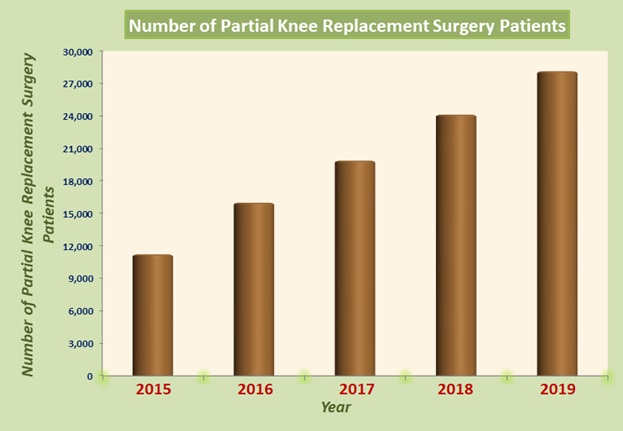
- سنويا وقد لوحظ زيادة متوسط من 15 إلى 20 في المئة في عدد المرضى في السنوات ال 5 الماضية.
- في مستشفيات جراحة استبدال الركبة الجزئي الهندية تقديم الرعاية الصحية المتقدمة وأرقى مستويات الخدمة التي تدعمها بنية تحتية متطورة وانخفاض تكلفة العلاج.
- ونظرا لأن جميع الموظفين في المستشفيات، بما في ذلك الممرضات وأخصائيي العلاج الطبيعي والأطباء والجراحين هم المدربين تدريبا جيدا في الناطقة باللغة الإنكليزية، والمرضى من أي جزء من العالم القادمة الى الهند تشعر بالراحة في التواصل مشاكلهم دون أية مشاكل.
وهنا الأرقام التقريبية للمرضى خضعت الجزئية جراحة استبدال الركبة في السنوات ال 5 الماضية في الهند:
هل تبحث عن بتكلفة معقولة من الجزئية الركبة جراحة استبدال في الأعلى المستشفيات في الهند؟
يرجى الرجوع بنا للحصول على أسعار مجانية وآراء من أعلى المستشفيات وأفضل الجراحين في الهند لالجزئية جراحة استبدال الركبة.
FAQ’s
Yes. Partial knee replacement, partial knee resurfacing surgery, unicompartmental knee replacement, and unicondylar knee replacement all refer to the same procedure.
There are no strict recommendations, but in general, partial knee replacements are appropriate for patients over 40 years old who meet other eligibility criteria.
The primary purpose of this procedure is relief of pain. Second is to enhance walking ability. Finally, restoring anatomy as close as possible to normal. The prosthesis is designed for walking or brisk walking, not running.
A general anasthetic means you will be unconscious during the surgery and should have no recollection aside from going to sleep and waking up. A local anasthetic allow you to remain conscious. Typically we use a spinal anesthetic which blocks all pain in the area while leaving the patient conscious. This is a personal choice and can be discussed with the anesthesiologist.
Knee prostheses or implants are made of metal and plastic. These surfaces are designed to glide smoothly against one another just as cartilage does in a healthy knee.
Although not all patients are able to return to unrestricted sport, many patients are able to resume biking, tennis and skiing.
As with any joint replacement surgery, complications may include instability of the knee, loosening of the implant, infection, nerve injury and deep vein thrombosis. Generally, complications occur less frequently after partial knee replacement than they do following total knee replacement. Be sure to discuss any concerns you have regarding these or other issues with your surgeon.
All surgeries result in some pain. We have robust systems and resources dedicated to address post-operative pain management. While pain varies by patient, typically patients experience less pain and stiffness following partial knee replacement than they do after total knee replacement. After partial knee replacement surgery, most patients receive 7-14 days of narcotic medications, but HSS also offers a limited narcotic pathway for patients who do not tolerate narcotic medications well.
Partial knee replacement will address the arthritis that is present in the particular compartment of the knee that is affected. However, there is no guarantee that arthritis will not develop elsewhere in the knee. Should this occur, surgical revision to a total knee replacement may be necessary.
A well-done partial knee replacement in an appropriately selected patient can have a survival rate that is comparable to that achieved with a total knee replacement in the first decade following surgery. The literature suggests that after the second decade, the revision rate may be somewhat higher for partial knee surgery than for total knee surgery.
Final range of motion in compartment procedures is usually comparable to preoperative range of motion.
Usually, full weight bearing is allowed immediately after the operation. Mobilization after surgery is important to prevent complications (deep venous thrombosis/pulmonary embolism) and to resume independent self-care as soon as possible.
The prosthesis is designed for walking/brisk walking – not running. That said, it is possible that some low impact exercises that avoid pivoting and twisting may be advantageous. Consult your doctor for specific information.
A brace is usually not required.
You can most definitely choose hotels as per your convenience to you and your budget.
Many hospitals in India have language translators to help you communicate better and effortlessly with the doctors and medical staff.
بلدنا محددة الخدمات
منشورات المدونة الخاصة بنا
تجارب مرضانا
الكلمات
Arthroplastie partielle du genou à faible coût en Inde
Quel est le coût de la chirurgie de remplacement partiel du genou avec les meilleurs hôpitaux et les meilleurs chirurgiens en Inde?
- Le coût de la chirurgie de remplacement partiel du genou en Inde peut aller de environ Rs. 1,80,000 ($2,200) à Rs. 3,60,000 ($4,500).
- Le coût moyen de la chirurgie partielle de remplacement du genou est très élevé dans les pays occidentaux.
- L’ Inde est connue dans le monde entier pour ses installations médicales de pointe et la technologie prometteuse pour Low Cost chirurgie de remplacement partiel du genou . Un grand nombre des meilleurs hôpitaux pour la chirurgie partielle de remplacement du genou se trouvent en Inde.
- Remplacement partiel du genou coût de la chirurgie en Inde est beaucoup moins par rapport à d’autres pays. De plus , le coût de la chirurgie partielle de remplacement du genou en Inde est nettement plus faible que les autres pays développés du monde.
Divers facteurs décisifs pourraient déterminer le prix de chirurgie partielle de remplacement du genou en Inde. Ceux-ci peuvent être classés comme hôpital, équipe médicale ou aux patients des facteurs dépendants.
Facteurs hospitaliers
- Type de l’hôpital (gouvernement / confiance / privé).
- L’utilisation de l’assurance, le type d’assurance ou d’auto payé.
- Accréditation de l’installation
- La réputation et la valeur de la marque de l’hôpital.
Facteurs de l’équipe médicale
- Technologie / approche utilisée
- Type de chirurgie
- Type d’anesthésie ou Sédation
- Qualification / Expertise du spécialiste
- Étendue de la chirurgie nécessaire
Facteurs liés au patient
- Le diagnostic du patient
- la santé générale du patient
- Catégorie de chambre choisie par le patient
- Autre traitement requis par le patient en même temps
La liste des coût moyen de la chirurgie partielle de remplacement du genou dans les 15 villes en Inde en roupie indienne (INR) est la suivante –
| Ville | Le coût le plus bas | Le coût le plus bas | Le coût le plus élevé |
|---|---|---|---|
| New Delhi | 1,80,000 | 2,55,000 | 3,30,000 |
| Mumbai | 1,90,000 | 2,65,000 | 3,40,000 |
| Chennai | 2,15,000 | 2,90,000 | 3,65,000 |
| Bangalore | 2,00,000 | 2,80,000 | 3,50,000 |
| Hyderabad | 2,40,000 | 3,15,000 | 3,90,000 |
| Ahmedabad | 2,65,000 | 3,40,000 | 4,15,000 |
| Nagpur | 1,65,000 | 2,40,000 | 3,15,000 |
| Pune | 1,90,000 | 2,65,000 | 3,40,000 |
| Gurgoan / Gurugram | 1,80,000 | 2,55,000 | 3,30,000 |
| Kolkata | 2,65,000 | 3,40,000 | 4,15,000 |
| Chandigarh | 1,90,000 | 2,65,000 | 3,40,000 |
| Jaipur | 2,40,000 | 3,15,000 | 3,90,000 |
| Noida | 1,80,000 | 2,55,000 | 3,30,000 |
| Kerala | 2,65,000 | 3,40,000 | 4,15,000 |
| Goa | 2,40,000 | 3,15,000 | 3,90,000 |
- CINQ CHIRURGIENS DE NOTRE RÉSEAU ONT REMPORTÉ DES PRIX DANS LEURS SPÉCIALITÉS CETTE ANNÉE
- NOS CONSULTANTS VISITERONT LE CAMEROUN, LE SOUDAN ET L’ETHIOPIE CETTE ANNEE
- NOUS SOMMES ASSOCIÉS À DES HÔPITAUX D’OMAN, D’ARABIE SAOUDITE ET DU KOWEÏT POUR OBTENIR UN DEUXIÈME AVIS DE NOS MÉDECINS EN INDE
- TROIS DE NOS HÔPITAUX PARTENAIRES ONT OUVERT DES CENTRES DE TÉLÉMÉDECINE EN AFRIQUE POUR ATTEINDRE LES PATIENTS ÉLOIGNÉS
- LA CHIRURGIE ROBOTIQUE AVANCÉE EST MAINTENANT DISPONIBLE DANS TOUS LES HÔPITAUX DU RÉSEAU
Contactez-nous pour un devis gratuit sans engagement et pour la chirurgie partielle Avis de remplacement du genou en Inde
Notre groupe réseau hospitalier et la chirurgie sont disponibles dans 15 villes de l’ Inde pour nos patients à l’ accès. Veuillez remplir le formulaire pour une opinion libre de notre équipe d’experts. Nous vous obtenir gratuitement, sans engagement Avis des meilleures chirurgiens de l’ Inde et meilleurs hôpitaux en Inde. PAS DE FRAIS PRELEVES.
Spéciaux TOUS LES SERVICES INCLUS Forfaits disponibles pour PATIENTS INTERNATIONAL
Top 10 des chirurgiens pour le remplacement partiel du genou en Inde
- Dr. Ashok Rajgopal
- Dr. Kaushal Malhan
- Dr. Manoj Miglani
- Dr. Rajeev Verma
- Dr. S K S Marya
- Dr. Kamal Bachani
- Dr. Yash Gulati
- Dr. Bhushan Nariani
- Dr. Abhijit Dey
- Dr. Vinay Joshi
- Dr. Manu Bora
- Dr. Raju Vaishya
- Dr. Raghava Dutt Mulukatla
- Dr. Vijay C Bose
- Dr. IPS Oberoi
- Dr. Haresh Manglani
- Dr. B. K. Singh
- Dr. Dhananjay Gupta
- Dr. A B Govindraj
- Dr. Subhash Jangid
- Dr. Nitiraj Oberoi
- Dr. Ramneek Mahajan
- Dr. Dinshaw Pardiwala
- Dr. Ravi V.
- Dr. Pradeep Sharma
- Dr. Sanjay Desai
Liste des 10 meilleurs hôpitaux de chirurgie de remplacement de la hanche en Inde
- Hôpital Fortis, Bombay
- Hôpital Artemis, Gurgaon
- Hôpital Fortis, Bangalore
- Institut de recherche Fortis Memorial, Gurgaon
- Hôpital Fortis Rajan Dhall, New Delhi
- Hôpital Indraprastha Apollo, New Delhi
- Hôpital Shalby, Ahemdabad
- Hôpital Kokilaben, Bombay
- Hôpital Nanavati, Bombay
- Hôpital Apollo, Chennai
- Hôpital Columbia Asia, Bangalore
- Institut mixte de reconstruction asiatique, Chennai
- Hôpitaux Paras, Gurgaon
- Hôpital Jaypee, Noida
- Hôpital Fortis Malar, Chennai
- Hôpital BLK Max, New Delhi
- Hôpital multispécialisé PSRI, Delhi
- Hôpital Max Super Specialty, New Delhi
- Medanta The Medicity, Delhi
- Hôpital SL Raheja, Bombay
- Hôpitaux mondiaux, Chennai
- Centre indien des lésions médullaires, New Delhi
Remplacement partiel du genou
introduction
remplacement partiel du genou, appelé aussi une arthroplastie du genou unicompartimentale, » est une chirurgie qui peut être considéré pour le traitement de l’arthrose de l’articulation du genou. Traditionnellement, les patients ont subi un remplacement total du genou pour l’arthrite sévère de l’articulation du genou. Dans un remplacement total du genou, tout cartilage est retiré de l’articulation du genou, et d’un implant en métal et en matière plastique est substitué.
Les êtres humains utilisent leurs genoux dans presque toutes leurs activités quotidiennes. Et s’ils souffrent de douleurs aux genoux, cela pourrait être très frustrant. La douleur au genou peut survenir pour diverses raisons. Dont l’arthrite du genou est la raison la plus courante. Le médecin peut recommander une arthroplastie partielle du genou dans les cas où le patient souffre de douleurs invalidantes. Arthroplastie partielle du genou est également connue sous le nom de chirurgie unicompartimentale du genou car elle se distingue de la chirurgie traditionnelle de remplacement total du genou.
Une arthroplastie partielle du genou est relativement moins invasive que la chirurgie traditionnelle du genou. Arthroplastie partielle du genou en Inde pourrait être une bonne option pour les patients souffrant d’arthrite au genou et de blessures au genou. Ce type de chirurgie de remplacement du genou est préférable à la chirurgie de remplacement total du genou classique car il remplace uniquement les parties endommagées du genou. Le séjour à l’hôpital postopératoire est également une très courte période d’un ou deux jours par rapport à une arthroplastie totale du genou. Les patients ont eu une période de récupération plus courte lors d’une arthroplastie partielle du genou.
La planification de votre voyage médical en Inde est un processus très simple avec la chirurgie de remplacement conjointe Hospital Inde
- Il vous suffit de remplir notre formulaire de demande et l’un de nos dirigeants vous contactera bientôt.
- + 91-9860432255 Appelez – nous au numéro de téléphone donné pour toute assistance.
- L’information complète sur la chirurgie est fournie sur notre site.
Avantages de la chirurgie de remplacement partiel du genou en Inde
De nombreuses études ont montré que le remplacement du genou unicompartimentale moderne fonctionne très bien dans la grande majorité des patients qui sont des candidats appropriés.
Les avantages de remplacement partiel du genou remplacement total du genou comprennent:
- La chirurgie minimalement invasive avec incision plus petite: Dans une chirurgie de remplacement du genou unicompartimentale ou partielle de l’incision est d’ environ trois pouces et la quantité de dissection et l’enlèvement des os est beaucoup plus petit.
- Coûts abordables: Le coût total de la chirurgie de remplacement partiel du genou en Inde est tout à fait abordable par rapport aux homologues occidentaux. Prix de la chirurgie du genou partielle en Inde est presque 1/4 e du coût de ce au Royaume – Uni et aux États – Unis.
- Récupération rapide et séjour hospitalier plus court: Par rapport à un remplacement total du genou, le temps de récupération et le nombre de jours de séjour à l’hôpital en remplacement partiel du genou est moindre.
- Moins de perte de sang: remplacement du genou partielle est réalisée en faisant une petite incision et donc une transfusion sanguine est rarement nécessaire. Le montant de la perte de sang est beaucoup moindre par rapport à un remplacement total du genou.
Less waiting time: Moins de temps d’ attente: Le temps d’ attente est moins pour la chirurgie en Inde et nous vous aiderons à accéder à l’ hôpital abordable pour la chirurgie partielle de remplacement du genou en Inde.
Notre expérience du patient traité – M. Bryan Tang de Singapour au sujet de son faible coût chirurgie de remplacement partiel du genou.
Une douleur au genou est probablement l’ un des pires maux qu’une personne ne peut jamais souffrir de. Pour moi, il était si persistant que je redoutais même monter les escaliers dans ma maison la plupart du temps. Mon collègue connaissait ma souffrance et me connecté avec groupe de chirurgie de remplacement en Inde , un groupe de chirurgiens orthopédiques et haut la plupart des hôpitaux. Mon médecin était un expert en me expliquant toute la procédure, la durée, le coût et le temps impliqué de récupération et un maître tout en effectuant la chirurgie de remplacement partiel du genou.
Les candidats à une chirurgie de remplacement partiel du genou
Le remplacement partiel du genou mini-invasive est indiquée chez les patients qui souffrent d’arthrite sévère du genou qui ont échoué les traitements conservateurs peuvent considérer cette procédure. Les mesures conservatrices peuvent inclure, mais sans s’y limiter, les médicaments (tels que Advil, Naprosyn, Celebrex et Vioxx), les injections de cortisone, des exercices de renforcement, et la perte de poids. Si ces traitements ne suffisent pas, et vous en tant que patient ne sont pas satisfaits, alors les interventions chirurgicales peuvent être envisagées.
La chirurgie du genou partielle peut être possible si l’arthrite du genou est limitée à une zone limitée. Si l’arthrite est très répandue, le remplacement partiel du genou ne convient pas, et ne doit pas être pris en considération. De plus, la chirurgie du genou partielle est recommandée chez les patients qui sont:
- Plus de 55 ans
- non obèses
- relativement sédentaire
- Avoir des ligaments intacts (spécifiquement l’ACL)
Si ces qualifications ne sont pas remplies, la chirurgie du genou partielle mini-invasive peut ne pas être aussi réussie. Malheureusement, de nombreux patients ne sont donc pas admissibles à cette procédure mini-invasive.
La plupart des patients qui cherchent un traitement chirurgical ont l’arthrite qui est trop avancé pour la procédure de remplacement partiel du genou mini-invasive. Parce que le traitement chirurgical est considéré comme un « dernier recours » par la plupart des patients, par la chirurgie de temps est nécessaire, leur arthrite est trop avancé pour envisager cette procédure mini-invasive. En cas de remplacement partiel du genou se fait chez un patient qui est un mauvais candidat, les taux d’échec peuvent être élevés, et la conversion à une chirurgie du genou totale traditionnelle peut être plus difficile.
Résultat à long terme avec la chirurgie de remplacement partiel du genou
Les résultats à long terme sont très bons lorsque le remplacement partiel du genou minimalement invasive est fait dans les bons patients. Des études ont montré des résultats très âgées pauvres du remplacement du genou partielle, mais ces résultats sont considérés comme en raison de mauvais choix du patient. Si la procédure mini-invasive est effectuée sur un patient souffrant d’arthrite trop répandue, les résultats sont très probablement moins que satisfaisant. Si votre médecin ne recommande pas le remplacement partiel du genou, vous pouvez être dans cette situation. Si tel est le cas, un traitement conservateur (par exemple des injections, la physiothérapie, les médicaments, etc.), ou la chirurgie totale du genou sont les meilleures options.
Si vous recherchez vraiment une chirurgie de remplacement total de la hanche, veuillez remplir le formulaire pour une consultation gratuite avec nos chirurgiens. Vous recevrez une analyse approfondie et des suggestions concernant la chirurgie de remplacement total de la hanche que vous recherchez.
chirurgie de remplacement partiel du genou
avant la chirurgie
Le jour de la chirurgie, vous serez probablement admis à l’ hôpital de chirurgie partielle de remplacement du genou en Inde .
Avant l’intervention, un médecin du service d’anesthésie vous évaluer. Il ou elle passera en revue vos antécédents médicaux et discuter des choix de l’anesthésie avec vous. Vous devriez également avoir discuté des choix anesthésie avec votre chirurgien lors de vos visites à la clinique pré-opératoire. L’anesthésie peut être générale (vous Endormi) ou de la colonne vertébrale (vous êtes éveillé, mais votre corps est engourdi de la taille vers le bas).
Votre chirurgien aussi vous voir avant la chirurgie et signer votre genou pour vérifier le site chirurgical.
Opération chirurgicale
Un remplacement du genou partielle opération dure généralement entre 1 et 2 heures.
Votre chirurgien fera une incision à l’avant de votre genou. Il ou elle sera ensuite explorer les trois compartiments de votre genou pour vérifier que les lésions du cartilage est, en fait, limité à un seul compartiment et que vos ligaments sont intacts. Si votre chirurgien estime que votre genou ne convient pas à un remplacement partiel du genou, il sera plutôt effectuer un remplacement total du genou. Il ou elle discutera de ce plan d’urgence avec vous avant votre opération pour vous assurer que vous êtes d’accord avec cette stratégie.
Si votre genou est adapté pour un remplacement partiel du genou, votre chirurgien utilisera des scies spéciales pour enlever le cartilage du compartiment endommagé du genou et plafonnera les extrémités du fémur et du tibia avec des revêtements métalliques. Les composants métalliques sont généralement tenues à l’os avec du ciment. Un insert en matière plastique est placé entre les deux composants métalliques pour permettre une surface de glissement lisse.
Après la chirurgie, vous serez amené à la salle de réveil, où vous serez suivi de près par les infirmières que vous récupérer de l’anesthésie. Vous serez alors redirigé vers votre chambre d’hôpital.
Complications
Comme toute intervention chirurgicale, il y a des risques avec le remplacement partiel du genou. Votre chirurgien discutera chacun des risques avec vous et prendre des mesures spécifiques pour aider à éviter des complications potentielles.
Bien que les risques rares, les plus courants sont:
- Caillots sanguins. Les caillots sanguins dans les veines de la jambe sont la complication la plus courante de la chirurgie de remplacement du genou. Les caillots sanguins peuvent se former dans les veines profondes des jambes ou du bassin après la chirurgie. Anticoagulants tels que la warfarine (Coumadin), héparine de bas poids moléculaire, l’aspirine ou d’autres médicaments peuvent aider à prévenir ce problème
- Vous serez donné des antibiotiques avant le début de la chirurgie et ceux-ci seront poursuivies pendant environ 24 heures après pour prévenir l’infection.
- Lésions des nerfs ou des vaisseaux. Bien qu’il arrive rarement, les nerfs ou les vaisseaux sanguins peuvent être blessés ou étirés pendant la procédure.
- la douleur continue.
- Les risques de l’anesthésie.
Récupération
Parce qu’un remplacement partiel du genou se fait à travers une petite incision moins invasive, l’ hospitalisation est plus courte et la réadaptation et le retour aux activités normales est plus rapide.
Les patients éprouvent habituellement moins de douleur post-opératoire, moins d’enflure, et ont la réadaptation plus facile que les patients ayant subi une arthroplastie totale du genou. Dans la plupart des cas, les patients rentrent chez eux 1 à 3 jours après l’opération.
Vous commencer à mettre du poids sur le genou immédiatement après la chirurgie. Vous devrez peut-être un déambulateur, une canne ou des béquilles pour les premiers jours ou semaines jusqu’à ce que vous devenez assez confortable pour marcher sans assistance.
Un physiothérapeute vous donnera des exercices pour aider à maintenir votre gamme de mouvement et de restaurer votre force. Vous continuerez à voir votre chirurgien orthopédique pour les visites de suivi dans sa clinique à intervalles réguliers.
Vous aurez très probablement reprendre vos activités régulières de la vie quotidienne de 6 semaines après la chirurgie.
Pourquoi choisir la chirurgie de remplacement conjointe hôpital en Inde pour la chirurgie partielle de remplacement du genou?
Joint Replacement Surgery Hospital India offre des soins de la santé des os et des articulations de la plus haute qualité, avec attention, compassion et compassion pour répondre aux besoins des patients et de leurs proches. L’équipe médicale comprend un jury certifié chirurgiens orthopédiquesqui connaissent tous les aspects du système musculo-squelettique. Notre hôpital utilise les technologies les plus avancées disponibles pour les procédures orthopédiques et présente un taux de complications plus faible.
Si vous recherchez vraiment une chirurgie de remplacement partiel du genou, veuillez remplir le formulaire pour une consultation gratuite avec nos chirurgiens. Vous recevrez une analyse approfondie et des suggestions concernant la chirurgie de remplacement partiel du genou que vous recherchez.
Combien de patients ont subi une chirurgie de remplacement partiel du genou en Inde au cours des 5 dernières années?
- Ces dernières années, l’ Inde est devenue un centre médical pour les patients qui recherchent un prix abordable, accessible et efficace à faible coût chirurgie de remplacement partiel du genou .
- Certains des plus convoités du genou partiel hôpitaux de traitement de chirurgie dans le monde se trouvent en Inde. Le pays est connu pour offrir des installations médicales de pointe au coût le plus raisonnable.
- Un diagnostic précoce, la chirurgie ou le traitement aide à améliorer les chances d’un succès.
- Une augmentation moyenne de 15 à 20 pour cent a été observée chaque année le nombre de patients au cours des 5 dernières années.
- Les partiel du genou indiens hôpitaux de chirurgie fournissent des soins de santé de pointe et services de haute qualité soutenus par une infrastructure complexe et à moindre coût de traitement.
- Étant donné que tout le personnel dans les hôpitaux, y compris les infirmières, les physiothérapeutes, les médecins, les chirurgiens sont bien formés en anglais parlant, les patients de toute partie du monde à venir en Inde se sentent à l’aise pour communiquer leurs problèmes sans aucun problème.
Voici les chiffres approximatifs des patients ont subi une chirurgie partielle de remplacement du genou au cours des 5 dernières années en Inde:
Vous cherchez un coût abordable de chirurgie de remplacement du genou partiel dans Top Hôpitaux de l’Inde?
S’il vous plaît nous consulter pour obtenir un devis gratuit, Avis de TOP Hôpitaux et meilleurs chirurgiens de l’Inde pour la chirurgie partielle de remplacement du genou.
FAQ’s
Yes. Partial knee replacement, partial knee resurfacing surgery, unicompartmental knee replacement, and unicondylar knee replacement all refer to the same procedure.
There are no strict recommendations, but in general, partial knee replacements are appropriate for patients over 40 years old who meet other eligibility criteria.
The primary purpose of this procedure is relief of pain. Second is to enhance walking ability. Finally, restoring anatomy as close as possible to normal. The prosthesis is designed for walking or brisk walking, not running.
A general anasthetic means you will be unconscious during the surgery and should have no recollection aside from going to sleep and waking up. A local anasthetic allow you to remain conscious. Typically we use a spinal anesthetic which blocks all pain in the area while leaving the patient conscious. This is a personal choice and can be discussed with the anesthesiologist.
Knee prostheses or implants are made of metal and plastic. These surfaces are designed to glide smoothly against one another just as cartilage does in a healthy knee.
Although not all patients are able to return to unrestricted sport, many patients are able to resume biking, tennis and skiing.
As with any joint replacement surgery, complications may include instability of the knee, loosening of the implant, infection, nerve injury and deep vein thrombosis. Generally, complications occur less frequently after partial knee replacement than they do following total knee replacement. Be sure to discuss any concerns you have regarding these or other issues with your surgeon.
All surgeries result in some pain. We have robust systems and resources dedicated to address post-operative pain management. While pain varies by patient, typically patients experience less pain and stiffness following partial knee replacement than they do after total knee replacement. After partial knee replacement surgery, most patients receive 7-14 days of narcotic medications, but HSS also offers a limited narcotic pathway for patients who do not tolerate narcotic medications well.
Partial knee replacement will address the arthritis that is present in the particular compartment of the knee that is affected. However, there is no guarantee that arthritis will not develop elsewhere in the knee. Should this occur, surgical revision to a total knee replacement may be necessary.
A well-done partial knee replacement in an appropriately selected patient can have a survival rate that is comparable to that achieved with a total knee replacement in the first decade following surgery. The literature suggests that after the second decade, the revision rate may be somewhat higher for partial knee surgery than for total knee surgery.
Final range of motion in compartment procedures is usually comparable to preoperative range of motion.
Usually, full weight bearing is allowed immediately after the operation. Mobilization after surgery is important to prevent complications (deep venous thrombosis/pulmonary embolism) and to resume independent self-care as soon as possible.
The prosthesis is designed for walking/brisk walking – not running. That said, it is possible that some low impact exercises that avoid pivoting and twisting may be advantageous. Consult your doctor for specific information.
A brace is usually not required.
You can most definitely choose hotels as per your convenience to you and your budget.
Many hospitals in India have language translators to help you communicate better and effortlessly with the doctors and medical staff.
Our Country Specific Services
Expériences de nos patients
- Chirurgie pédiatrique réussie de la dysplasie de la hanche chez International Patient
- Exemple de réussite de remplacement du genou d’un patient nigérian en Inde
- Chirurgie de remplacement de la hanche réussie avec le meilleur soutien et les meilleurs conseils
- Surmonter les symptômes douloureux avec une chirurgie de resurfaçage de la hanche réussie en Inde
Mots clés

Resurfaçage de la hanche à faible coût (Birmingham Hip) en Inde
Quel est le coût de la chirurgie de la hanche resurfaçage (Birmingham Hip) avec les meilleurs hôpitaux et les meilleurs chirurgiens en Inde?
- Le coût d’une chirurgie de resurfaçage de la hanche en Inde peut varier d’environ 2 20 000 roupies (2 800 $) à 4 40 000 roupies (5 500 $).
- Le coût de la chirurgie Hip resurfaçage (Birmingham Hip) en Inde est généralement une fraction du coût pour la même procédure et les soins aux États – Unis et d’ autres pays développés
- Le coût peut varier selon le diagnostic et les conditions des patients ainsi que les installations prévalus.
- Et si vous comparez la même chose avec les pays développés, le coût de ces traitements est souvent double que ce que vous trouvez en Inde.
La liste des différents facteurs déterminants du prix du resurfaçage de la hanche (Birmingham Hip) La chirurgie en Inde est la suivante:
- Procédé de traitement
- Type de chirurgie
- D’autres traitements requis conjointement avec resurfaçage de la hanche (Birmingham Hip) Chirurgie
- Enquêtes et évaluation requise
- frais d’hôpital
- Catégorie de chambre
VIDÉO – CHIRURGIE DE REMPLACEMENT TOTAL DE LA HANCHE EN INDE
La liste des coût moyen de la hanche resurfaçage (Birmingham Hip) Chirurgie dans les 15 villes en Inde en roupie indienne (INR) est la suivante:
| Ville | Le coût le plus bas | Coût moyen | Le coût le plus élevé |
|---|---|---|---|
| New Delhi | 2,25,000 | 3,00,000 | 4,25,000 |
| Mumbai | 2,50,000 | 3,75,000 | 4,75,000 |
| Chennai | 2,50,000 | 3,75,000 | 4,75,000 |
| Bangalore | 2,75,000 | 4,25,000 | 5,25,000 |
| Hyderabad | 3,00,000 | 4,50,000 | 5,50,000 |
| Ahmedabad | 2,75,000 | 4,25,000 | 5,25,000 |
| Nagpur | 2,25,000 | 3,00,000 | 4,25,000 |
| Pune | 2,50,000 | 3,75,000 | 4,75,000 |
| Gurgoan / Gurugram | 2,25,000 | 3,00,000 | 4,25,000 |
| Kolkata | 2,75,000 | 4,25,000 | 5,25,000 |
| Chandigarh | 2,75,000 | 4,25,000 | 5,25,000 |
| Jaipur | 2,50,000 | 3,75,000 | 4,75,000 |
| Noida | 2,25,000 | 3,00,000 | 4,25,000 |
| Kerala | 2,50,000 | 3,75,000 | 4,75,000 |
| Goa | 2,75,000 | 4,25,000 | 5,25,000 |
La variation du coût ci-dessus dépend de ce qui suit:
- Type de l’hôpital (gouvernement / confiance / privé).
- L’utilisation de l’assurance, le type d’assurance ou d’auto payé.
- Accréditation de l’installation
- Expertise, l’ancienneté, la réputation et la valeur de la marque du chirurgien / médecin.
- CINQ CHIRURGIENS DE NOTRE RÉSEAU ONT REMPORTÉ DES PRIX DANS LEURS SPÉCIALITÉS CETTE ANNÉE
- NOS CONSULTANTS VISITERONT LE CAMEROUN, LE SOUDAN ET L’ETHIOPIE CETTE ANNEE
- NOUS SOMMES ASSOCIÉS À DES HÔPITAUX D’OMAN, D’ARABIE SAOUDITE ET DU KOWEÏT POUR OBTENIR UN DEUXIÈME AVIS DE NOS MÉDECINS EN INDE
- TROIS DE NOS HÔPITAUX PARTENAIRES ONT OUVERT DES CENTRES DE TÉLÉMÉDECINE EN AFRIQUE POUR ATTEINDRE LES PATIENTS ÉLOIGNÉS
- LA CHIRURGIE ROBOTIQUE AVANCÉE EST MAINTENANT DISPONIBLE DANS TOUS LES HÔPITAUX DU RÉSEAU
La planification abordable resurfaçage de la hanche (Birmingham Hip) Chirurgie en Inde est un processus facile.
Notre groupe réseau hospitalier et la chirurgie est disponible dans 15 villes de l’ Inde pour nos patients à l’ accès. Veuillez remplir le formulaire pour une opinion libre de notre équipe d’experts. Vous recevrez une analyse et des recommandations pour la chirurgie. PAS DE FRAIS PRELEVES.
Special Spéciaux TOUS LES SERVICES INCLUS Forfaits disponibles pour PATIENTS INTERNATIONAL
Resurfaçage de la hanche (Birmingham Hip) en Inde
Resurfaçage de la hanche est l’autre forme de prothèse de hanche qui conserve l’os du fémur proximal. L’avantage signifie une plus grande amplitude de mouvement de l’articulation de la hanche après la chirurgie avec un taux de dislocation. Cette forme de chirurgie peut être plus approprié pour les patients jeunes et actifs. Resurfaçage de la hanche en Inde a été développé comme une alternative au remplacement total de la hanche. Pourquoi il est appelé Birmingham est qu’il se trouve être l’endroit où a été défini la chirurgie resurfaçage de la hanche.
Comment puis-je savoir si je suis un bon candidat pour resurfaçage de la hanche (Birmingham Hip) Procédure?
Vous devez tenir compte, de nombreux facteurs, que ce soit le bon moment pour subir une intervention chirurgicale. Les facteurs comprennent la qualité de vie actuelle et le niveau de la douleur. L’étendue des dégâts à la hanche et le reste du corps sont également des indicateurs importants.

La planification de votre voyage médical en Inde est un processus très simple avec la chirurgie de remplacement conjointe Hospital Inde
- Il vous suffit de remplir notre formulaire de demande et l’un de nos dirigeants vous contactera bientôt.
- + 91-9860432255 Appelez – nous au numéro de téléphone donné pour toute assistance.
- L’information complète sur la chirurgie est fournie sur notre site.
Resurfaçage de la hanche (Birmingham Hip) Procédure et récupération et efficacité
Resurfaçage de la hanche (Birmingham Hip) Procédure est un métal sur le système de remplacement de la hanche artificielle resurfaçage métal qui est implanté par voie chirurgicale pour enlever l’articulation de la hanche. Le système comporte deux parties, une douille qui est la forme d’une cuvette peu profonde et le capuchon sous la forme d’une tête sphérique.
Les transfusions sanguines peuvent être nécessaires après la chirurgie lorsque vous êtes encore à l’hôpital. Si vous êtes en médicaments que vous devez bénéficier de l’avis du médecin qui peut vous guider mieux.
L’efficacité de resurfaçage de la hanche (Birmingham Hip) inclut les caractéristiques suivantes
- Moins désossé et un os sain développé
- Une meilleure fonction des hanches
- un minimum de risque de dislocation
- Plus facile révision si un autre remplacement de la hanche devient nécessaire
Pourquoi Opter resurfaçage de la hanche (Birmingham Hip) est nécessaire?
Resurfaçage de la hanche (Birmingham Hip) en Inde examine indique qu’il est nécessaire pour les jeunes patients qui veulent rester actifs. Dans cette chirurgie plus de l’ os du patient, appelé le col du fémur est préservée. Avec le recul , le patient peut mener une vie plus active après la fin de cette opération. Les patients qui ont entrepris cette forme de chirurgie peuvent retourner aux sports actifs.
Avantages de resurfaçage de la hanche (Birmingham Hip) en Inde
Les avantages comprennent avantages de coûts chirurgie hanche resurfaçage en Inde, les meilleurs chirurgiens de la hanche en Inde, la moins chère resurfaçage de la hanche au meilleur hôpital en Indeavec les dernières technologies et équipements.
Notre expérience du patient traité – Mme Judie Pollock de la Nouvelle-Zélande au sujet de son faible coût resurfaçage de la hanche (Birmingham Hip) Chirurgie.

Mon expérience avec le groupe de chirurgie de remplacement commune en Inde pour la procédure de resurfaçage de la hanche Birmingham a été tout à fait satisfaisante. Les médecins dans les hôpitaux en Inde sont vraiment comprendre les craintes de leurs patients et les souffrances et sont toujours disponibles pour répondre aux questions même minute, avant la procédure et pendant les suivis. Il a été 3 mois depuis mon opération et je n’ai pas souffert d’aucune douleur ou problème dans ma hanche depuis. En fait, je me sens plus confiant et énergique chaque jour à participer à toutes ces activités que je l’ habitude de passer plus tôt en raison de mes problèmes de hanche.
Pourquoi choisir un hôpital indien pour votre resurfaçage de la hanche (Birmingham Hip)?
L’ Inde est la prochaine destination médicale pour les touristes médicaux de partout dans le monde. Un témoignage de ce fait est que le nombre de patients en visite en Inde a augmenté manifold au cours des dernières années. L’ une des principales raisons de c’est abordable resurfaçage de la hanche (Birmingham Hip) en Inde avec le meilleur de la qualité. En fait, encaissant sur ce grand nombre d’entreprises de tourisme médical ont évolué et ils fournissent également les services de consultation gratuite resurfaçage de la hanche (Birmingham Hip) en Inde
Combien de patients ont resurfaçage de la hanche (Birmingham Hip) Chirurgie en Inde au cours des 5 dernières années?
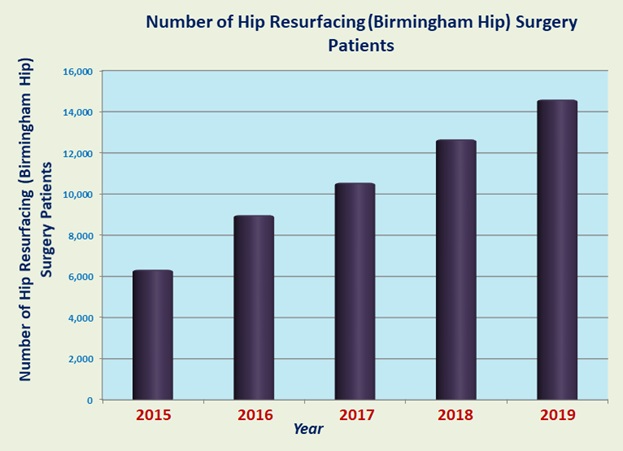
Ces dernières années, l’ Inde est devenue un centre médical pour les patients qui cherchent abordables, accessibles et chirurgie efficace à faible coût total de la hanche resurfaçage (Birmingham Hip) . Cette émergence est principalement due au développement de l’ état de l’art des établissements de santé du secteur public et privé, l’ assurance médicale et la facilité d’accès à des services de santé. Une augmentation moyenne de 15 à 20 pour cent a été observée chaque année le nombre de patients au cours des 5 dernières années.
Voici les chiffres approximatifs des patients ont bénéficié resurfaçage de la hanche (Birmingham Hip) Chirurgie au cours des 5 dernières années en Inde:
Top 10 des chirurgiens pour la chirurgie de resurfaçage de la hanche (hanche de Birmingham) en Inde
- DR. VIJAY BOSE
- DR. KAUSHAL MALHAN
- DR. IPS OBEROI
- DR. ASHOK RAJGOPAL
- DR. VIJAY KUMAR S
- DR. SAJAN K HEGDE
- DR. S K S MARYA
- DR. (BRIG.) B. K. SINGH
- DR. GYAN SAGAR TUCKER
- DR. DHANANJAY GUPTA
- DR. KAMAL BACHANI
- DR. A B GOVINDRAJ
- DR. VINAY S JOSHI
- DR. DEVENDRA YADAV
- DR. CHANDER SHEKHAR
- DR. PRADEEP SHARMA
- DR. VIKRAM I SHAH
- DR. SANJAY GUPTA
- DR. RAJEEV VERMA
- DR. BALVINDER RANA
10 meilleurs hôpitaux pour la chirurgie de resurfaçage de la hanche (hanche de Birmingham) en Inde
- FORTIS HÔPITAL MUMBAI
- FORTIS MALAR HÔPITAL, CHENNAI
- ASIAN COMMUNE INSTITUT RECONSTRUCTION
- FORTIS HÔPITAL, BANGALORE
- PUSHPAWATI Singhania INSTITUT DE RECHERCHE, NEW DELHI
- FORTIS FLT. LT. RAJAN Dhall HÔPITAL, Vasant Kunj, NEW DELHI
- MAX SUPER SPÉCIALITÉ HÔPITAL, Saket, NEW DELHI
- Medanta HÔPITAL GURGAON
- JAYPEE HÔPITAL Noida
- Shalby HÔPITAL, ahemdabad
- ARTEMIS HÔPITAL, GURGAON
- HÔPITAUX Paras, GURGAON
- Indraprastha APOLLO HÔPITAL, NEW DELHI
- Kokilaben Dhirubhai Ambani HÔPITAL, MUMBAI
- BLK Superspécialisé HÔPITAL, NEW DELHI
- FORTIS MEMORIAL INSTITUT DE RECHERCHE, GURGAON
Vous cherchez un coût abordable de resurfaçage de la hanche (Birmingham Hip) Chirurgie dans Top Hôpitaux de l’Inde?
S’il vous plaît se renseigner auprès de nous, obtenir un « Aucune obligation Citation »
FAQ’s
While there is usually a number of people waiting for this procedure some scheduling flexibility is possible based on need and availability. Additionally, as outlined in my practice philosophy, expedited consultation and private surgery can be arranged (ideally allowing treatment within several months instead of several years). Send us your query to get definitive information.
Birmingham replacement in this age group is thought to have a lower failure rate than more conventional stemmed prostheses. Patients have been reported to resume running. I do not recommend this. If this is realistic for you (i.e. no other major health or joint issues), you have to accept a gradual return to this high level of activity, to strengthen the femoral neck bone. Furthermore, intense running may still lead to early or earlier failure. It will almost certainly increase the rate of metal ion generation, which may have implications for your general health. This concern has not been substantiated as of to date.
A standard hip replacement has approximately 90-95% chance to be still satisfactory and functional at 10 years. The exception is the group of young patients, perhaps between 40-55 y of age, who have a markedly higher failure rate. However, the effect of newer bearing surfaces of the longevity of standard total hip replacement in this group has not been established yet. Most likely, significant improvement will be obtained with these newer designs.The Birmingham hip replacement may have a very low failure rate at 8 years, approximately 1%. More recent data suggests that a slightly higher early failure rate may be present. It is thought that once the first 1-2 years have passed the risk of failure becomes very low.
Based on this, most Birmingham hip replacements are expected to last for a long time, 20 or 30 years would not be unreasonable to assume. However, only time will tell.
1) Preparing Your Body
- Increase your upper body strength to enable you to use mostly your arms after surgery.
- Lose weight reducing the weight strain on your new hip.
- Stop taking any anti-inflammatory medications or aspirins at least 10 days prior to surgery.
- Stop smoking as early as you can before Birmingham Hip Resurfacing surgery.
2) Preparing Your Home
- Rent or purchase special equipment to make your home life comfortable when you return from your surgery: some long-handled devices to avoid bending more than 90 degrees, elevated toilet seat, good chair cushions, and a shower chair.
3) Preparing to Travel
- It is generally safe to travel within a week of your surgery. Discuss this with your doctors. Take advantage of the wheelchair services offered at the airports.
The recovery period following Hip Resurfacing surgery will vary depending on the patient. In general, the orthopaedic surgeon will encourage the patient to use the new joint soon after the operation. Usually the patient will be standing and beginning to walk within several days. The patient will normally use crutches or cane for a period of time. The patient will also learn to do appropriate exercises to move and strengthen the joint.
- With the development of Birmingham hip resurfacing surgery, many advantages exist for hip resurfacing surgery compared to the traditional full hip replacement.
- Smaller Device: Birmingham device is chrome cobalt, metal combination. It is smaller than a traditional total hip device. With a smaller device the recovery is quicker.
- Reduction in the Bone removed: Birmingham hip resurfacing literally means retreading the bone with a metal prosthesis. Therefore, there is a significant decrease in the amount of bone removed. Only a very small amount of bone needs to be removed. The femur (thigh) bone does not need to be damaged.
- Decrease in Complication Rates: Birmingham hip surgery greatly reduces the disruption of the joint, therefore providing a shorter recovery period and a decrease in some complications. There is a dramatic reduction of dislocation rates and a reduction to the problem of lengthening or shortening of the leg.
- Shorter Recovery Time: Most Birmingham hip patients are walking 4 hours after surgery. Total time spent in hospital is approximately 2 days. Within 2 weeks, most patients are back driving, resuming most of their normal activities. Birmingham hip resurfacing dramatically improves quality of life. For total hip replacement most people remain in hospital for 5-6 days and remain off driving for 6 weeks.
- More stable hip: Because hip replacements use a smaller ball (to allow thicker plastic for longer wear) the range of movement is less and the dislocation rate greater (up to 1 in a 25) than a BHR. The hip resurfacing has a dislocation rate of less than 1 in 500 because the ball is not removed and remains the same size as the patient’s original hip. The range of movement is greater. Because the hip is more stable and feels more normal, the recovery is quicker and the function generally better.
- Ease of Revision: Because hip resurfacing does not damage the thigh bone, when they fail they can be more easily converted to a total hip replacement. This is important in young patients who wear out total hip replacements, because it saves this procedure as a later option when they are older.
There are risks with any surgical procedure. Hip Resurfacing Surgery being a relative new procedure, there is long term use data available. Hip Resurfacing surgery requires a well trained orthopaedic surgery.The person considering Hip Resurfacing surgery should tell the orthopaedic surgeon about any additional medical conditions that might complicate the surgery. The patient’s regular doctor should be told of the proposed surgery. Before the operation, the patient should discuss with the anesthetists the type of anaesthetic and possible risks involved.
- Being a relative new procedure, there is long term use data available. Hip Resurfacing surgery requires a well trained orthopaedic surgery.
- Materials and surgical techniques are improving rapidly because of the efforts of orthopaedic surgeons working with engineers and other scientists.
Hip Resurfacing surgery is approximately 2 hours of set up and operating time. There is approximately 1 hour in the recovery room after surgery. Hip resurfacing surgery requires the removal of the diseased bone only.
The pain usually decreases rapidly during the first few weeks, but the hip continues to improve for 12 months or even longer. The swelling is due to alterations in fluid return up the limb and will gradually diminish but may take many months. Mobilisation helps, as does elevation when not exercising.
Mild and moderate exercise is beneficial, but over-exercise is painful. Be guided by the hip symptoms. Generally the more active you are, the better, but within your tolerance.
Driving is an individual matter. Some people regain their co-ordination and reflexes quickly and others take longer. Following hip surgery, you should avoid driving for at least 2-3 weeks, depending on your progress.
During the first days after surgery, you should learn to walk stairs with a physiotherapist at the hospital. The pace at which you regain agility on stairs depends on individual traits.
High heels should be avoided for the first few months. Otherwise, there are no rules regarding shoes.
Both ice and heat can be used to help relieve pain, but both can be harmful if left on too long. Never sleep with a heating pad on your hip. It can damage the skin and even cause a severe burn. Ice can be used several times a day. 20 minutes on, 20 minutes off, is the usual regime.
Blood thinning medications (Aspirin, Cartia) should be taken for 1 month. All pain medications may be taken as directed for pain. We suggest you use these pain medications regularly for the first 10 days after surgery to prevent pain, after this they can be used just as necessary. If you have any questions about your medications, please ask.
It is common to have clicking of the artificial joint. It is caused by the movement of the hard joint surfaces or tendons moving across them. As your hip recovers and strengthens it tends to go away.
Sleeping trouble is the most common question. You need patience. Surgical healing takes approximately 6-8 weeks. Therefore, you may be slightly uncomfortable for this time. When you sleep, your own natural body produced pain killers (endorphins) reduced so the leg and hip can ache. Taking prescribed medication at night (Paracetamol, Tramadol and Gabapentin) will help and heat packs can also help. Also getting out of bed and moving the joint sometimes helps. Keep active during the day and avoid napping during the day as this makes night sleep more difficult. Normal sleep will return as the hip heals. This can take 6 -12 weeks.
It is important not to have any infections at the time of surgery, including teeth problems, bladder or skin infections. We suggest that you have a dental check up within 6 months prior to surgery as it is important not to have any major dental work for 6 months after the surgery. Please let me know if you have any infections prior to surgery.
Joint Replacement Surgery Hospital India offers highest quality bone and joint health care with attentiveness, care and compassion to meet the needs of the patients and their loved ones. The medical team includes board-certified orthopedic surgeons who are familiar with all the aspects of the musculoskeletal system. Our hospital uses the most advanced technologies available for the orthopaedic procedures and has a lower complication rate.
Nos services spécifiques au pays
- Chirurgie pour le Malawi Les patients Cliquez ici S’il vous plaît
- Chirurgie pour le Rwanda Les patients Cliquez ici S’il vous plaît
- Chirurgie pour le Soudan Les patients S’il vous plaît Cliquez ici
- Chirurgie pour la Zambie Les patients Cliquez ici S’il vous plaît
- Chirurgie pour le Zimbabwe Les patients S’il vous plaît Cliquez ici
Expériences de nos patients
- Chirurgie pédiatrique réussie de la dysplasie de la hanche chez International Patient
- Exemple de réussite de remplacement du genou d’un patient nigérian en Inde
- Chirurgie de remplacement de la hanche réussie avec le meilleur soutien et les meilleurs conseils
- Surmonter les symptômes douloureux avec une chirurgie de resurfaçage de la hanche réussie en Inde
Mots clés
انخفاض تكلفة الورك الظهور (برمنغهام هوب) في الهند
ما هي تكلفة هوب الظهور جراحة (برمنغهام هوب) مع الأعلى المستشفيات والجراحين الأعلى في الهند؟
- يمكن أن تتراوح تكلفة تكلفة جراحة تجديد سطح الورك في الهند من ما يقرب من روبية. 2,20,000 ($2,800) إلى روبية. 4,40,000 ($5,500).
- و تكلفة الورك الظهور جراحة (برمنغهام هوب) في الهند هو عادة جزء صغير من التكلفة لنفس الإجراء والرعاية في الولايات المتحدة وغيرها من الدول المتقدمة.
- تكلفة يمكن أن تختلف وفقا لتشخيص وظروف المرضى جنبا إلى جنب مع مرافق الاستفادة.
- وإذا قارنت نفسها مع الدول المتقدمة، فإن تكلفة هذه العلاجات وغالبا ما يكون ضعف مما كنت تجد في الهند.
قائمة لمختلف العوامل الحاسمة سعر الظهور هوب (برمنغهام هوب) جراحة في الهند هي على النحو التالي:
- طريقة العلاج
- نوع من جراحة
- العلاجات الأخرى المطلوبة بالاشتراك مع (برمنغهام هوب) جراحة الورك الظهور
- تحقيقات والتقييم المطلوبة
- رسوم المستشفى
- فئة الغرف
فيديو – جراحة استبدال مفصل الورك بالكامل في الهند
قائمة متوسط التكلفة لجراحة إعادة هيب (بيرمينغهام هيب) عبر 15 مدينة في الهند بالروبية الهندية (الروبية الهندية) على النحو التالي:
| مدينة | بأقل تكلفة | متوسط السعر | أعلى تكلفة |
|---|---|---|---|
| نيو دلهي | 2,25,000 | 3,00,000 | 4,25,000 |
| مومباي | 2,50,000 | 3,75,000 | 4,75,000 |
| تشيناي | 2,50,000 | 3,75,000 | 4,75,000 |
| بنغالور | 2,75,000 | 4,25,000 | 5,25,000 |
| حيدر أباد | 3,00,000 | 4,50,000 | 5,50,000 |
| أحمد أباد | 2,75,000 | 4,25,000 | 5,25,000 |
| ناجبور | 2,25,000 | 3,00,000 | 4,25,000 |
| بيون | 2,50,000 | 3,75,000 | 4,75,000 |
| گڑگاؤں / گروگرام | 2,25,000 | 3,00,000 | 4,25,000 |
| كولكاتا | 2,75,000 | 4,25,000 | 5,25,000 |
| شانديغار | 2,75,000 | 4,25,000 | 5,25,000 |
| جايبور | 2,50,000 | 3,75,000 | 4,75,000 |
| نويدا | 2,25,000 | 3,00,000 | 4,25,000 |
| ولاية كيرالا | 2,50,000 | 3,75,000 | 4,75,000 |
| غوا | 2,75,000 | 4,25,000 | 5,25,000 |
الاختلاف في التكاليف المذكورة أعلاه يعتمد على ما يلي:
- نوع من المستشفى (حكومية / ثقة / خاصة).
- استخدام التأمين، نوع من التأمين أو دفع النفس.
- اعتماد مرفق
- الخبرة والأقدمية، وسمعة وقيمة العلامة التجارية الجراح / الطبيب.
- فاز خمسة من جراحي شبكتنا بجوائز في تخصصاتهم هذا العام
- سيزور مستشارونا الكاميرون والسودان وإثيوبيا هذا العام
- لقد عقدنا شراكة مع مستشفيات في عمان والمملكة العربية السعودية والكويت للحصول على الآراء الثانية من أطبائنا في الهند
- قام ثلاثة من شركائنا من المستشفيات بافتتاح مراكز طبية في إفريقيا للوصول إلى المرضى عن بعد
- تتوفر الجراحة الروبوتية المتقدمة في جميع مستشفيات الشبكة الآن
تخطط بأسعار معقولة هوب الظهور (برمنغهام هوب) جراحة في الهند هو عملية سهلة.
غير متوفرة في 15 مدن الهند لمرضانا لقدرتنا على الوصول مجموعة مستشفيات الشبكة وجراحة. يرجى ملء استمارة لحرية الرأي من فريق من الخبراء لدينا. وسيتم توفير لكم مع تحليل وتوصيات لإجراء الجراحة. الرسوم المفروضة.
خاصة خدمات مشمولة الحزم المتاحة لل مرضى الدوليين
الورك الظهور (برمنغهام الورك) في الهند
الظهور الورك هو الوسيلة البديلة للتقويم مفاصل الورك الذي يحافظ على العظام الفخذ القريبة. ميزة تعني مجموعة أكبر من الحركة من مفصل الورك بعد الجراحة جنبا إلى جنب مع انخفاض معدل التفكك. هذا النوع من الجراحة قد تكون أكثر ملاءمة بالنسبة للمرضى الشباب ونشطة. الظهور الفخذ في الهند وقد وضعت كبديل لاستبدال مفصل الورك. على ماذا يطلق عليه برمنغهام هو أنه يحدث أن تكون في المكان الذي تم تعريف جراحة الورك الظهور.
كيف أعرف إذا أنا مرشح جيد لهوب الظهور (برمنغهام هوب) الإجراء؟
تحتاج إلى النظر في عوامل عديدة، في ما إذا كان هو الوقت المناسب لعملية جراحية. وتشمل العوامل النوعية الحالية من الحياة، ومستوى الألم. مدى الأضرار التي لحقت الورك وبقية الجسم أيضا مؤشرات هامة.
تخطط رحلة علاج إلى الهند هو عملية بسيطة للغاية مع جراحة استبدال المفاصل مستشفى الهند
- تحتاج فقط إلى ملء نموذج الاستفسار واحد من المديرين التنفيذيين لدينا وسوف نتصل بك قريبا.
- + 91-9860432255 اتصل بنا على رقم الاتصال تعطى لأي مساعدة.
- يتم توفير معلومات كاملة عن عملية جراحية في موقعنا على الانترنت.
الظهور الفخذ (الورك برمنجهام) الإجراءات والاسترداد وفعالية
الورك الظهور (برمنغهام الورك) الإجراء هو معدن على معدن الظهور الاصطناعي نظام استبدال مفصل الورك الذي هو مزروع جراحيا لإزالة مفصل الورك. النظام من جزأين، مأخذ وهو شكل كوب الضحلة وغطاء على شكل رأس الكرة.
قد يكون من الضروري نقل الدم بعد الجراحة عندما كنت لا تزال في المستشفى. إذا كنت في الأدوية تحتاج إلى الاستفادة من رأي الطبيب الذي يمكن أن يرشدك نحو أفضل.
فعالية الظهور هوب (برمنغهام هوب) وتشمل الميزات التالية
- أقل العظام إزالتها ووضع العظام صحية
- وظيفة أفضل من الوركين
- الحد الأدنى خطر التفكك
- المراجعة أسهل إذا أصبح من الضروري استبدال مفصل الورك آخر
لماذا اختارت هوب الظهور (برمنغهام هوب) هو ضروري؟
الورك الظهور (برمنغهام الورك) في الهند يستعرض يدل على أنه من الضروري للمرضى الشباب الذين يريدون أن تبقى نشطة. في هذه الجراحة المزيد من عظم المريض نفسه، دعا والحفاظ على عنق الفخذ. في وقوعه المريض يمكن أن يؤدي أسلوب حياة أكثر نشاطا بعد الانتهاء من هذه العملية. المرضى الذين أجروا هذا النوع من الجراحة يمكن العودة إلى الرياضة النشطة.
فوائد الظهور هوب (برمنغهام هوب) في الهند
وتشمل الفوائد فوائد التكلفة جراحة الظهور هوب في الهند، أفضل الجراحين في الفخذ في الهند، أرخص الظهور هوب في مستشفى أفضل في الهند مع أحدث التقنيات والمعدات.
لدينا تجربة المرضى المعالجين – السيدة جودي بولوك من نيوزيلندا عنها جراحة منخفضة التكلفة هوب الظهور (برمنغهام هوب).
تجربتي مع المجموعة جراحة استبدال المفاصل في الهند ل إجراء الورك الظهور برمنغهام كان الوفاء تماما. الأطباء في المستشفيات في الهند في فهم حقا من المخاوف مرضاهم والمعاناة ومتوفرة دائما للإجابة على الاستفسارات حتى الدقيقة، سواء قبل الإجراء وأثناء المتابعة. لقد كان 3 أشهر منذ الجراحة بلدي، وأنا لم تعاني من أي ألم أو مشكلة في الورك بلدي منذ ذلك الحين. في الواقع، أشعر بمزيد من الثقة ونشيطة مع كل يوم يمر على المشاركة في جميع الأنشطة التي اعتدت على نقل في وقت سابق بسبب مشاكل الورك بلدي.
لماذا لاختيار مستشفى الهندي لجهودكم هوب الظهور (برمنغهام هوب)؟
الهند هي الوجهة الطبية القادمة للسياح الطبية من جميع أنحاء العالم. ويشهد على هذه الحقيقة هي أن عدد المرضى الذين يزورون الهند زاد متعددة في السنوات القليلة الماضية. واحدة من الأسباب الرئيسية لذلك هو هوب بأسعار معقولة الظهور (برمنغهام هوب) في الهند مع أفضل جودة. في الواقع، في صرف على هذا الكثير من شركات السياحة الطبية قد تطورت وأنها توفر أيضا خدمات استشارة مجانية الظهور هوب (برمنغهام هوب) في الهند
كم عدد المرضى الذين خضعوا الظهور هوب (برمنغهام هوب) جراحة في الهند في السنوات ال 5 الماضية؟
في السنوات الأخيرة، و الهند برزت كمركز طبي لمرضى تبحث عن بأسعار معقولة، ويمكن الوصول إليها و (برمنغهام هوب) جراحة كفاءة منخفضة التكلفة الورك الظهور . هو يرجع في المقام الأول إلى تطوير دولة من أحدث مرافق الرعاية الصحية في القطاع الخاص والعام، والتأمين الطبي وسهولة الحصول على خدمات الرعاية الصحية عالية الجودة هذا الظهور. سنويا وقد لوحظ زيادة متوسط من 15 إلى 20 في المئة في عدد المرضى في السنوات ال 5 الماضية.
وهنا الأرقام التقريبية للمرضى خضعت الظهور هوب (برمنغهام هوب) جراحة في السنوات ال 5 الماضية في الهند:
أفضل 10 جراحين لجراحة الورك في برمنغهام في الهند
- الدكتور. فيجاالدكتور. فيجاي بوسY بوس
- دكتور. فيجاي بوس
- دكتور. كوشال ملحان
- دكتور. آي بي إس أوبروي
- دكتور. اشوك رايغوبال
- دكتور. فيجاي كومار S
- دكتور. ساجان هغدة
- دكتور. اس كيه اس ماريا
- دكتور. (العميد) بی کے سنگھ
- دكتور.گیان ساگر ٹکر
- دكتور. دانانجاي گپتا
- دكتور. كمال بچانی
- دكتور. اے بی گووندراج
- دكتور. فيناي ایس يوشي
- دكتور. ديفيندرا یادو
- دكتور. شاندر شيخار
- دكتور. براديب شارما
- دكتور. فيكرام أنا شاہ
- دكتور. سانجاي غوبتا
- دكتور. راجيف فيرما
- دكتور. بالفيندر رنا
أفضل 10 مستشفيات لجراحة الورك في برمنغهام في الهند
- فورتيس مستشفى مومباي
- فورتيس جني مستشفى، تشيناي
- المعهد الآسيوي المشترك لإعادة الإعمار
- فورتيس مستشفى، بنغالور
- بوشباواتي سينجانيا معهد البحوث، نيودلهي
- فورتيس فلوريدا. لتر. راجان الذال مستشفى، فاسانت كونج، نيودلهي
- الأعلى سوبر المستشفى التخصصي، الساكت، نيودلهي
- ميدانتا مستشفى گڑگاؤں
- جايبي مستشفى نويدا
- شلبي مستشفى، احمد اباد
- أرتيميس مستشفى، گڑگاؤں
- پارس المستشفيات، گڑگاؤں
- في اندرا پرستھ اپولو مستشفى، نيودلهي
- کوکیلابین ظهير أمباني مستشفى، مومباي
- بی ایل کے سوبر المستشفى التخصصي، نيودلهي
- معهد أبحاث فورتيس التذكاري, گڑگاؤں
هل تبحث عن من حيث التكلفة من (برمنغهام هوب) جراحة الورك الظهور في الأعلى المستشفيات في الهند؟
يرجى الاستفسار معنا، والحصول على “عدم الالتزام اقتباس”
FAQ’s
While there is usually a number of people waiting for this procedure some scheduling flexibility is possible based on need and availability. Additionally, as outlined in my practice philosophy, expedited consultation and private surgery can be arranged (ideally allowing treatment within several months instead of several years). Send us your query to get definitive information.
Birmingham replacement in this age group is thought to have a lower failure rate than more conventional stemmed prostheses. Patients have been reported to resume running. I do not recommend this. If this is realistic for you (i.e. no other major health or joint issues), you have to accept a gradual return to this high level of activity, to strengthen the femoral neck bone. Furthermore, intense running may still lead to early or earlier failure. It will almost certainly increase the rate of metal ion generation, which may have implications for your general health. This concern has not been substantiated as of to date.
A standard hip replacement has approximately 90-95% chance to be still satisfactory and functional at 10 years. The exception is the group of young patients, perhaps between 40-55 y of age, who have a markedly higher failure rate. However, the effect of newer bearing surfaces of the longevity of standard total hip replacement in this group has not been established yet. Most likely, significant improvement will be obtained with these newer designs.The Birmingham hip replacement may have a very low failure rate at 8 years, approximately 1%. More recent data suggests that a slightly higher early failure rate may be present. It is thought that once the first 1-2 years have passed the risk of failure becomes very low.
Based on this, most Birmingham hip replacements are expected to last for a long time, 20 or 30 years would not be unreasonable to assume. However, only time will tell.
1) Preparing Your Body
- Increase your upper body strength to enable you to use mostly your arms after surgery.
- Lose weight reducing the weight strain on your new hip.
- Stop taking any anti-inflammatory medications or aspirins at least 10 days prior to surgery.
- Stop smoking as early as you can before Birmingham Hip Resurfacing surgery.
2) Preparing Your Home
- Rent or purchase special equipment to make your home life comfortable when you return from your surgery: some long-handled devices to avoid bending more than 90 degrees, elevated toilet seat, good chair cushions, and a shower chair.
3) Preparing to Travel
- It is generally safe to travel within a week of your surgery. Discuss this with your doctors. Take advantage of the wheelchair services offered at the airports.
The recovery period following Hip Resurfacing surgery will vary depending on the patient. In general, the orthopaedic surgeon will encourage the patient to use the new joint soon after the operation. Usually the patient will be standing and beginning to walk within several days. The patient will normally use crutches or cane for a period of time. The patient will also learn to do appropriate exercises to move and strengthen the joint.
- With the development of Birmingham hip resurfacing surgery, many advantages exist for hip resurfacing surgery compared to the traditional full hip replacement.
- Smaller Device: Birmingham device is chrome cobalt, metal combination. It is smaller than a traditional total hip device. With a smaller device the recovery is quicker.
- Reduction in the Bone removed: Birmingham hip resurfacing literally means retreading the bone with a metal prosthesis. Therefore, there is a significant decrease in the amount of bone removed. Only a very small amount of bone needs to be removed. The femur (thigh) bone does not need to be damaged.
- Decrease in Complication Rates: Birmingham hip surgery greatly reduces the disruption of the joint, therefore providing a shorter recovery period and a decrease in some complications. There is a dramatic reduction of dislocation rates and a reduction to the problem of lengthening or shortening of the leg.
- Shorter Recovery Time: Most Birmingham hip patients are walking 4 hours after surgery. Total time spent in hospital is approximately 2 days. Within 2 weeks, most patients are back driving, resuming most of their normal activities. Birmingham hip resurfacing dramatically improves quality of life. For total hip replacement most people remain in hospital for 5-6 days and remain off driving for 6 weeks.
- More stable hip: Because hip replacements use a smaller ball (to allow thicker plastic for longer wear) the range of movement is less and the dislocation rate greater (up to 1 in a 25) than a BHR. The hip resurfacing has a dislocation rate of less than 1 in 500 because the ball is not removed and remains the same size as the patient’s original hip. The range of movement is greater. Because the hip is more stable and feels more normal, the recovery is quicker and the function generally better.
- Ease of Revision: Because hip resurfacing does not damage the thigh bone, when they fail they can be more easily converted to a total hip replacement. This is important in young patients who wear out total hip replacements, because it saves this procedure as a later option when they are older.
There are risks with any surgical procedure. Hip Resurfacing Surgery being a relative new procedure, there is long term use data available. Hip Resurfacing surgery requires a well trained orthopaedic surgery.The person considering Hip Resurfacing surgery should tell the orthopaedic surgeon about any additional medical conditions that might complicate the surgery. The patient’s regular doctor should be told of the proposed surgery. Before the operation, the patient should discuss with the anesthetists the type of anaesthetic and possible risks involved.
- Being a relative new procedure, there is long term use data available. Hip Resurfacing surgery requires a well trained orthopaedic surgery.
- Materials and surgical techniques are improving rapidly because of the efforts of orthopaedic surgeons working with engineers and other scientists.
Hip Resurfacing surgery is approximately 2 hours of set up and operating time. There is approximately 1 hour in the recovery room after surgery. Hip resurfacing surgery requires the removal of the diseased bone only.
The pain usually decreases rapidly during the first few weeks, but the hip continues to improve for 12 months or even longer. The swelling is due to alterations in fluid return up the limb and will gradually diminish but may take many months. Mobilisation helps, as does elevation when not exercising.
Mild and moderate exercise is beneficial, but over-exercise is painful. Be guided by the hip symptoms. Generally the more active you are, the better, but within your tolerance.
Driving is an individual matter. Some people regain their co-ordination and reflexes quickly and others take longer. Following hip surgery, you should avoid driving for at least 2-3 weeks, depending on your progress.
During the first days after surgery, you should learn to walk stairs with a physiotherapist at the hospital. The pace at which you regain agility on stairs depends on individual traits.
High heels should be avoided for the first few months. Otherwise, there are no rules regarding shoes.
Both ice and heat can be used to help relieve pain, but both can be harmful if left on too long. Never sleep with a heating pad on your hip. It can damage the skin and even cause a severe burn. Ice can be used several times a day. 20 minutes on, 20 minutes off, is the usual regime.
Blood thinning medications (Aspirin, Cartia) should be taken for 1 month. All pain medications may be taken as directed for pain. We suggest you use these pain medications regularly for the first 10 days after surgery to prevent pain, after this they can be used just as necessary. If you have any questions about your medications, please ask.
It is common to have clicking of the artificial joint. It is caused by the movement of the hard joint surfaces or tendons moving across them. As your hip recovers and strengthens it tends to go away.
Sleeping trouble is the most common question. You need patience. Surgical healing takes approximately 6-8 weeks. Therefore, you may be slightly uncomfortable for this time. When you sleep, your own natural body produced pain killers (endorphins) reduced so the leg and hip can ache. Taking prescribed medication at night (Paracetamol, Tramadol and Gabapentin) will help and heat packs can also help. Also getting out of bed and moving the joint sometimes helps. Keep active during the day and avoid napping during the day as this makes night sleep more difficult. Normal sleep will return as the hip heals. This can take 6 -12 weeks.
It is important not to have any infections at the time of surgery, including teeth problems, bladder or skin infections. We suggest that you have a dental check up within 6 months prior to surgery as it is important not to have any major dental work for 6 months after the surgery. Please let me know if you have any infections prior to surgery.
Joint Replacement Surgery Hospital India offers highest quality bone and joint health care with attentiveness, care and compassion to meet the needs of the patients and their loved ones. The medical team includes board-certified orthopedic surgeons who are familiar with all the aspects of the musculoskeletal system. Our hospital uses the most advanced technologies available for the orthopaedic procedures and has a lower complication rate.
بلدنا محددة الخدمات
منشورات المدونة الخاصة بنا
تجارب مرضانا
الكلمات
Low Cost Total Hip Replacement Surgery in India
Planning Your MedicaTrip to India?
Joint Replacement Surgery Hospital India makes it simple:
- Fill in our enquiry form — our executive will contact you shortly.
- Call us anytime: +91-9860432255
- Complete surgery details are available on our website.
What is the Cost of Total Hip Replacement Surgery with Top Hospitals and Best Surgeons in India?
- The cost of total hip replacement surgery in India can range from approximately Rs. 2,00,000 ($2,500) to Rs. 4,40,000 ($5,500).
- The Cost of the Total Hip Replacement Surgery in India is typically a fraction of the cost for the same procedure and care in the US and other developed countries.
- The cost can vary as per the diagnosis and conditions of the patients along with the facilities availed.
- And if you compare the same with developed nations, the cost for these treatments is often the double than what you find in India.
The list of various factors deciding the price of Total Hip Replacement Surgery in India is as follows :
- Treatment Method
- Type of Surgery
- Other treatments required in conjunction with Total Hip Replacement Surgery
- Investigations & evaluation required
- Hospital Fee
- Room Category
VIDEO – TOTAL HIP REPLACEMENT SURGERY INDIA
The LIST of AVERAGE COST of Total Hip Replacement Surgery across TOP 15 Cities in India in Indian Rupees (INR) is as follows :
| City | Lowest Cost | Average Cost | Highest Cost |
|---|---|---|---|
| New Delhi | 2,00,000 | 3,00,000 | 4,75,000 |
| Mumbai | 2,00,000 | 3,00,000 | 4,75,000 |
| Chennai | 2,00,000 | 3,00,000 | 4,75,000 |
| Bangalore | 2,25,000 | 3,50,000 | 5,25,000 |
| Hyderabad | 3,00,000 | 3,75,000 | 5,50,000 |
| Ahmedabad | 2,25,000 | 3,50,000 | 5,25,000 |
| Nagpur | 1,75,000 | 2,75,000 | 4,25,000 |
| Pune | 2,50,000 | 3,25,000 | 4,75,000 |
| Gurgaon / Gurugram | 2,50,000 | 3,25,000 | 4,25,000 |
| Kolkata | 3,00,000 | 3,75,000 | 5,50,000 |
| Chandigarh | 2,50,000 | 3,25,000 | 4,75,000 |
| Jaipur | 2,25,000 | 3,00,000 | 4,75,000 |
| Noida | 1,75,000 | 2,75,000 | 4,25,000 |
| Kerala | 2,25,000 | 3,00,000 | 4,75,000 |
| Goa | 2,50,000 | 3,25,000 | 4,75,000 |
The variation in the above cost factor is dependent on the following :
- Type of the hospital (Government/Trust/Private).
- Use of insurance, type of insurance or self paid.
- Accreditation of the facility
- Expertise, seniority, reputation and brand value of the surgeon/doctor.
- FIVE OF OUR NETWORK SURGEONS HAVE WON AWARDS IN THEIR SPECIALTIES THIS YEAR
- OUR CONSULTANTS WILL BE VISITING CAMEROON, SUDAN, AND ETHIOPIA THIS YEAR
- WE HAVE PARTNERED WITH HOSPITALS IN OMAN, SAUDI ARABIA AND KUWAIT FOR SECOND OPINIONS FROM OUR DOCTORS IN INDIA
- THREE OF OUR PARTNER HOSPITALS HAVE OPENED TELEMEDICINE CENTRES IN AFRICA FOR REACHING OUT TO REMOTE PATIENTS
- ADVANCED ROBOTIC SURGERY IS AVAILABLE ACROSS ALL NETWORK HOSPITALS NOW
Planning Your Affordable Total Hip Replacement Surgery in India is an Easy Process.
Our Hospitals Network and Surgery Group is available in 15 cities of India for our patients to access. Kindly fill up the form for a free opinion from our expert team. You will be provided with an analysis and recommendations for your surgery. NO CHARGES LEVIED.
Special ALL SERVICES INCLUSIVE Packages available for INTERNATIONAL PATIENTS
List of Top 10 Surgeons For Total Hip Replacement Surgery In India?
- Dr. Vijay Bose
- Dr. IPS Oberoi
- Dr. Sanjay Gupta
- Dr. Vijay Kumar S
- Dr. Ameet Pispati
- Dr. Haresh Manglani
- Dr. S K S Marya
- Dr. Kamal Bachani
- Dr. Sanjay Sarup
- Dr. Subhash Jangid
- Dr. Yash Gulati
- Dr. Dinshaw Pardiwala
- Dr. Bhushan Nariani
- Dr. Pradeep Sharma
- Dr. Sanjay Desai
- Dr. Kaushal Malhan
- Dr. Ashok Rajgopal
- Dr. Rajeev Verma
- Dr. Sajan K Hegde
- Dr. Shekhar Bhojraj
- Dr. Manoj Miglani
- Dr. Dhananjay Gupta
- Dr. A B Govindraj
- Dr. B. K. Singh
- Dr. Ramneek Mahajan
- Dr. Aashish Chaudhary
- Dr. Manu Bora
- Dr. Raju Vaishya
- Dr. Raghava Dutt Mulukatla
- Dr. Prabhat Lakkireddi
List of 10 Best Hip Replacement Surgery Hospitals In India
- Asian Joint Reconstruction Institute
- Fortis Malar Hospital, Chennai
- Artemis Hospital, Gurgaon
- Paras Hospitals, Gurgaon
- Max Super Specialty Hospital, New Delhi
- Shalby Hospital, Ahemdabad
- BLK Max Hospital, New Delhi
- Fortis Rajan Dhall Hospital, New Delhi
- Medanta The Medicity, Delhi
- Fortis Escorts Heart Institute, Delhi
- Apollo Hospitals, Chennai
- Apollo Gleneagles Hospital, Kolkata
- Fortis Hospital Mumbai
- Medanta Hospital Gurgaon
- Fortis Hospital, Bangalore
- Jaypee Hospital Noida
- Kokilaben Hospital, Mumbai
- PSRI Hospital, New Delhi
- Indraprastha Apollo Hospital, New Delhi
- FMRI Institute, Gurgaon
- Sevenhills Hospital, Mumbai
- Aster Medcity, Kerala
- Global Hospitals, Chennai
- Indian Spinal Injuries Center, New Delhi
What is Total Hip Replacement Surgery?
The surgical procedure that involves the replacement of diseased cartilage and bone of the hip with artificial materials is known as a total hip replacement surgery. The material used for artificial components of the hip includes chromium, titanium, cobalt and ceramic. Hip Replacement Surgery in India is also called as Hip Arthroplasty, Hip Hemiarthroplasty and Total Hip Replacement. In this surgical procedure, orthopedic surgeon removes the damaged femur and replaces the ball-and-socket component of hip with artificial implants. Hip replacement surgery enables the patient to perform daily activities with ease by relieving the pain and improving the mobility.
Such a joint replacement orthopaedic surgery generally is conducted to relieve arthritis pain or fix severe physical joint damage as part of hip fracture treatment. A total hip replacement (total hip arthroplasty) consists of replacing both the acetabulum and the femoral head while hemiarthroplasty generally only replaces the femoral head. Hip replacement is currently the most common orthopaedic operation, though patient satisfaction short and long term varies widely.
Hip Replacement Surgery Procedure in India
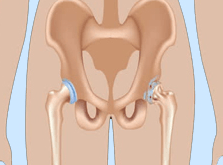
A total hip replacement surgery in India is a surgical procedure that replaces the painful hip joint with an artificial hip joint. In a hip replacement, the head of the femur (the bone that extends from the hip to the knee) is removed along with the surface layer of the socket in which it rests (called the acetabulum).
- The head of the femur, which is situated within the pelvis socket, is replaced with a metal ball and stem. This stem fits into the shaft of the femur.
- The socket is replaced with a plastic or a metal and plastic cup.
- Recently there has been a return to the earlier version of the operation when the hip was ‘resurfaced’. Rather than remove the head of the femur it is covered by a metal cover. The socket is replaced with a metal socket.
For nearly a century, doctors have been putting various materials into diseased and painful hip joints to relieve pain. Up until the 1960s, outcomes had been unreliable. At that time, the metal ball and plastic socket for the replacement of the hip joint was introduced. Today, the artificial components used in a hip replacement are stronger and more designs are available.
There are many different shapes, sizes, and designs of artificial components of the hip joint. For the most part these are composed of chrome, cobalt, titanium, or ceramic materials. Some surgeons are also using custom-made components to improve the fit in the femur.
What are the Benefits of Total Hip Replacement Surgery?

If the patients who have hip damage, but no relief after using anti inflammatory medicines and physiotherapy, hip replacement is the only option to eliminate hip pain. Hip replacement surgery restores normal hip function of the patient and improves physical functioning like walking and other movements.
Overall, a hip replacement surgery can give freedom from pain and fatigue. The benefits also include Cheapest Price of Hip Replacement Surgery in India, almost zero wait list for patients at Top Affordable Hip Replacement Surgery Hospital India.
Best Candidates for Total Hip Replacement Surgery
Osteoarthritis of the hip most commonly affects people who are middle-aged and older. Symptoms range from mild discomfort to severe pain and immobility. Treatment for osteoarthritis of the hip focuses on decreasing pain and improving joint movement. When conservative methods of treatment fail to provide adequate relief, hip replacement may be considered.
An orthopaedic surgeon, who specializes in treating problems of the bones and joints, will evaluate if you are a candidate for a hip replacement. The surgeon will discuss your medical history, measure the range of motion and muscle strength of your hips, and observe how you sit, bend, and move. In addition, x-rays will be taken to determine the extent of damage to your hip joints. If the x-ray shows severe joint damage and no other means of treatment have provided relief, the orthopaedic surgeon may suggest hip replacement surgery.
Planning your medical trip to India is a very simple process with Joint Replacement Surgery Hospital India
- You just need to fill in our enquiry form and one of our executives will contact you soon.
- +91-9860432255 Call us at the given contact number for any assistance.
- Complete information regarding surgery is provided on our website.
Who Should Have a Total Hip Replacement Surgery?
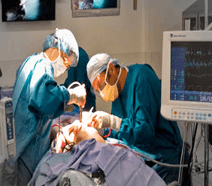
People with hip joint damage that causes pain and interferes with daily activities despite treatment may be candidates for hip replacement surgery. Osteoarthritis is the most common cause of this type of damage. However, other conditions, such as rheumatoid arthritis (a chronic inflammatory disease that causes joint pain, stiffness, and swelling), osteonecrosis (or avascular necrosis, which is the death of bone caused by insufficient blood supply), injury, fracture, and bone tumors also may lead to breakdown of the hip joint and the need for hip replacement surgery.
In the past, doctors reserved hip replacement surgery primarily for people over 60 years of age. The thinking was that older people typically are less active and put less stress on the artificial hip than do younger people. In more recent years, however, doctors have found that hip replacement surgery can be very successful in younger people as well.
New technology has improved the artificial parts, allowing them to withstand more stress and strain and last longer.
Today, a person’s overall health and activity level are more important than age in predicting a hip replacement’s success. Hip replacement may be problematic for people with some health problems, regardless of their age. For example, people who have chronic disorders such as Parkinson’s disease, or conditions that result in severe muscle weakness, are more likely than people without chronic diseases to damage or dislocate an artificial hip. People who are at high risk for infections or in poor health are less likely to recover successfully. Therefore, they may not be good candidates for this surgery. Recent studies also suggest that people who elect to have surgery before advanced joint deterioration occur tend to recover more easily and have better outcomes.
Symptoms
Hip arthritis typically causes pain that is dull and aching. The pain may be constant or it may come and go. Pain may be felt in the groin, thigh and buttock with possible referred pain to the knee. Walking long distances can also cause severe pain resulting in the patient limping. Some patients may need a cane, crutch, or walker to help them get around. Pain usually starts slowly and worsens with time and higher activity levels.
Patients with a bad hip joint can have difficulty in certain normal activities like climbing stairs, wearing trousers, tying shoes and clipping toenails.
Diagnosis
A complete history and physical examination allow the physician to determine any correlation between symptoms of pain with past history and demands that have been placed upon the hips. The physician will inquire about experiencing episodes of trauma or instability, and examine the ligaments and hip alignment.
X-rays are used to determine the extent of degeneration to the cartilage or bone and may suggest a cause for the degeneration of the hip joint. Blood tests and joint aspiration (removing a small amount of fluid from the affected hip joint) may be required to rule out systemic arthritis (such as Rheumatoid Arthritis) or infection in the hip if there is reason to believe that other conditions are contributing to the degenerative process.
What Are The Treatment Options For Hip Joint Damage?
Several hip replacement procedures are performed to replace the head of the femur with new, artificial parts. They include Total Hip Replacement, Hip Resurfacing, Proxima Hip Replacement procedure, Computer Assisted Surgery, Revision Hip Replacement treatment and Bilateral Hip Replacement. Since, hip replacement is a major operation, depending on the damage and necessity, the surgeon will decide the treatment option.
People from all over the world visit abroad for their medical and surgical needs. India has become a favorable destination for medical tourists because of its infrastructure and technology that are on par with those in western countries.
- Non Surgical Treatment
For hip arthritis, the first treatment a doctor may recommend is over-the-counter, anti-inflammatory medications. Certain nutritional supplements including glucosamine could provide some relief. Short-term physical therapy may help improve strength and reduce pain. Transferring of weight to a walker helps relieve pain and walking ability.
- Surgical Treatment
General anesthesia is most used for joint replacement surgeries, but sometimes regional anesthesia is also used. This depends on your doctor, on your overall health and personal preference.
The damaged cartilage and bone is first removed. To remove the worn out ball of the ball-and-socket hip joint, the bone is cut to remove the femoral head. In order to insert a new joint, the damaged bone and cartilage must first be removed. Once the arthritic ball is removed, the worn out socket can be addressed. Unlike the ball, this bone cannot be cut off — the socket of the hip joint is part of the pelvis bone.
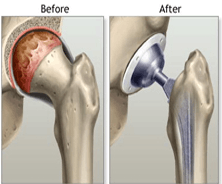
A reamer is used to scrape away the damaged cartilage and bone and a smooth, perfectly rounded surface are got which accepts the new hip implant. Once the damaged bone has been removed, the new socket of the hip replacement can be inserted. The socket of the pelvis is called the acetabulum and the part of the hip replacement inserted into the socket is called the acetabular component. The acetabular component is held tightly in the pelvis by making the socket slightly smaller than the acetabular component and wedging the implant into the bone. The implant has a rough surface to allow bone to grow into the surface of the implant over time.
Now that the socket has been addressed, attention can turn to the ball of the ball-and-socket hip joint. The ball is supported with an implant inserted down the hollow center of the thigh bone (femur). This implant is called the femoral stem.
For the femoral stem to be held tightly in the bone special tools are used to shape the center of the thigh bone to accommodate the femoral stem. With the bone prepared, the femoral stem is inserted and held in the bone with or without cement.
If bone cement is used, the cement is inserted in a liquid form and the stem is then placed. The cement permanently hardens within a few minutes to hold the implant fixed within the bone. When no cement is used, the implant is called “press-fit.” This means that the implant is wedged tightly into the bone. A rough surface covering the implant allows bone to grow into the implant over time.
With the stem inserted down the center of the thigh bone, the ball of the ball-and-socket hip joint can be inserted on top of the stem. A metal ball tightly fits onto the top of the stem.
Precaution
- Avoid sitting on low chairs, beds or toilets
- Do not raise your knee higher than the level of your hip
- One should not lean forward while sitting down or as you stand up
- Avoid crossing legs for over 8 weeks
- The leg should not rotate in or too far out
Before Operation
Preparing for a hip replacement begins weeks before the actual surgery date. In general, patients may be told to:
- Consider autologous blood donation – To avoid using donor blood, patients may donate their own blood ahead of time. While some total joint procedures do not require blood transfusion, it is possible that a patient may need blood during or after surgery.
- Begin exercising under a physician’s supervision- It is important to be in the best possible overall health to help promote the best possible surgical experience. Increasing upper body strength is important because of the need to use a walker or crutches after hip or knee replacement. Strengthening the lower body is also key because increasing leg strength before surgery can reduce recovery time.
- Have a general physical examination- Patients who are considering total joint replacement should be evaluated by their primary care physician to assess overall health and identify any medical conditions that could interfere with surgery or recovery.
- Have a dental examination- Although infections after joint replacement are not common, an infection can occur if bacteria enter the bloodstream. Therefore, dental procedures such as extractions and periodontal work should be completed before joint replacement surgery.
- Stop taking certain medications- Your orthopedic surgeon can advise you which over-the-counter and prescription medications should not be taken before surgery.
- Stop smoking- A good idea at any time, but particularly before major surgery in order to help reduce the risk of post-operative lung problems and improve healing.
- Lose weight- In patients who are obese, losing weight will help reduce stress on the new joint.
- Arrange a pre-op visit- An important opportunity to meet with healthcare professionals at the hospital to discuss your personal hospital care plan, including anesthesia, preventing complications, pain control, and diet.
- Have routine laboratory tests- Blood tests, urine tests, an ECG or cardiogram, and chest X-ray may be prescribed to confirm that you are fit for surgery.
- Evaluate post-surgical needs for at-home care – Every patient who undergoes total joint replacement will need help at home for the first few weeks, including assistance with preparing meals and transportation.
Recovery
Pain medication will be given depending on the severity of the pain. Anticoagulants may be prescribed for several weeks following surgery.
On a cemented joint, mobilization can be done and partial weight loading is done within 24 hrs. On an un-cemented hip for weight bearing is not permitted for about 6 weeks. With a cemented or hybrid (one piece cemented and one piece un-cemented) hip, you can usually put some weight on your leg right away, but you’ll still need a walker, a cane, or crutches for several weeks.
In general, most people get out of bed with help on the day after surgery. A walker or crutches will be used during the initial phase. A physiotherapist and sometimes an occupational therapist will guide you on basic movements and exercises.
Why You Should Choose India for Total Hip Replacement Surgery?
Total Hip Replacement Surgery India Reviews show that India is a favored destination for orthopedic surgery and provides world class treatment in hip replacement. The world class treatment by internationally certified surgeons, best medical facilities, dedicated specialized hospitals are some of the key factors that attract patients from abroad to get treated in India.
The skilled, experienced surgeons in India use the latest scientific procedures to ensure speedy recovery of the patients. Best Hospitals in India, provide high quality and cost effective hip replacement treatment options. They boast of state of the art diagnostics, world class operating theaters, cutting edge technologies, expert professionals along with highly efficient English speaking paramedical staff.
India has become a hub of orthopedic surgeries as it offers advanced technology and high quality procedures on par with hospitals in developed countries at a fraction of the cost. India possesses some of the best hospitals and treatment centers like Joint Replacement Surgery Hospital India in the world with latest facilities. That’s why more and more western patients prefer India for their medical needs. Combining with a refreshing holiday, medical tourism in India is amidst the best in the world.
Our Treated Patient Experience – Mr. Jacob Poya from Philippines about his Low Cost Total Hip Replacement Surgery.
I have been suffering with the arthritis pain in my hip from a few years now and it was becoming difficult to even carry out simple day-to-day activities with the recurring pain. Though I knew that my only option for permanent relief was a hip replacement surgery, I was a bit apprehensive because of the cost and risks involved. A friend then introduced me to Joint Replacement Surgery Group in India who had treated her also and I was amazed to see the way they carried out the entire procedure so smoothly while making me feel completely satisfied with the end result.
How to Get Qualitative Total Hip Replacement Surgery in India?
As the name implies, free consultation total hip replacement surgery in India is the surgery for the replacement of the hip, the need for which could arise due to hip arthritis or an accident. Patients need to undergo total hip replacement surgery in severe cases where medicines are unable to ease the chronic pain caused due to the friction between the ball and socket joint of the thigh bone and the pelvis. The procedure involves replacing these joints with artificial parts, which then provide relief from the pain and enable the patient to carry on the daily routine activities.
Affordable Total Hip Replacement Surgery in India is provided in select towns and cities owing to the complex nature of the surgery. However, the hospitals that do provide this surgery are super specialty hospitals that are equipped to carry out such procedures. The best thing about getting the surgery done in Indian super specialty hospitals is the experience of the doctors and surgeons. During the recent years, we have seen that the Indian doctors and surgeons making a mark at the medical forum on an international platform with breakthrough performances in complex surgeries using latest techniques. Many of the doctors have pioneered the technique of joint replacement surgery and have offered their services in several different hospitals in the world, gaining experience and expertise during the process.
While the total hip replacement surgery is provided in all metro cities of India. The hospital has received special acclaim for carrying out complex joint replacement surgeries with ease and success. The doctors and surgeons at the hospital are highly skilled, trained and experienced. Comparing with the best hospitals in the world, the Hospital is at par with the international standards of medical and health care, provision of world class, high quality treatment, usage of equipment and ambience. While the skill and dexterity of the surgeons are one reason to get the said surgery at the hospital there are some other benefits of getting the joint replacement surgeries here. One of these benefits relates to the cost of joint replacement surgery and the other is that of the absence of any waiting period.
Contact Best Hip Replacement Hospital in India to get highest quality medical services and care at low price. The low Cost Hip Replacement Surgery in India do not compromise with the quality of medical services and treatments thereby adheres to the International Standards.
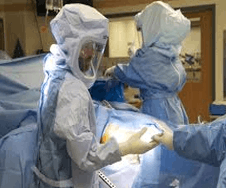
Joint replacement surgery is a type of surgery that involves high costs and most of the world-renowned advanced hospitals of the world have a long waiting period before a patient can get the said surgery. However, in India the trend is exactly the opposite. While there is virtually no waiting period to get any type of joint replacement surgery, the cost of the surgery is also very low as compared to the cost of the same procedure in any advanced hospital in countries like the US and the UK. This makes India a lucrative choice to get the surgery done.
Overseas patients can find all information related to the joint surgery in India by accessing the Joint Replacement Surgery Hospital India website or by taking the services of the premier medical tourism consultants that take care of all issues related to medical tourism in India.
How many patients underwent Total Hip Replacement Surgery in India in the last 5 years?
In recent years, India has emerged as a medical hub for patients looking for affordable, accessible and efficient low cost Total Hip Replacement Surgery. This emergence is primarily due to the development of state-of-the-art private and public sector healthcare facilities, medical insurance and the ease of access to quality healthcare services. An average increase of 15 to 20 percent annually has been observed in the number of patients in the last 5 years.
Here are the approximate figures of the patients underwent Total Hip Replacement Surgery in the last 5 years in India :
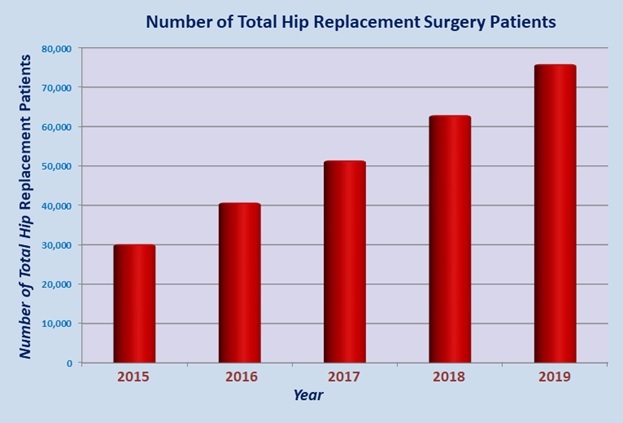
Are you looking for affordable cost of Hip Replacement Surgery in Top Hospitals of India?
Please enquire with us, Get a “No Obligation Quote”
If you are really seeking for Total Hip Replacement Surgery, kindly fill up the form for a free consultation with our surgeons. You will be provided with thorough analysis and suggestions regarding the Total Hip Replacement Surgery you are seeking.
Listen to the Voices of Our Happy Patients




Faq’s
Arthritis is the major cause of the hip pain.
Low impact cardio exercises are a good way to prepare for hip replacement surgery. Consider using an exercise bike, doing water aerobics or swimming. Not only are these exercises helpful in your surgery preparation, it can also improve the symptoms of your arthritis.
I really like it when patients have enough calcium in their diet. I ask patients to take 400 mg of calcium with each meal and 1000 IU of Vitamin D each day. The extra vitamins will help your body grow into your hip components and make it stronger.
I have had patients in their 30s, which is rare, 40s, which is not quite as rare, 50s, 60s and 70s are the most common ages. That being said I have had patients in their 80s and even in their 90s.
They had a condition where the hip bone died and it could not be replaced.
Total hip replacements are really fun because it is no exaggeration that patients will tell me they feel better the day-after-surgery than they did the day-before-surgery.
The hardest part will probably be gaining physical capabilities you haven’t had in years. Many people are just happy to get their hip replaced and be able to do the things they used to do immediately before the replacement but now can do it without pain. Our goal is for the patient to think back years ago, before they had pain and regain that level of fitness. The reason it is hard is because a lot of people don’t ever think they will get back to that activity level. It just takes time. How far were you hiking? Or dancing? Or golfing? Were you riding your bike further? Were you doing other things? You can regain a higher level of fitness you haven’t had in years.
Yes, the surgery is an inpatient procedure; however, most patients leave two days after surgery.
No, if we do the surgery in the morning you will be out of bed by the end of the day. If we do the surgery later in the day, you will be out of bed the following morning.
You will be weight bearing as tolerated. The hospital staff will teach you how to get in and out of bed safely. Before you go home, they will make sure you are able to go up and down stairs.
We always prescribe physical therapy. It usually starts in your house and progresses to an outpatient facility. The sooner we can get you to a physical therapy clinic the better because the therapy center has more equipment and is more conducive to recovering from a hip replacement surgery.
You can easily replace both hips in the same year. The real go-getters will have their surgeries within six weeks of each other. More commonly people will have the hip replacement surgeries, three months apart.
Someone with a desk job might return to work in 3-6 weeks. For someone in construction it will be closer to 8-12 weeks.
There are dislocation precautions that are theoretically in place your whole life. Practically speaking, no one ever feels restricted after their hip replacement. They don’t feel like they can’t do things. The hip dislocation precautions are just part of your life. They are not that restrictive, but they are onerous.
Usually, our orthopaedic surgeon’s use the posterior lateral approach which is the traditional/standard approach. There was a time that the surgeons did the anterior lateral approach too. We have such great results with the standard posterior approach – the patients are walking within two days and some take very few pain pills.
The shortest scars are less than four inches and it is unusual that I would go more than six inches.
Yes, I have all my patients see the dentist before I replace their hips to make sure their mouth is healthy. If you have any source of infection in your mouth it needs to be treated as best as possible so there is no risk of infection from your mouth to your new hip. After the replacement, we want you to see a dentist 2 times per year. Good dental hygiene is very important.
Your allergic response at the skin level is much different than that at the bone level. I have never had to take out a hip or knee because of allergies.
Yes, most people want a walker right after surgery; however, most people are done using their walker by the time they get to the ten day post-operative follow-up in my office.
Pre-planning is important. It is helpful to have people at home to help.
It’s much easier to recover from a hip replacement verses a knee replacement. Most people don’t need a blood transfusion.
You can most definitely choose hotels as per your convenience to you and your budget.
You can talk to the doctor and satisfy all your medical queries. You can also send us your queries for answers from the top doctors.
To know about the procedure of getting an Indian Medical Visa, please go to our website where you will find all the details regarding the initial procedure. You can also send us a query regarding the same.
Many hospitals in India have language translators to help you communicate better and effortlessly with the doctors and medical staff.
Our Country Specific Services
Related Pages
Our Blog Posts
Our Patient’s Experiences
Tags
Low Cost Arthroscopy Surgery in India
Planning Your MedicaTrip to India?
Joint Replacement Surgery Hospital India makes it simple:
- Fill in our enquiry form — our executive will contact you shortly.
- Call us anytime: +91-9860432255
- Complete surgery details are available on our website.
What is the Cost of Arthroscopy Surgery with Top Hospitals and Best Surgeons in India?
- The Cost of Arthroscopy Surgery in India can range from approximately Rs. 1,60,000 ($2,000) to Rs. 4,00,000 ($5,000).
- The average cost of Arthroscopy Surgery in India is typically a fraction of the cost for the same procedure and care in the US and other developed countries.
- If you compare the same with developed nations, the cost for these treatments is often the double than what you find in India.
- The cost can vary as per the diagnosis and conditions of the patients along with the facilities availed.
The list of various factors deciding the price of Arthroscopy Surgery in India is as follows:
- Treatment Method
- Type of Surgery
- Other treatments required in conjunction with Arthroscopy Surgery
- Investigations & evaluation required.
- Hospital Fee
- Room Category
VIDEO – ARTHROSCOPY SURGERY INDIA
The LIST of Best Arthroscopy COST in India across TOP 15 Cities in Indian Rupees (INR) is as follows:
| City | Lowest Cost | Average Cost | Highest Cost |
|---|---|---|---|
| New Delhi | 1,60,000 | 2,40,000 | 4,00,000 |
| Mumbai | 1,70,000 | 2,50,000 | 4,25,000 |
| Chennai | 1,80,000 | 2,60,000 | 4,50,000 |
| Bangalore | 2,00,000 | 2,80,000 | 4,75,000 |
| Hyderabad | 1,60,000 | 2,40,000 | 4,00,000 |
| Ahmedabad | 1,70,000 | 2,50,000 | 4,25,000 |
| Nagpur | 1,80,000 | 2,60,000 | 4,50,000 |
| Pune | 2,00,000 | 2,80,000 | 4,75,000 |
| Gurgoan / Gurugram | 1,60,000 | 2,40,000 | 4,00,000 |
| Kolkata | 1,70,000 | 2,50,000 | 4,25,000 |
| Chandigarh | 1,80,000 | 2,60,000 | 4,50,000 |
| Jaipur | 2,00,000 | 2,80,000 | 4,75,000 |
| Noida | 1,60,000 | 2,40,000 | 4,00,000 |
| Kerala | 1,70,000 | 2,50,000 | 4,25,000 |
| Goa | 1,80,000 | 2,60,000 | 4,50,000 |
The variation in the above cost is dependent on the following:
- Type of the hospital (Government/Trust/Private).
- Use of insurance, type of insurance or self paid.
- Accreditation of the facility
- Expertise, seniority, reputation and brand value of the surgeon/doctor.
- FIVE OF OUR NETWORK SURGEONS HAVE WON AWARDS IN THEIR SPECIALTIES THIS YEAR
- OUR CONSULTANTS WILL BE VISITING CAMEROON, SUDAN, AND ETHIOPIA THIS YEAR
- WE HAVE PARTNERED WITH HOSPITALS IN OMAN, SAUDI ARABIA AND KUWAIT FOR SECOND OPINIONS FROM OUR DOCTORS IN INDIA
- THREE OF OUR PARTNER HOSPITALS HAVE OPENED TELEMEDICINE CENTRES IN AFRICA FOR REACHING OUT TO REMOTE PATIENTS
- ADVANCED ROBOTIC SURGERY IS AVAILABLE ACROSS ALL NETWORK HOSPITALS NOW
Planning Your Affordable Knee Arthroscopy Surgery in India is an Easy Process.
Our Hospitals Network and Surgery Group is available in 15 cities of India for our patients to access. Kindly fill up the form for a free opinion from our expert team. You will be provided with an analysis and recommendations for your surgery. NO CHARGES LEVIED.
Special ALL SERVICES INCLUSIVE Packages available for INTERNATIONAL PATIENTS
What is Arthroscopy?
Arthroscopy in India is a surgical procedure, where orthopedic surgeons visualize, diagnose and treat problems inside a joint. In an arthroscopic examination, the surgeon makes a small incision in the skin of the patient and then inserts pencil sized instruments which contain a small lens along with a lightning system to magnify and illuminate the structures inside the joint.
The television camera attached to the arthroscope displays the image on the giant screen, allowing the surgeon to look further. The surgeon can determine the amount or the type of injury and then correct or repair the problem if it is necessary.
Benefits of Arthroscopy in India
The benefits of arthroscopy in India includes best price hospital for arthroscopy in Inida, Internationally accredited surgeons, Affordable Arthroscopy at Best Joint Replacement Hospital India, almost zero patient wait list, state of the art equipments and the latest technology.
How do I know if I am a good candidate for Arthroscopy Procedure?
This surgery has received a lot of public attention as it is used for treating well known athletes. It is an extreme valuable tool for the orthopedic patients and works out to be a blessing for patients who have had an open surgery. This surgery is conducted as an outpatient surgery and the indications are when the pain in the joint becomes unbearable, then surgery is the only option which is left.
Top 10 Arthroscopy Surgery Hospitals in India
- Fortis Hospital, Delhi
- Max Hospital, Delhi
- Artemis Hospital, Delhi
- BLK Hospital, Delhi
- Nanvati Hospital, Mumbai
- Global Hospital, Mumbai
- Manipal Hospital, Bangalore
- Kokilaben Hospital, Mumbai
- Saifee Hospital, Mumbai
- Medanta Hospital, Gurgaon
10 Best Knee Arthroscopy Surgeons in India
- Dr. Ashok Rajgopal
- Dr. Kaushal Malhan
- Dr. Haresh Mangalani
- Dr. Aditya Menon
- Dr. Sanjay Sarup
- Dr. IPS Oberio
- Dr. Harshwardhan Hegde
- Dr. Pradeep B. Bhosale
- Dr. Sachin Bhonsle
- Dr. Anil R Karkhanis
Patient Testimonial – Nigerian Patient Shares Success Stories of Arthroscopy Treatment in India
Hello, my name is Becca Adesina from Nigeria. I visited India for Arthroscopy with the assistance of your medical tourism company. I was suffering from long-standing and repetitive injuries to my ankle. My doctor recommended me to undergo this surgery. Back in my native place there is a lack of medical facilities and so I decided to undergo my surgery abroad. However, the highly expensive surgery in the US made me look for pocket-friendly treatment. Luckily I found your website and got my appointment fixed. I received a warm welcome at the airport and was taken to the hospital. My surgeon was a nice and caring person. The nurses were amazing and took care of all my needs. The hospital room was hygienic. I extend my gratitude to everyone, including the surgeon, nurses and the entire team of medical tourism company for assisting me throughout my journey to India.
Arthroscopy Procedure, Recovery & Effectiveness
Affordable Arthroscopy in India ensures that one has to use anesthesia, though it depends upon the nature of the suspected problem. A small incision may be inserted inside the arthroscopy. Several other incisions may be made to see other parts of the joint. After the surgery the small incisions may be covered with dressing. One will be moved from the operating to the recovery room and many patients need little or no form of medications. After being discharged one will be given instructions on how to care for the incisions.
The amount and the time of the recovery will to a large extend depend upon the complexity of the problem. Occasionally, when one has an eye on Arthroscopy in India reviews it may be noticed that the surgery only cannot provide sure shot results, then an open surgery may be needed.
Why Opting Arthroscopy is necessary?
Free Consultation Arthroscopy in India ensures that the diagnosis is necessary for the joint injuries which begin with a thorough medical history, physical examination and X rays. CT or MRI scans may also be performed if the situation demands. Some of the most frequent conditions which occur during arthroscopic examinations are as follows
- Shoulder
- Knee
- Wrist
Why to Choose an Indian Hospital for your Arthroscopy Procedure?
In the rampant growth of medical tourism the Indian hospitals have profound impacts. Some of the skilled surgeons who have a proven track record are found in the Indian hospitals. Many foreign nationals worry about the quality of health care services which they receive abroad, and when it comes to India they have complete peace of mind with the cheapest price Arthroscopy in India. Since English is a language which is spoken by the support staff, the foreign tourists tend to be at ease.
Arthroscopy Cost in India
Low Cost Arthroscopy in India ensures that you can make considerable savings in cost when you choose India as the one stop destination for all your medical needs. You can resort to medical tourism companies which provide the best of health care at reasonable prices. A call or an email will give you further information in this regard.
Here are the approximate figures of the patients underwent Arthroscopy Surgery in the last 5 years in India:
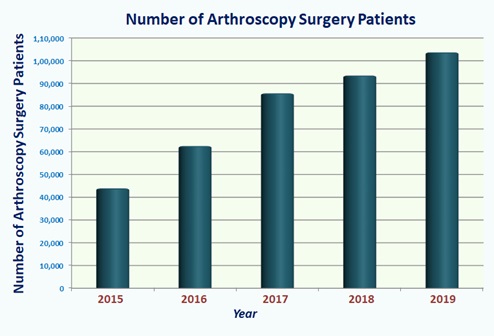
Are you looking for affordable cost of Knee Arthroscopy Surgery in India?
Please enquire with us, get a “No Obligation Quote”
If you are really seeking Arthroscopy, kindly fill up the form for a free consultation with our surgeons. You will be provided with thorough analysis and suggestions regarding the Arthroscopy you are seeking.
Listen to the Voices of Our Happy Patients
FAQ’s
Arthroscopy is a surgical procedure during which the internal structure of a joint is examined for diagnosis and treatment of problems inside the joint.
Arthroscopic examination of joints is helpful in diagnosis and treatment of the following conditions:
- Inflammation: Synovitis, the inflammation of the lining of the knee, shoulder, elbow, wrist, or ankle.
- Acute or chronic injury: Injuries to the shoulder, knee and wrist joint, such as cartilage tears, tendon tears, carpal tunnel syndrome.
- Osteoarthritis: A type of arthritis caused by cartilage loss in a joint.
- Removal of loose bodies of bone or cartilage that becomes logged within the joint.
During arthroscopic surgery, either general, spinal, or a local anesthesia will be given depending on the condition. A small incision of the size of a buttonhole is made through which the arthroscope is inserted. Other accessory incisions will be made through which specially designed instruments are inserted. After the procedure is completed, the arthroscope is removed and incisions are closed.
Some of the possible complications after arthroscopy include infection, phlebitis (clotting of blood in veins), excessive swelling, bleeding, blood vessel, or nerve damage and instrument breakage.
It may take several weeks for the puncture wounds heal and the joint to recover completely. A rehabilitation program may be advised for a speedy recovery of normal joint function. You can resume normal activities and go back to work within a few days. You may be instructed about the incision care, activities to be avoided, and exercises to be performed for faster recovery.
Getting a full range of motion, strength, and flexibility back after surgery usually takes time. That is where pre-operative exercise, education, and post-operative physical therapy programs come in – to ensure you are physically and emotionally prepared for surgery and to maximize your recovery after surgery.
When you come for your appointment remember to bring the following:
- Driver’s License or a valid ID
- Insurance information
- Referral Letter (if required)
- Reports, X-rays, MRI’s, CT scans, etc. and any other relevant information
- List of medications (if any)
You can most definitely choose hotels as per your convenience to you and your budget.
You can talk to the doctor and satisfy all your medical queries. You can also send us your queries for answers from the top doctors.
To know about the procedure of getting an Indian Medical Visa, please go to our website where you will find all the details regarding the initial procedure. You can also send us a query regarding the same.
Many hospitals in India have language translators to help you communicate better and effortlessly with the doctors and medical staff.
Our Country Specific Services
Related Pages
Our Blog Posts
Our Patient’s Experiences
Tags

LOW COST Shoulder Replacement Surgery in India
Planning Your MedicaTrip to India?
Joint Replacement Surgery Hospital India makes it simple:
- Fill in our enquiry form — our executive will contact you shortly.
- Call us anytime: +91-9860432255
- Complete surgery details are available on our website.
What is Shoulder replacement Surgery?
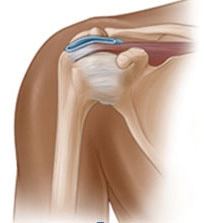
Shoulder replacementis a surgical procedure in which all or part of the glenohumeral
joint is replaced by a prosthetic implant. Such joint replacement surgery generally is conducted to relieve arthritis pain or fix severe physical joint damage.
Shoulder replacement surgery is an option for treatment of severe arthritis of the shoulder joint. Arthritis is a condition that affects the cartilage of the joints. As the cartilage lining wears away, the protective lining between the bones is lost. When this happens, painful bone-on-bone arthritis develops. Severe shoulder arthritis is quite painful, and can cause restriction of motion. While this may be tolerated with some
medications and lifestyle adjustments, there may come a time when surgical treatment is necessary.
Symptoms-
Patients with arthritis typically describe a deep ache within the shoulder joint. Initially, the pain feels worse with movement and activity, and eases with rest. As the arthritis progresses, the pain may occur even when you rest. By the time a patient sees a physician for the shoulder pain, he or she often has pain at night. This pain may be severe enough to prevent a good night’s sleep. The patient’s shoulder may make grinding or grating noises when moved. Or the shoulder may catch, grab, clunk or lock up. Over time, the patient may notice loss of motion and/or weakness in the affected shoulder. Simple daily activities like reaching into a cupboard, dressing, toileting and washing the opposite armpit may become increasingly difficult.
Common Symptoms of Shoulder Arthritis include:
- Pain with activities
- Limited range of motion
- Stiffness of the shoulder
- Swelling of the joint
- Tenderness around the joint
- A feeling of grinding or catching within the joint
VIDEO – SHOULDER REPLACEMENT SURGERY IN INDIA
Patient Review – African Patient share Success Stories
of Low Cost Shoulder Replacement Surgery in India
Hello, I am Andre Jacobs from South Africa. I got my shoulder replacement surgery in India through Joint Replacement Hospital India. I had experienced soreness in my left shoulder while lifting weights and working in my yard. Over time, this discomfort progressed into pain and started interfering with my daily activities. Though I underwent the physical therapy and took medications, but nothing seemed to work out. It was then, that a friend of my relative who is doctor suggested me about your surgery group in India. I went online searching for more information and impressed with it, I send my inquiry. They called me back and replied to all my queries. They explained me well about the surgery and what I should expect with it. They also asked me for my medical reports and after getting the best treatment options, I got my surgery fixed with them. I had one of the amazing experiences during my trip in India. The surgeon took his time clearing all my doubts and putting me at ease. The whole staff was friendly. Thank you for the wonderful care and quality of service you guys rendered throughout my stay in India.
Shoulder Treatment Options-
Nonsurgical Treatment-
Treatment of an arthritic shoulder starts with rest, exercise and taking arthritis medications. Resting the shoulder and applying moist heat can ease mild pain. After strenuous activity, an ice pack may be more effective at decreasing pain and swelling.
Physical therapy may be helpful when arthritis is in early stages. It helps maintain joint motion and strengthen the shoulder muscles. Physical therapy is less effective when the arthritis has advanced to the point that bone rubs on bone. When this is the case, physical therapy may make the shoulder hurt more.
Arthritis medications, called nonsteroidal anti-inflammatories (NSAIDs), can control arthritis pain. Certain NSAIDs may be purchased over-the-counter, while others require a prescription. Periodic cortisone injections into the shoulder joint can provide temporary pain relief. Excessive cortisone shots can have adverse effects, however.
Surgical Treatment-

If nonoperative treatments fail, shoulder replacement surgery may be needed. Shoulder replacements are usually done to relieve pain.
There are several different types of shoulder replacements. The usual total shoulder replacement involves replacing the arthritic joint surfaces with a highly polished metal ball attached to a stem, and a plastic socket. The components come in various sizes. If the bone is of good quality, your surgeon may choose to use a non-cemented or press-fit humeral component. If the bone is soft, the humeral component may be implanted with bone cement. In most cases, an all-plastic glenoid component is implanted with bone cement. Implantation of a glenoid component is not advised if:
- The glenoid has good cartilage.
- The glenoid bone is severely deficient.
- The rotator cuff tendons are irreparably torn.
Patients with bone-on-bone osteoarthritis and intact rotator cuff tendons are generally good candidates for conventional total shoulder replacement. Depending on the condition of the shoulder, your surgeon may replace only the ball. Sometimes, this decision is made in the operating room at the time of the surgery. Some surgeons replace the ball when it is severely fractured and the socket is normal.
Preparation-
Some severe degenerative problems of the shoulder may require replacement of the painful shoulder with an artificial shoulder joint. You and your surgeon should make the decision to proceed with surgery together. You need to understand as much about the procedure as possible. If you have concerns or questions, you should talk to your surgeon.
Once you decide on surgery, you need to take several steps. Your surgeon may suggest a complete physical examination by your regular doctor. This exam helps ensure that you are in the best possible condition to undergo the operation.
You may also need to spend time with the physical or occupational therapist who will be managing your rehabilitation after surgery. This allows you to get a head start on your recovery. One purpose of this pre-operative visit is to record a baseline of information. Your therapist will check your current pain levels, ability to do your activities, and the movement and strength of each shoulder.
A second purpose of the pre-operative visit is to prepare you for surgery. You’ll begin learning some of the exercises you’ll use during your recovery. And your therapist can help you anticipate any special needs or problems you might have at home, once you’re released from the hospital.
On the day of your surgery, you will probably be admitted to the hospital early in the morning. You shouldn’t eat or drink anything after midnight the night before. Come prepared to stay in the hospital for several nights. The length of time you will spend in the hospital depends a lot on you.
What is the Shoulder Replacement Surgery Cost in India?
The Cost of Shoulder Replacement Surgery in India can range from approximately Rs. 4,00,000 ($5,000) to Rs. 5,60,000 ($7,000).
The cost will be depending upon the Stage of Arthritis, Type of Surgery required, Investigation & evaluation required, Specialty of Surgeon, Hospital Fee, and Room Category.
Top 10 Shoulder Replacement Surgery Hospitals in India
- Fortis Hospital, Delhi
- Max Hospital, Delhi
- Artemis Hospital, Delhi
- BLK Hospital, Delhi
- Nanvati Hospital, Mumbai
- Global Hospital, Mumbai
- Manipal Hospital, Bangalore
- Kokilaben Hospital, Mumbai
- Saifee Hospital, Mumbai
- Medanta Hospital, Gurgaon
10 Best Shoulder Replacement Surgeons in India
- Dr. Kaushal Malhan
- Dr. Haresh Mangalani
- Dr. Ashok Rajgopal
- Dr. Aditya Menon
- Dr. Sanjay Sarup
- Dr. IPS Oberio
- Dr. Sachin Bhonsle
- Dr. Harshwardhan Hegde
- Dr. Pradeep B. Bhosale
- Dr. Anil R Karkhanis
Planning Your Affordable Shoulder Replacement Surgery in India is an Easy Process.
Our Hospitals Network and Surgery Group is available in 15 cities of India for our patients to access. Kindly fill up the form for a free opinion from our expert team. You will be provided with an analysis and recommendations for your surgery. NO CHARGES LEVIED.
Special ALL SERVICES INCLUSIVE Packages available for INTERNATIONAL PATIENTS
Operation-
Shoulder replacement surgery can be done in one of two ways. When the cartilage of both the humeral head (the ball) and the glenoid (the socket) is worn away, both parts of the joint must be replaced. This surgery is called arthroplasty, which is the term used for joint reconstruction.
If the glenoid still has some articular cartilage, your surgeon may replace only the humeral head. This procedure is known as a hemiarthroplasty. (Hemi means half.) The hemi-arthroplasty is most commonly used after a fracture of the shoulder where the blood supply to the ball portion (the humeral head) of the humerus is damaged. Research has shown that when the shoulder is being replaced for arthritis, the complete shoulder arthroplasty performs better. Patients have less pain immediately after surgery and in the long run have a better functioning shoulder with less complication and are less likely to need a second operation.
You will most likely need general anesthesia for shoulder replacement surgery. General anesthesia puts you to sleep. It is difficult to numb only the shoulder and arm in a way that makes such a major surgery possible.
Shoulder replacement surgery is done through an incision on the front of your shoulder. This is called an anterior approach. The surgeon cuts through the skin and then isolates the nerves and blood vessels and moves them to the side. The muscles are also moved to the side.
The surgeon enters the shoulder joint itself by cutting into the joint capsule. This allows the surgeon to see the joint.
At this point, the surgeon can prepare the bone for attaching the replacement parts. The ball portion of the humeral head is removed with a bone saw. The hollow inside of the upper numerus is prepared using a rasp. This lets your surgeon mold the space to anchor the metal stem of the humeral component inside the bone.
If the glenoid will be replaced, it is prepared by grinding away any remaining cartilage on the surface. This is done with an instrument called a burr. The surgeon usually uses the burr to drill holes into the bone of the scapula. This is where the stem of the glenoid component is anchored.
Finally, the humeral component and the glenoid component are inserted and the humeral ball is attached.
Once the joint is anchored, the surgeon tests for proper fit. When the surgeon is satisfied with the fit, the joint capsule is stitched together. The muscles are then returned to their correct positions, and the skin is also stitched up.
Your incision will be covered with a bandage, and your arm will be placed in a sling. You will then be woken up and taken to the recovery room.
After surgery-
After surgery, you’ll be transported to the recovery room. You will have a dressing wrapped over your shoulder that will need to be changed frequently over the next few days. Your surgeon may have inserted a small drainage tube into the shoulder joint to help keep extra blood and fluid from building up inside the joint. An intravenous line (IV) will be placed in your arm to give you needed antibiotics and medication.
Your shoulder may be placed in a continuous passive motion (CPM) machine immediately after surgery. CPM helps the shoulder begin to move and alleviates joint stiffness. The machine straps to the shoulder and continuously bends and straightens the joint. This motion is thought to reduce stiffness, ease pain, and keep extra scar tissue from forming inside the joint. You’ll use a shoulder sling to support your arm when you’re not using the CPM machine.
Rehabilitation-
A physical or occupational therapist will see you the day after surgery to begin your rehabilitation program. Therapy treatments will gradually improve the movement in your shoulder. If you are using CPM, your therapist will check the alignment and settings. Your therapist will go over your exercises and make sure you are safe getting in and out of bed and moving about in your room.
When you go home, you may get home therapy visits. By visiting your home, your therapist can check to see that you are safe getting around in your home. Treatments will also be done to help improve your range of motion and strength. In some cases, you may require up to three visits at home before beginning outpatient therapy.
The first few outpatient treatments will focus on controlling pain and swelling. Ice and electrical stimulation treatments may help. Your therapist may also use massage and other types of hands-on treatments to ease muscle spasm and pain. Continue to use your shoulder sling as prescribed.
As the rehabilitation program evolves, more challenging exercises are chosen to safely advance the shoulder’s strength and function.
Finally, a select group of exercises can be used to simulate day-to-day activities, like grooming your hair or getting dressed. Specific exercises may also be chosen to simulate work or hobby demands.
When your shoulder range of motion and strength has improved enough, you’ll be able to gradually get back to normal activities. Ideally, you’ll be able to do almost everything you did before. However, you may need to avoid heavy or repeated shoulder actions.
You may be involved in a progressive rehabilitation program for two to four months after surgery to ensure the best results from your artificial joint. In the first six weeks after surgery, you should expect to see your therapist two to three times a week. At that time, if everything is still going as planned, you may be able to advance to a home program. Then you will only check in with your therapist every few weeks.
Why Choose India for Shoulder Replacement Surgery?
Joint Replacement Surgery Hospital India offers highest quality bone and joint health care with attentiveness, care and compassion to meet the needs of the patients and their loved ones. The medical team includes board-certified orthopedic surgeons who are familiar with all the aspects of the musculoskeletal system. Our hospital uses the most advanced technologies available for the orthopedic procedures and has a lower complication rate.
Since the shoulder replacement surgery is a complex operation, we have an experienced surgical team and fully equipped operation theatre facility with excellent infrastructure for the post-operative care and rehabilitation. The shoulder fracture surgery when performed by a high-volume surgeon under a high-volume hospital provides you a better outcome.
Are you looking for Affordable Cost of Shoulder Replacement Surgery in Top Hospitals of India?
Please enquire with us Get a “No Obligation Quote”
If you are really seeking for Shoulder Replacement Surgery, kindly fill up the form for a free consultation with our surgeons. You will be provided with thorough analysis and suggestions regarding the Shoulder Replacement Surgery you are seeking.
Listen to the Voices of Our Happy Patients
FAQ’s
Arthritis. Arthritis is the result of the cartilage in a joint being worn out over time. I often describe the arthritis in the shoulder as having a “rusty hinge”. The cartilage in your joint is supposed to be a smooth surface that allows things to move easily; however, when the cartilage wears out as a result of arthritis it becomes a rough surface, or “rusty”.
If you have pain in your shoulder, limited function and difficulty sleeping it is important to try arthritis medications and cortisone injections. If the medication and injections do not relieve your shoulder pain, then it is time to discuss a shoulder replacement.
The typical age group for a shoulder replacement patient is 60-80 years old. I have performed shoulder replacements on patients as old as 88 and as young as the mid-40s. Every patient’s situation is uniquely different and I take that into consideration when discussing a shoulder replacement.
For the most part it is not valuable to do therapy or exercise before a shoulder replacement surgery. Unfortunately the movement further aggravates the shoulder and causes more pain. My preparation advice for shoulder replacement surgery is more focused on the practical things in life… you have to prepare for the fact that you aren’t going to have use of your arm for a matter of weeks, which means you might need some help at home (cooking, showering, driving, etc.). I don’t recommend you drive for at least a couple of weeks following surgery. It is important for patients to plan ahead and understand what the nuts/bolts are regarding their recovery.
Certain foods, more related to nutritional supplements, can cause your blood to be thinned, a similar effect as aspirin or blood thinners. I will go over a list of supplements that could have this effect… I will have you stop taking those items a week prior to your shoulder replacement surgery.
There is some immediate change in regard to the movement of the shoulder being much smoother; however, for a few weeks after surgery it is more painful than before surgery. At about two weeks post-surgery people start to get over the “hump” and it is less painful than prior to surgery. The pain will continue to gradually decrease. At two months the average patient is very happy they had their shoulder replaced.
Most people require, to some degree, oxycodone or hydrocodone. In addition, I supplement anti-inflammatory medications. Each patient is very unique and their pain levels vary, naturally I make those adjustments accordingly.
The first couple of days the pain will be significant, but it can also be controlled with the appropriate medications. Regaining range of motion takes time, patience and persistence it only improves at a certain rate each month.
Yes. The typical stay is somewhere between 24-48 hours: 50% stay one day while 50% stay two days. Rarely do patients stay longer than two days.
Yes, we will prescribe physical therapy. Typically, therapy will last two months following the operation; however, sometimes patients require more.
Most people who develop arthritis on one side develop it on the other side as well. Most often one side hurts worse than the other and so many patients opt for both shoulders to be replaced, but it is usually a couple years between the two operations.
The estimate is around 15 years, but that estimate is variable and we see them last longer in some patients. It is difficult to predict how long each patient’s shoulder replacement will last, specifically because the materials we use now are improved from those 7-8 years ago.
Typically, if you need a shoulder redone, you redo the whole thing (not just parts), but it is rare that we have to do that. For most people, their shoulder will last for as long as they need it; however, that depends on the age that the patient received their replacement.
Infection is always the number one concern. We take a lot of precaution to prevent an infection when it comes to the surgery technique and antibiotics (you get antibiotics around the time of surgery). There is a possibility I can injure a very important nerve in the shoulder that is close to where I am working. If that nerve is injured it can have an impact on your ability to raise your arm above your head. I am very mindful of that nerve during the surgery. From a practical standpoint, wear and tear of the parts over time can cause complications.
Construction worker: 3 months
Desk worker: 2 weeks
Almost everyone has a thorough physical exam with their primary care physician to make sure they are healthy enough to handle the stress of replacement surgery. In addition, the biggest thing to plan for is to have help at home. We also don’t recommend you drive for at least a couple of weeks following surgery.
Our Country Specific Services
Related Pages
Our Blog Posts
Our Patient’s Experiences
Tags
Low Cost Partial Knee Replacement Surgery in India
What is the Cost of Partial Knee Replacement Surgery with Top Hospitals and Top Surgeons in India?
- The Cost of Partial Knee Replacement Surgery in India can range from approximately Rs. 1,80,000 ($2,200) to Rs. 3,60,000 ($4,500).
- The average cost of the Partial Knee Replacement Surgery is very high in western countries.
- Partial Knee Replacement Surgery cost in India is much less when compared to any other countries. Also the cost of Partial Knee Replacement Surgery in India is substantially lower than other developed countries of the world.
- India is known worldwide for its advanced medical facilities and promising technology for Low Cost Partial Knee Replacement Surgery. Many of the best hospitals for Partial Knee Replacement Surgery can be found in India.
Various deciding factors could determine the price of Partial Knee Replacement Surgery in India. These can be broadly classified as Hospital, Medical Team or Patient Dependent factors.
Hospital Factors
- Type of the hospital (Government / Trust / Private).
- Use of insurance, type of insurance or self paid.
- Accreditation of the facility
- Reputation and brand value of the hospital.
Medical Team Factors
- Technology / Approach Used
- Surgery Type
- Type of Anesthesia or Sedation
- Qualification / Expertise of the specialist
- Extent of the surgery needed
Patient Factors
- Patient’s diagnosis
- Patient’s general health
- Room Category selected by the patient
- Other treatment required by the patient in conjunction
The LIST of AVERAGE COST of the Partial Knee Replacement Surgery across TOP 15 cities in India in Indian Rupee (INR) is as follows –
| City | Lowest Cost | Average Cost | Highest Cost |
|---|---|---|---|
| New Delhi | 1,80,000 | 2,55,000 | 3,30,000 |
| Mumbai | 1,90,000 | 2,65,000 | 3,40,000 |
| Chennai | 2,15,000 | 2,90,000 | 3,65,000 |
| Bangalore | 2,00,000 | 2,80,000 | 3,50,000 |
| Hyderabad | 2,40,000 | 3,15,000 | 3,90,000 |
| Ahmedabad | 2,65,000 | 3,40,000 | 4,15,000 |
| Nagpur | 1,65,000 | 2,40,000 | 3,15,000 |
| Pune | 1,90,000 | 2,65,000 | 3,40,000 |
| Gurgaon / Gurugram | 1,80,000 | 2,55,000 | 3,30,000 |
| Kolkata | 2,65,000 | 3,40,000 | 4,15,000 |
| Chandigarh | 1,90,000 | 2,65,000 | 3,40,000 |
| Jaipur | 2,40,000 | 3,15,000 | 3,90,000 |
| Noida | 1,80,000 | 2,55,000 | 3,30,000 |
| Kerala | 2,65,000 | 3,40,000 | 4,15,000 |
| Goa | 2,40,000 | 3,15,000 | 3,90,000 |
- FIVE OF OUR NETWORK SURGEONS HAVE WON AWARDS IN THEIR SPECIALTIES THIS YEAR
- OUR CONSULTANTS WILL BE VISITING CAMEROON, SUDAN, AND ETHIOPIA THIS YEAR
- WE HAVE PARTNERED WITH HOSPITALS IN OMAN, SAUDI ARABIA AND KUWAIT FOR SECOND OPINIONS FROM OUR DOCTORS IN INDIA
- THREE OF OUR PARTNER HOSPITALS HAVE OPENED TELEMEDICINE CENTRES IN AFRICA FOR REACHING OUT TO REMOTE PATIENTS
- ADVANCED ROBOTIC SURGERY IS AVAILABLE ACROSS ALL NETWORK HOSPITALS NOW
Contact Us for a FREE No Obligation Quote & Opinion for Partial Knee Replacement Surgery in India
Our Hospitals Network and Surgery Group are available in 15 cities of India for our patients to access. Kindly fill up the form for a free opinion from our expert team. We shall get you a Free, No Obligation Opinion from India’s best Surgeons and best Hospitals in India. NO CHARGES LEVIED.
Special ALL SERVICES INCLUSIVE Packages available for INTERNATIONAL PATIENTS
Top 10 Surgeons For Partial Knee Replacement In India
- Dr. Ashok Rajgopal
- Dr. Kaushal Malhan
- Dr. Manoj Miglani
- Dr. Rajeev Verma
- Dr. S K S Marya
- Dr. Kamal Bachani
- Dr. Yash Gulati
- Dr. Bhushan Nariani
- Dr. Abhijit Dey
- Dr. Vinay Joshi
- Dr. Manu Bora
- Dr. Raju Vaishya
- Dr. Raghava Dutt Mulukatla
- Dr. Vijay C Bose
- Dr. IPS Oberoi
- Dr. Haresh Manglani
- Dr. B. K. Singh
- Dr. Dhananjay Gupta
- Dr. A B Govindraj
- Dr. Subhash Jangid
- Dr. Nitiraj Oberoi
- Dr. Ramneek Mahajan
- Dr. Dinshaw Pardiwala
- Dr. Ravi V.
- Dr. Pradeep Sharma
- Dr. Sanjay Desai
List of Top 10 Partial Knee Replacement Surgery Hospitals In India
- Fortis Hospital, Mumbai
- Artemis Hospital, Gurgaon
- Fortis Hospital, Bangalore
- Fortis Memorial Research Institute, Gurgaon
- Fortis Rajan Dhall Hospital, New Delhi
- Indraprastha Apollo Hospital, New Delhi
- Shalby Hospital, Ahemdabad
- Kokilaben Hospital, Mumbai
- Nanavati Hospital, Mumbai
- Apollo Hospital, Chennai
- Columbia Asia Hospital, Bangalore
- Asian Joint Reconstruction Institute, Chennai
- Paras Hospitals, Gurgaon
- Jaypee Hospital, Noida
- Fortis Malar Hospital, Chennai
- BLK Max Hospital, New Delhi
- PSRI Multispecialty Hospital, Delhi
- Max Super Specialty Hospital, New Delhi
- Medanta The Medicity, Delhi
- SL Raheja Hospital, Mumbai
- Global Hospitals, Chennai
- Indian Spinal Injuries Center, New Delhi
Partial Knee Replacement
Introduction
Partial knee replacement, also called a unicompartmental knee arthroplasty,’ is a surgery that may be considered for treatment of osteoarthritis of the knee joint. Traditionally, patients have undergone total knee replacement for severe arthritis of the knee joint. In a total knee replacement, all cartilage is removed from the knee joint, and a metal and plastic implant is substituted.
Human beings use their knees in almost all of their daily activities. And if they suffer from pain in the knees, this could be very frustrating. Knee pain can occur for a variety of reasons. Of which, knee arthritis is the most common reason. The doctor can recommend a partial knee replacement surgery in cases where the patient is suffering from debilitating pain. Partial knee replacement surgery is also known as uni-compartmental knee surgery because it is different from a traditional total knee replacement surgery.
A partial knee replacement surgery is relatively less invasive than a traditional total knee replacement surgery. Partial knee replacement surgery in India could be a good option for patients suffering from knee arthritis and from knee injuries. This type of knee replacement surgery is preferred over the traditional total knee replacement surgery because it replaces only the damaged parts of the knee. The post operative hospital stay is also a very short period of one or two day as compared to a total knee replacement surgery. Patients have experienced a shorter recovery period in a partial knee replacement surgery.
Planning your medical trip to India is a very simple process with Joint Replacement Surgery Hospital India
- You just need to fill in our enquiry form and one of our executives will contact you soon.
- +91-9860432255 Call us at the given contact number for any assistance.
- Complete information regarding surgery is provided on our website.
Benefits of Partial Knee Replacement Surgery in India
Multiple studies have shown that modern unicompartmental knee replacement performs very well in the vast majority of patients who are appropriate candidates.
The advantages of partial knee replacement over total knee replacement include:
- Minimally invasive surgery with smaller incision: In a unicondylar or partial knee replacement surgery the incision is about three inches and the amount of dissection and the bone removal is much smaller.
- Affordable costs: The total cost of partial knee replacement surgery in India is quite affordable compared to the Western counterparts. Price of partial knee surgery in India is almost 1/4th of the cost of that in the UK and the US.
- Quicker recovery and shorter hospital stay: Compared to a total knee replacement, the recovery time and the number of days of hospital stay in a partial knee replacement is lesser.
- Less blood loss: Partial knee replacement is performed by making a small incision and hence a blood transfusion is infrequently needed. The amount of blood loss is much lesser when compared to a total knee replacement.
Less waiting time: The waiting time is less for surgery in India and we will help you access the Affordable Hospital for Partial Knee Replacement Surgery in India.
Our Treated Patient Experience – Mr. Bryan Tang from Singapore about his Low Cost Partial Knee Replacement Surgery.
Knee pain is probably one of the worst ailments that an individual can ever suffer from. For me, it was so persistent that I used to dread even climbing the stairs in my home most of the times. My co-worker was familiar with my suffering and connected me with Joint Replacement Surgery Group in India, a group of orthopedic surgeons and top most hospitals. My doctor there was an expert while explaining me the entire procedure, duration, cost involved and time of recovery and a master while performing the partial knee replacement surgery.
Candidates for Partial Knee Replacement Surgery
The minimally invasive partial knee replacement is indicated in patients who have severe arthritis of the knee that have failed conservative treatments may consider this procedure. Conservative measures may include, but are not limited to, medications (such as Advil, Naprosyn, Celebrex, and Vioxx), cortisone injections, strengthening exercises, and weight loss. If these treatments are not adequate, and you as a patient are not satisfied, then surgical procedures may be considered.
The partial knee surgery may be possible if the arthritis in the knee is confined to a limited area. If the arthritis is widespread, then the partial knee replacement is NOT appropriate, and should not be considered. In addition, the partial knee surgery is recommended in patients who are:
- Older than 55 years
- Not obese
- Relatively sedentary
- Have intact ligaments (specifically the ACL)
If these qualifications are not met, then the minimally invasive partial knee surgery may not be as successful. Unfortunately, many patients are therefore ineligible for this minimally invasive procedure.
Most patients who seek surgical management have arthritis that is too advanced for the minimally invasive partial knee replacement procedure. Because surgical treatment is considered a ‘last-resort’ by most patients, by the time surgery is necessary, their arthritis is too advanced to consider this minimally invasive procedure. If partial knee replacement is done in a patient who is a poor candidate, failure rates can be high, and conversion to a traditional total knee surgery may be more difficult.
Long term Result with Partial Knee Replacement Surgery
The long-term results are very good when the minimally invasive partial knee replacement is done in the right patients. Older studies showed very poor results of the partial knee replacement, but these results are thought to be due to poor patient selection. If the minimally invasive procedure is done on a patient with too widespread arthritis, the results are very likely to be less than satisfactory. If your doctor does not recommend a partial knee replacement, you may be in this situation. If this is the case, further conservative treatment (e.g. injections, physical therapy, medications, etc.), or total knee surgery are the best options.
If you are really seeking for Partial Knee Replacement Surgery, kindly fill up the form for a free consultation with our surgeons. You will be provided with thorough analysis and suggestions regarding the Partial Knee Replacement Surgery you are seeking.
Partial knee replacement surgery
Before surgery
On the day of the surgery, you will likely be admitted to the Partial Knee Replacement Surgery Hospital in India.
Before your procedure, a doctor from the anesthesia department will evaluate you. He or she will review your medical history and discuss anesthesia choices with you. You should also have discussed anesthesia choices with your surgeon during your preoperative clinic visits. Anesthesia can be either general (you are put to sleep) or spinal (you are awake but your body is numb from the waist down).
Your surgeon will also see you before surgery and sign your knee to verify the surgical site.
Surgical procedure
A partial knee replacement operation typically lasts between 1 and 2 hours.
Your surgeon will make an incision at the front of your knee. He or she will then explore the three compartments of your knee to verify that the cartilage damage is, in fact, limited to one compartment and that your ligaments are intact. If your surgeon feels that your knee is unsuitable for a partial knee replacement, he or she will instead perform a total knee replacement. He or she will discuss this contingency plan with you before your operation to make sure that you agree with this strategy.
If your knee is suitable for a partial knee replacement, your surgeon will use special saws to remove the cartilage from the damaged compartment of your knee and will cap the ends of the femur and tibia with metal coverings. The metal components are generally held to the bone with cement. A plastic insert is placed between the two metal components to allow for a smooth gliding surface.
After the surgery, you will be taken to the recovery room, where you will be closely monitored by nurses as you recover from the anesthesia. You will then be taken to your hospital room.
Complications
As with any surgical procedure, there are risks involved with partial knee replacement. Your surgeon will discuss each of the risks with you and will take specific measures to help avoid potential complications.
Although rare, the most common risks include:
- Blood clots. Blood clots in the leg veins are the most common complication of knee replacement surgery. Blood clots can form in the deep veins of the legs or pelvis after surgery. Blood thinners such as warfarin (Coumadin), low-molecular-weight heparin, aspirin, or other drugs can help prevent this problem.
- You will be given antibiotics before the start of your surgery and these will be continued for about 24 hours afterward to prevent infection.
- Injury to nerves or vessels. Although it rarely happens, nerves or blood vessels may be injured or stretched during the procedure.
- Continued pain.
- Risks of anesthesia.
Recovery
Because a partial knee replacement is done through a smaller, less invasive incision, hospitalization is shorter, and rehabilitation and return to normal activities is faster.
Patients usually experience less postoperative pain, less swelling, and have easier rehabilitation than patients undergoing total knee replacement. In most cases, patients go home 1 to 3 days after the operation.
You will begin putting weight on your knee immediately after surgery. You may need a walker, cane, or crutches for the first several days or weeks until you become comfortable enough to walk without assistance.
A physical therapist will give you exercises to help maintain your range of motion and restore your strength. You will continue to see your orthopedic surgeon for follow-up visits in his or her clinic at regular intervals.
You will most likely resume your regular activities of daily living by 6 weeks after surgery.
Why Choose Joint Replacement Surgery Hospital India for Partial Knee Replacement Surgery?
Joint Replacement Surgery Hospital India offers highest quality bone and joint health care with attentiveness, care and compassion to meet the needs of the patients and their loved ones. The medical team includes board-certified orthopedic surgeons who are familiar with all the aspects of the musculoskeletal system. Our hospital uses the most advanced technologies available for the orthopaedic procedures and has a lower complication rate.
If you are really seeking for Partial Knee Replacement Surgery, kindly fill up the form for a free consultation with our surgeons. You will be provided with thorough analysis and suggestions regarding the Partial Knee Replacement Surgery you are seeking.
How many patients underwent Partial Knee Replacement Surgery in India in the last 5 years?
- In recent years, India has emerged as a medical hub for patients looking for affordable, accessible and efficient low cost Partial Knee Replacement Surgery.
- Some of the most coveted Partial Knee Replacement Surgery Treatment hospitals in the world are found in India. The country is known for offering advanced medical facilities at the most reasonable cost.
- Early diagnosis, surgery or treatment helps to enhance the chances of a successful outcome.
- An average increase of 15 to 20 percent annually has been observed in the number of patients in the last 5 years.
- The Indian Partial Knee Replacement Surgery hospitals deliver advanced health care and highest quality services backed by elaborate infrastructure and lower treatment cost.
- Since all the staff in hospitals, including nurses, physiotherapists, doctors, surgeons are well-trained in English speaking, patients from any part of the world coming to India feel comfortable in communicating their problems without any issues.
Here are the approximate figures of the patients underwent Partial Knee Replacement Surgery in the last 5 years in India :
Are you looking for Affordable Cost of Partial Knee Replacement Surgery in Top Hospitals of India?
Please consult us to get FREE Quotes, Opinions from TOP Hospitals and BEST Surgeons of India for Partial Knee Replacement Surgery.
Listen to the Voices of Our Happy Patients
FAQ’s
Yes. Partial knee replacement, partial knee resurfacing surgery, unicompartmental knee replacement, and unicondylar knee replacement all refer to the same procedure.
There are no strict recommendations, but in general, partial knee replacements are appropriate for patients over 40 years old who meet other eligibility criteria.
The primary purpose of this procedure is relief of pain. Second is to enhance walking ability. Finally, restoring anatomy as close as possible to normal. The prosthesis is designed for walking or brisk walking, not running.
A general anasthetic means you will be unconscious during the surgery and should have no recollection aside from going to sleep and waking up. A local anasthetic allow you to remain conscious. Typically we use a spinal anesthetic which blocks all pain in the area while leaving the patient conscious. This is a personal choice and can be discussed with the anesthesiologist.
Knee prostheses or implants are made of metal and plastic. These surfaces are designed to glide smoothly against one another just as cartilage does in a healthy knee.
Although not all patients are able to return to unrestricted sport, many patients are able to resume biking, tennis and skiing.
As with any joint replacement surgery, complications may include instability of the knee, loosening of the implant, infection, nerve injury and deep vein thrombosis. Generally, complications occur less frequently after partial knee replacement than they do following total knee replacement. Be sure to discuss any concerns you have regarding these or other issues with your surgeon.
All surgeries result in some pain. We have robust systems and resources dedicated to address post-operative pain management. While pain varies by patient, typically patients experience less pain and stiffness following partial knee replacement than they do after total knee replacement. After partial knee replacement surgery, most patients receive 7-14 days of narcotic medications, but HSS also offers a limited narcotic pathway for patients who do not tolerate narcotic medications well.
Partial knee replacement will address the arthritis that is present in the particular compartment of the knee that is affected. However, there is no guarantee that arthritis will not develop elsewhere in the knee. Should this occur, surgical revision to a total knee replacement may be necessary.
A well-done partial knee replacement in an appropriately selected patient can have a survival rate that is comparable to that achieved with a total knee replacement in the first decade following surgery. The literature suggests that after the second decade, the revision rate may be somewhat higher for partial knee surgery than for total knee surgery.
Final range of motion in compartment procedures is usually comparable to preoperative range of motion.
Usually, full weight bearing is allowed immediately after the operation. Mobilization after surgery is important to prevent complications (deep venous thrombosis/pulmonary embolism) and to resume independent self-care as soon as possible.
The prosthesis is designed for walking/brisk walking – not running. That said, it is possible that some low impact exercises that avoid pivoting and twisting may be advantageous. Consult your doctor for specific information.
A brace is usually not required.
You can most definitely choose hotels as per your convenience to you and your budget.
Many hospitals in India have language translators to help you communicate better and effortlessly with the doctors and medical staff.
Our Country Specific Services
Related Pages
Our Blog Posts
Our Patient’s Experiences
Tags
Low Cost Total Knee Replacement Surgery in India
What is the Cost of Total Knee Replacement Surgery with Top Hospitals and Best Surgeons in India?
- The Cost of Total Knee Replacement Surgery in India can range from approximately Rs. 2,00,000 ($2,500 USD) to Rs. 4,50,000 ($5,600 USD).
- The cost can vary as per the diagnosis and conditions of the patients along with the facilities availed.
- The average cost of Knee Replacement Surgery in India is typically a fraction of the cost for the same procedure and care in the US and other developed countries.
- And if you compare the same with developed nations, the cost for these treatments is often the double than what you find in India.
The list of various factors deciding the price of Total Knee Replacement Surgery in India is as follows :
- Treatment Method
- Type of Surgery
- Other treatments required in conjunction with Total Knee Replacement Surgery
- Investigations & evaluation required
- Hospital Fee
- Room Category
VIDEO – TOTAL KNEE REPLACEMENT SURGERY INDIA
The LIST of Best Total Knee Replacement Surgery COST in India across TOP 15 Cities in Indian Rupees (INR) is as follows:
| City | Lowest Cost | Average Cost | Highest Cost |
|---|---|---|---|
| New Delhi | 2,00,000 | 2,75,000 | 4,25,000 |
| Mumbai | 2,25,000 | 3,00,000 | 4,75,000 |
| Chennai | 2,25,000 | 3,00,000 | 4,75,000 |
| Bangalore | 2,50,000 | 3,25,000 | 5,25,000 |
| Hyderabad | 2,75,000 | 3,50,000 | 5,50,000 |
| Ahmedabad | 2,50,000 | 3,25,000 | 5,25,000 |
| Nagpur | 2,00,000 | 2,75,000 | 4,25,000 |
| Pune | 2,25,000 | 3,00,000 | 4,75,000 |
| Gurgoan / Gurugram | 2,50,000 | 2,75,000 | 4,25,000 |
| Kolkata | 2,75,000 | 3,50,000 | 5,50,000 |
| Chandigarh | 2,25,000 | 3,00,000 | 4,75,000 |
| Jaipur | 2,00,000 | 2,75,000 | 4,25,000 |
| Noida | 2,00,000 | 2,75,000 | 4,25,000 |
| Kerala | 2,00,000 | 2,75,000 | 4,25,000 |
| Goa | 2,25,000 | 3,00,000 | 4,75,000 |
The variation in the above cost is dependent on the following :
- Type of the hospital (Government/Trust/Private).
- Use of insurance, type of insurance or self paid.
- Accreditation of the facility
- Expertise, seniority, reputation and brand value of the surgeon/doctor.
- FIVE OF OUR NETWORK SURGEONS HAVE WON AWARDS IN THEIR SPECIALTIES THIS YEAR
- OUR CONSULTANTS WILL BE VISITING CAMEROON, SUDAN, AND ETHIOPIA THIS YEAR
- WE HAVE PARTNERED WITH HOSPITALS IN OMAN, SAUDI ARABIA AND KUWAIT FOR SECOND OPINIONS FROM OUR DOCTORS IN INDIA
- THREE OF OUR PARTNER HOSPITALS HAVE OPENED TELEMEDICINE CENTRES IN AFRICA FOR REACHING OUT TO REMOTE PATIENTS
- ADVANCED ROBOTIC SURGERY IS AVAILABLE ACROSS ALL NETWORK HOSPITALS NOW
Planning Your Affordable Total Knee Replacement Surgery in India is an Easy Process.
Our Hospitals Network and Surgery Group is available in 15 cities of India for our patients to access. Kindly fill up the form for a free opinion from our expert team. You will be provided with an analysis and recommendations for your surgery. NO CHARGES LEVIED.
Special ALL SERVICES INCLUSIVE Packages available for INTERNATIONAL PATIENTS
List of Top 10 Surgeons For Total Knee Replacement Surgery In India
- Dr. Ashok Rajgopal
- Dr. Kaushal Malhan
- Dr. Manoj Miglani
- Dr. Rajeev Verma
- Dr. S K S Marya
- Dr. Kamal Bachani
- Dr. Yash Gulati
- Dr. Bhushan Nariani
- Dr. Abhijit Dey
- Dr. Vinay Joshi
- Dr. Manu Bora
- Dr. Raju Vaishya
- Dr. Raghava Dutt Mulukatla
- Dr. Vijay C Bose
- Dr. IPS Oberoi
- Dr. Haresh Manglani
- Dr. B. K. Singh
- Dr. Dhananjay Gupta
- Dr. A B Govindraj
- Dr. Subhash Jangid
- Dr. Nitiraj Oberoi
- Dr. Ramneek Mahajan
- Dr. Dinshaw Pardiwala
- Dr. Ravi V.
- Dr. Pradeep Sharma
- Dr. Sanjay Desai
List of 10 Best Total Knee Replacement Surgery Hospitals In India
- Fortis Hospital, Mumbai
- Artemis Hospital, Gurgaon
- Fortis Hospital, Bangalore
- Fortis Memorial Research Institute, Gurgaon
- Fortis Rajan Dhall Hospital, New Delhi
- Indraprastha Apollo Hospital, New Delhi
- Shalby Hospital, Ahemdabad
- Kokilaben Hospital, Mumbai
- Nanavati Hospital, Mumbai
- Apollo Hospital, Chennai
- Columbia Asia Hospital, Bangalore
- Asian Joint Reconstruction Institute, Chennai
- Paras Hospitals, Gurgaon
- Jaypee Hospital, Noida
- Fortis Malar Hospital, Chennai
- BLK Max Hospital, New Delhi
- PSRI Multispecialty Hospital, Delhi
- Max Super Specialty Hospital, New Delhi
- Medanta The Medicity, Delhi
- SL Raheja Hospital, Mumbai
- Global Hospitals, Chennai
- Indian Spinal Injuries Center, New Delhi
Total Knee Replacement Overview
If your knee is severely damaged by arthritis or any form of injury, then it becomes hard for you to perform the simplest of activities like walking or climbing up the stairs. If non surgical methods failed to yield the desired results then you need to consider Total Knee Replacement Surgery in India. It is a safe and an effective procedure to relieve the pain, correct deformity and help you resume normal day to day activities.
How do I know if I am a good candidate for Total Knee Replacement Procedure?
The candidates for total knee replacement fall into the following criteria
- Patients with severe destruction of the knee joint who may experience progressive pain
- Orthopedics is one of the most common reasons for total knee replacement
- The risks associated with this form of surgery have been identified
Regardless of the cause of damage to the joint, resulting in pain along with stiffness and at the same time the function of the knees is hampered than total knee replacement is the only option. Decisions’ regarding whether to opt for this surgery is not an easy task. The patients should evaluate the pros along with the cons before they undertake this form of surgery.
Total Knee Replacement in India reviews points to the fact that there may be some risks associated with this form of surgery where the blood clots in the legs can travel to the legs. It may also cause chest pain or shortness of breath.
Mrs. Brenda Gillander from New Zealand sharing her experience of her Total Knee Replacement Surgery in India.

I had been dependent on the pain relieving pills for a long period for my knee pain. Though the total knee replacement surgery seemed like an apt permanent solution to my problem, I was not able to opt for it due to the financial constraints. While surfing about my options on the internet one day, I got in touch with Joint Replacement Surgery Group in India. I discussed my medical concern and the team there was quickly available for support and assistance. They also ensured me about the low cost of the surgery with fulfilling results. I am glad that I went ahead with it with doctors in India as it turned out to be a success.
Total Knee Replacement Procedure & Recovery
Knee replacement procedure can also be termed as knee resurfacing as only the surface of the joints are replaced. During Free Consultation Total Knee Replacement in India you can find out there are some main procedures involved in this
- Preparing the bone- the damaged surface of the cartilages and the ends of the tibia along with bone are removed with a small portion of the underlying bone
- Correct positioning of the metal implants- the cartilage and the removed bone is replaced by metal implant and they can be cemented or press fit.
Before the surgery, the joints adjacent to the hip and the deceased knee are carefully evaluated. This is indeed important to assume a positive outcome from the surgery. Replacing a joint that is adjacent to a severely managed joint may tend to be more painful. Furthermore all medications need to be reviewed. Routine tests in the form of blood or urine tests need to be conducted finally the total outcome of the total knee replacement will not yield the desired results if the weight of the person is more than 200 pounds. Excess body weight places more risk on the knee joint getting dislocated. Another risk is in the young patients where chances of dislocation are more as they have an active lifestyle.
Affordable Total Knee Replacement in India requires in terms of operative time somewhere between 1 to 3 hours at the most. After the surgery the patient are taken to a recovery room, where the vital organs are monitored. When stabilized they are taken back to the hospital room. Physical therapy is an important part of the recovery process and requires the active participation of the patient. One can also use the CPM (continuous passive machine) that aids in the speedy recovery of the patient. Here the machine is attached to the leg and it moves the machine through various ranges of motions
Planning your medical trip to India is a very simple process with Joint Replacement Surgery Hospital India
- You just need to fill in our enquiry form and one of our executives will contact you soon.
- +91-9860432255 Call us at the given contact number for any assistance.
- Complete information regarding surgery is provided on our website.
Why Is Total Knee Replacement Effective?
For a positive outcome to emerge after the course of surgery, the patients need to conduct an outpatient therapy along with some home based exercises to yield the desired results. The post recovery part in this surgery is the most important and if it is not taken care of properly, the desired results cannot be achieved.
Why Opting total knee replacement physiotherapy, implants & arthroplasty is necessary?
Total knee replacement can relief the pain in the knees and improve the movement in the knees. All these surgical procedures are performed under the influence of anesthesia and the prime objective is to reduce the pain along with stiffness in the knees. The function and mobility of the knee needs to be restored.
Advantages of Total Knee Replacement Surgery in India
Total knee replacement surgery in India is at affordable price,, provides pain relief, improved function and mobility of the knees and improved quality of life. There is zero waiting period for Total Knee Replacement Surgery Hospital in India when compared to the Western nations. You can also avail the cheapest knee replacement surgery in India in comparison to the developed countries.
Why to choose Indian Hospital for your Total Knee Replacement?
The role of the surgeons has a considerable say in the positive outcome of the surgery. So the first and foremost thing which you need to do is to consider a top quality surgeon. Indian hospitals boost a plethora of options when it comes to the choice of the surgeon. They have a proven track record and the testimonies of the patients are a precise indicator in this regard. The technological leap that India has taken in the advancement of medical procedures has proven to be vantage point over other countries, as a patient can either go for traditional knee replacement surgery or the patient can also go for robotic surgery for knee replacement in India as the surgeons in India are highly trained in Advanced technology.
How much does it cost for total knee replacement surgery in India?
When you consider medical treatment the two things which come to your mind are low cost and quality health care. This is provided in India as one can save close to 60 % of the cost when they undertake the same surgery in the western countries as the cost of knee joint replacement surgery in India is low. Low cost Total Knee Replacement in India ensures that you can utilize the extra money for a tourism trip to the beautiful tourist locations of the country.. Low cost Total Knee Replacement in India ensures that you can utilize the extra money for a tourism trip to the beautiful tourist locations of the country.
How many patients underwent Total Knee Replacement Surgery in India in the last 5 years?
In recent years, India has emerged as a medical hub for patients looking for affordable, accessible and efficient low cost Total Knee Replacement Surgery. This emergence is primarily due to the development of state-of-the-art private and public sector healthcare facilities, medical insurance and the ease of access to quality healthcare services. An average increase of 15 to 20 percent annually has been observed in the number of patients in the last 5 years.
Here are the approximate figures of the patients underwent Total Knee Replacement Surgery in the last 5 years in India :
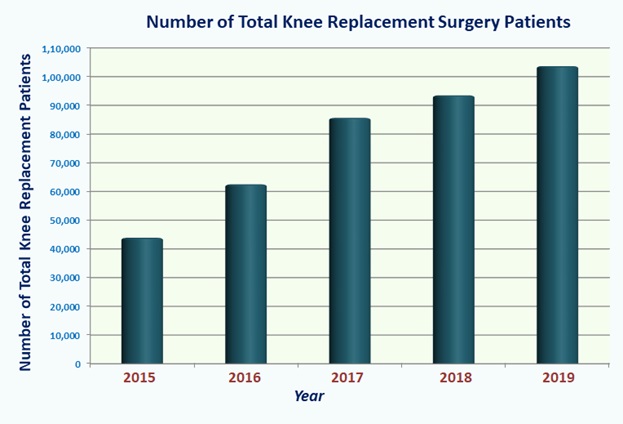
Are you looking for affordable cost of Knee Replacement Surgery in Top Hospitals of India?
Please enquire with us, get a “No Obligation Quote”
If you are really seeking Total Knee Replacement Surgery, kindly fill up the form for a free consultation with our surgeons. You will be provided with thorough analysis and suggestions regarding the Total Knee Replacement Surgery you are seeking.
Listen to the Voices of Our Happy Patients
FAQ’s
Joint Replacement Surgery Hospital India offers highest quality bone and joint health care with attentiveness, care and compassion to meet the needs of the patients and their loved ones. The medical team includes board-certified orthopedic surgeons who are familiar with all the aspects of the musculoskeletal system. Our hospital uses the most advanced technologies available for the orthopaedic procedures and has a lower complication rate.
You can most definitely choose hotels as per your convenience to you and your budget.
You can talk to the doctor and satisfy all your medical queries. You can also send us your queries for answers from the top doctors.
To know about the procedure of getting an Indian Medical Visa, please go to our website where you will find all the details regarding the initial procedure. You can also send us a query regarding the same.
A total knee replacement is really a bone and cartilage replacement with an artificial surface. The knee itself is not replaced as commonly thought, but rather an implant is inserted on the bone ends. This is done with a metal alloy in the femur (thigh bone) and plastic spacer on the tibia (lower leg bone) and patella (knee cap). This creates a new, smooth cushion and functioning joint that can reduce or eliminate pain.
Results will vary depending on the quality of the surrounding tissue, the severity of the arthritis at the time of surgery, the patient’s activity level, and the patient’s adherence to the doctor’s orders.
Your orthopedic surgeon will decide if you are a candidate for the surgery. The decision will be based on your history, exam, x-rays, and response to conservative treatment.
Age is generally not an issue if you are in reasonable health and have the desire to continue living a productive, active life. You may be asked to see your personal physician for his/her opinion about your general health and readiness for surgery.
All implants have a limited life expectancy depending on the individual’s age, weight, activity level, and other medical condition(s). A total joint implant’s longevity will vary in every patient. It is important to remember that and implant is a medical device subject to wear that may lead to mechanical failure. While it is important to follow all of your surgeon’s recommendations after surgery, there is no guarantee that you particular implant will last for any specific length of time.
Yes, you should consult your surgeon and physical therapist about the exercise appropriate for you. The more prepared you are for surgery the better the potential recovery. Strengthening your entire body may help you perform daily activities after your knee surgery.
You may need blood after the surgery. You may use the community blood supply, have your relatives donate for you or donate your own blood, if you are able.
You will probably stay in bed the day of your surgery. However, the next morning patients will get up, sit in a chair or recliner, and should be walking with a walker or crutches later that day. This program stresses early, extensive physical activity to help you prepare to go home.
Most knee patients will be hospitalized for three days after surgery. There are several goals that must be achieved before discharge.
Many hospitals in India have language translators to help you communicate better and effortlessly with the doctors and medical staff.
Our Country Specific Services
Related Pages
Our Blog Posts
Our Patient’s Experiences
Tags
Metal-on-metal Hip Resurfacing In India
Planning Your MedicaTrip to India?
Joint Replacement Surgery Hospital India makes it simple:
- Fill in our enquiry form — our executive will contact you shortly.
- Call us anytime: +91-9860432255
- Complete surgery details are available on our website.
Overview
Metal-on-metal hip resurfacing in India uses a metal on metal bearing hip. The ball part along with the socket joint, and a metal cap is put over the surface during this course of surgery
How do I know if I am a good candidate for Metal-on-metal hip resurfacing?
The candidates for this surgery are someone who is decided by the anatomy of the patient and the surgeon. It can be performed on young patients who are not obese. It should be undertaken in patients who have a severe amount of bone loss in the femoral head. They are not suitable for women because of the child bearing ability and the effects of metal ion release on the fetus. Free Consultation Metal-on-metal hip resurfacing in India will provide you a clear cut idea on what to expect during the course of surgery.
Patient Testimonial – Nigerian Patient Shares Experience of Metal-on-Metal Hip Resurfacing Surgery in India
Hello, my name is Noomi Magaro. I am from Nigeria and I got metal-on-metal hip resurfacing arranged through Joint Replacement Surgery Hospital India. Before my surgery, I was living with excruciating pain that kept me from doing everyday activities. I went to my local doctor, but was not satisfied with the treatments. A friend of mine recommended to check out medical services and treatments in India. While browsing, I came across two websites and impressed with your healthcare consultants, I opted for a free consultation and got my surgery fixed. On arrival in India, I was taken to the hospital. The surgeon was a gentleman and cleared all my worries and anxieties. The hospital staff was amazing and provided me expert care. I had a very easy recovery. I can’t thank you enough as now I am able to do anything that I want! I would recommend your healthcare group for the assistance and support during the entire process. Thank you! Stay blessed.
Metal-on-Metal Hip Resurfacing Cost in India
Low cost Metal-on-metal hip resurfacing in India start from $3,500 USD, ensures that you do not have to burn your pockets while getting the surgery in this part of the world. In addition to this you can avail the international standards in terms of quality.
Metal-on-metal hip resurfacing Procedure & Recovery & Effectiveness
Cobalt like metal cap, which is shaped like a mushroom, is placed over the head of the femur while a matching metal cup that is similar to a total replacement surgery is placed in the pelvis joint. When the patient moves the hip, the movement of the joint forces the synovial liquid to flow between the hard metal bearing surfaces.
Why Opting Metal-on-metal hip resurfacing is necessary?
The potential advantage of metal on metal resurfacing, compared to the total hip replacement is less bone removal. There is less chance of reduced hip dislocation due to the large size of the femoral head size. Metal-on-metal hip resurfacing in India reviews of patients indicate that several people have benefitted from this surgery.
The success of the surgeon depends upon the experience of the surgeon. In this regard the proper position of hip resurfacing components is crucial. Therefore, in addition to take into account that a proper device is used, one should select a surgeon with a proven track record or experience. Affordable Metal-on-metal hip resurfacing in India allows young people to return back to their routine activities. Perhaps the greatest advantage of this surgery is the retention of the femoral neck.
Are you looking for Affordable Cost of Metal-on-metal Hip Resurfacing in India?
Please enquire with us Get a “No Obligation Quote”
Why to choose an Indian Hospital for your Metal-on-metal hip resurfacing?
Medical tourism companies have captured the medical world by storm. During the times of your medical journey, they act as a friend in disguise and help you in each and every step. The choice of the correct company is important as they are a host of them and one need to go with one which has a proven track record. In this regard the testimonies of customers or word of mouth publicity will be a perfect guide.
It is observed that surgery might not be the only solution, as sometimes non surgical methods can yield the desired results. These companies have eminent medical panelists who can guide you on whether surgery is the only option or not.
If you are really seeking Advanced Metal-on-Metal Hip Resurfacing Surgery in India, kindly fill up the form for a FREE CONSULTATION with our surgeons. You will be provided with thorough analysis and suggestions regarding the Metal-on-Metal Hip Resurfacing you are seeking.
FAQ’s
Joint Replacement Surgery Hospital India offers highest quality bone and joint health care with attentiveness, care and compassion to meet the needs of the patients and their loved ones. The medical team includes board-certified orthopedic surgeons who are familiar with all the aspects of the musculoskeletal system. Our hospital uses the most advanced technologies available for the orthopaedic procedures and has a lower complication rate.
Yes, completely. A hip resurfacing has only two components, made of identical material. These two surfaces rub together in a bearing that has been used since the 1960s.
In a hip resurfacing, there are only two components, one resurfacing the femoral head, and one relining the acetabulum. These are made of identical material, cobalt chrome alloy. Hip replacements were made of exactly the same material back in the 1960s, using a design called the McKee-Farrar.
Depending on the type, there can be 2,3 or 4 parts.
- The acetabular component can be made of a single material – either plastic or cobalt chrome alloy or ceramic, or it could have an outer shell of titanium and a lining of plastic, cobalt chrome alloy, or ceramic.
- A hip replacement has a stem in the femur which can be made of titanium, cobalt-chrome alloy, or stainless steel. On top of this a femoral head is placed. Some systems provide the head and stem in one piece, called a monobloc, while most nowadays have heads of different sizes and lengths to allow the surgeon to make adjustments at the time.
- Femoral heads may be made of metal or ceramic. The exact type of metal is important, as some metals can corrode when placed against others.
All artificial bearings wear, but some wear faster than others. The rate of wear depends on how hard you use the hip, and the material and design of the bearing surfaces. In general, your bearing was chosen for you, to ensure that it lasted longer than you could expect to live, no matter how much exercise you do, so it is rather unlikely that any hip inserted in the last 15 years will actually wear out through overuse, no matter how long you live. In older hips, from the 1980s and earlier, this wasn’t the case, so we can expect to have to change the bearings in some of these.
The wear process caused by everyday life, produces small particles. In bearings with the same surfaces on each side, such as ceramic-on-ceramic or metal-on-metal, the particles may come from either surface, while bearings with a poly acetablular liner only generate particles of poly. The poly particles are so large that they cannot be digested easily. They tend to accumulate around the joint, and are associated with some hips loosening after many years because of a reaction to those wear particles.
Wear of metal on metal bearings should be extremely slow, so most hip resurfacings will never wear out in any human lifetime. They do produce wear particles, however, which are extremely small, and broken down into ‘ions’ or the single atoms of metal that are used in our body naturally. Cobalt ions are part of vitamin B12, while Chromium ions are in haemoglobin. The level of circulating cobalt and chromium in our blood stream is usually very low. After a hip resurfacing the levels rise, as the particles from the hip are dissolved into ions. These particles are then excreted by the kidneys into the urine. So a normal hip resurfacing actually is self-cleaning, with any wear particles eliminated from the body naturally every day.
Metal ions are essential for life, and cobalt and chromium are in every cell in our body naturally. Only excessive metal ions may be of concern.
If your hip is comfortable, then you almost certainly don’t have a problem. To reassure you and your doctor that all is well, a simple blood test to measure the levels may be helpful. A plain X-ray, or an MRI, or just an ultrasound may also be options to reassure that all is well. Only very occasionally does a blood test or scan throw up unexpected findings.
The measurement is not performed in every laboratory, and is best carried out on ‘whole blood’ not just the plasma. It is also best done in a laboratory that specializes in the test, so that the results are reliable. A technique called ‘mass spectroscopy’ is used. This requires a special and quite expensive instrument, which explains why many labs don’t do the measurement themselves.
Hips can only corrode if there are two different metals attached to each other. Even then, corrosion is unlikely, but it can happen, and is particularly likely if the stem is one metal, the femoral head another, and the acetabular shell still another. In these hips, the so called Large Diameter Metal-on-Metal Total Hip Arthroplasties (LDMoMTHA), corrosion has been a problem. The process has occurred at the junction between the stem and the femoral head. This process has produced many more wear particles and an entirely new problem. It is this problem that has caused all the fuss. The companies that supplied the heads and stems and sockets did not appreciate what a problem it would cause.
If you have a Large Diameter Metal-on-Metal Total Hip Arthroplasties (LDMoMTHA),, then you may have already been invited to come back for a review. If you have no problems, then the review will probably not yield anything. If you are having nagging pain, it might just be that some corrosion is happening, so it is worth going to see your surgeon.
If you have a LDMoMTHA, then the government recommendation is that you should have an annual check-up. However, if all is well, then it is exceeding unlikely that any harm will come if the gap between visits is lengthened to 5 or even 10 years.
We are working on a web based system, and in some circumstances a phone call may be sufficient. However, as surgeons who want to be sure that our patients are well, we would rather you were seen in person if at all possible, so that we don’t miss anything.
If all feels well, it is exceeding unlikely that any harm will come whatever. But if you do have any aches and pains, then it is worth having a check-up, in the same way that it is worth having your car reviewed regularly by the garage.
The surgeon who did the operation was trying to provide a stable hip that would last for a long time. Every bearing has its own problems, and at the time, the surgeon felt that the advantages of a large bearing, which would abolish any risk of dislocation, outweighed any risks.
By all means, you may call the hospital where you had the surgery, or your surgeon’s office and ask for a follow up. In the NHS, there are some rules about follow-up appointments that can make this difficult. To avoid a long wait on the phone, (which can be maddening), a short note to your GP will result in a referral that will make it all happen without any more effort from you. Unless you are in pain, there is no urgency, as the chances of any major problem developing are very small.
You can most definitely choose hotels as per your convenience to you and your budget.
You can talk to the doctor and satisfy all your medical queries. You can also send us your queries for answers from the top doctors.
To know about the procedure of getting an Indian Medical Visa, please go to our website where you will find all the details regarding the initial procedure. You can also send us a query regarding the same.
Many hospitals in India have language translators to help you communicate better and effortlessly with the doctors and medical staff.