 +91-9860432255
 RWANDA
 INDIA
In Brief
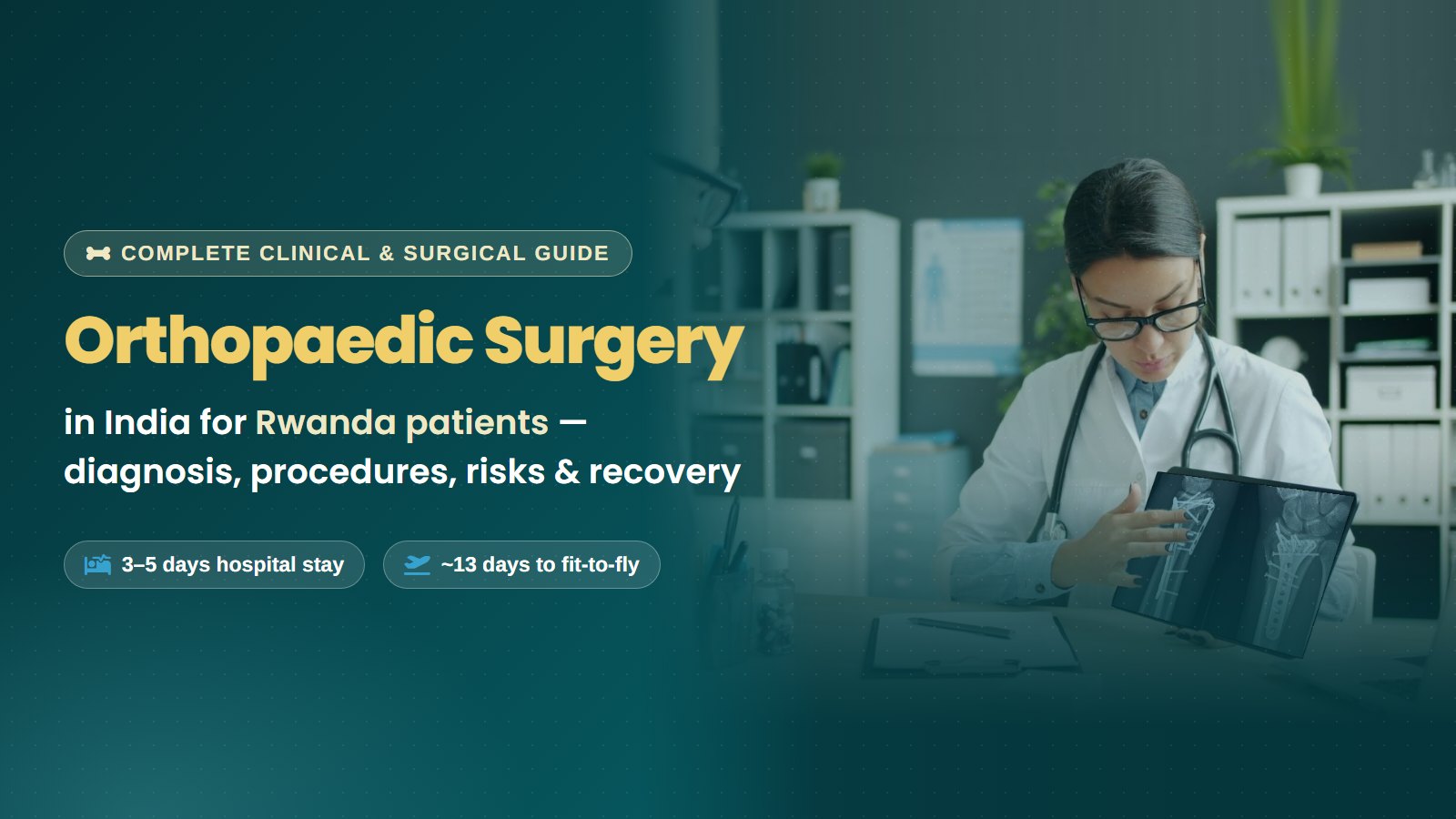
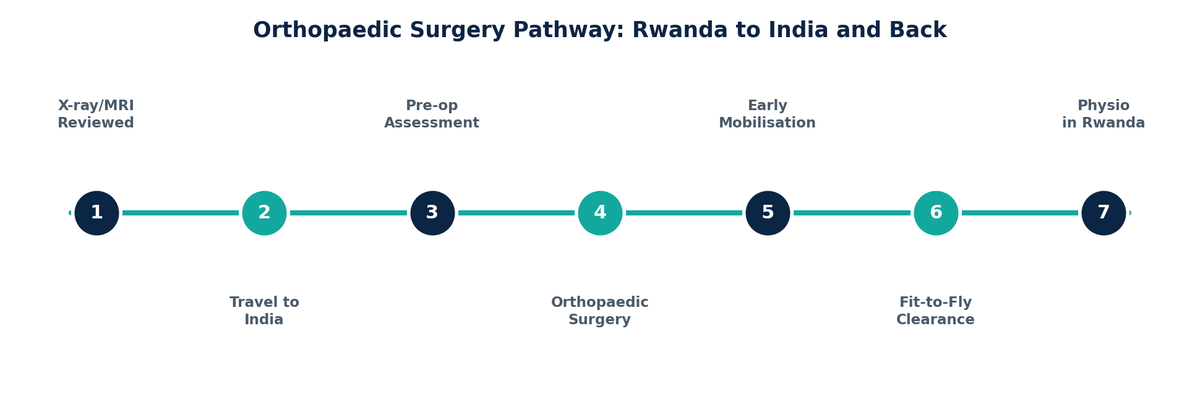
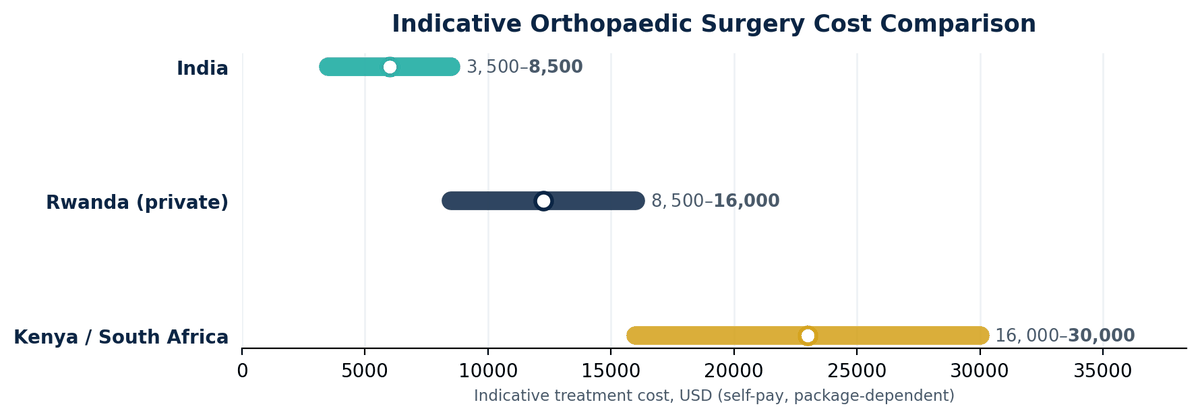
India offers Rwanda patients the full range of orthopaedic surgery — shoulder, sports injury, ligament, foot and ankle, trauma and revision surgery — at an indicative USD 3,500–8,500, a typical 45–65% saving versus Kenya / South Africa. X-rays and MRI can usually be reviewed before travel, hospital stay is typically 3–5 days, and most patients are fit to fly home in about two weeks. The key is the right diagnosis, the right procedure and a clear follow-up plan back in Rwanda.
For patients in Rwanda living with joint pain, bone deformity, sports injuries, or the effects of trauma, orthopaedic surgery may become necessary when symptoms are severe or appropriate non-surgical treatment has not provided sufficient relief. Beyond knee and hip replacement, India offers a broad range of orthopaedic care — shoulder, elbow, wrist, ankle and foot surgery, sports medicine and joint arthroscopy, complex trauma reconstruction, and revision joint surgery — delivered by dedicated orthopaedic surgical teams.
- 3–5 Daystypical hospital stay after major orthopaedic surgery
- 45–65%typical cost saving vs. Kenya / South Africa, package-dependent
Table of Contents(Quick Browse)
- What Is Orthopaedic Surgery?
- Common Orthopaedic Conditions
- Does Every Condition Need Surgery?
- When Surgery Is Recommended
- Warning Signs to Watch
- Tests Before Surgery
- Types of Orthopaedic Surgery in India
- Minimally Invasive & Arthroscopic
- Robotic & Navigation-Assisted
- Risks & Complications
- Recovery After Surgery
- Physiotherapy & Rehab
- Return to Work
- How Long to Stay in India
- Flying Back to Rwanda
- Documents to Take Home
- Follow-Up in Rwanda
- How Successful Is It?
- Questions to Ask Your Surgeon
- Frequently Asked Questions
For a patient travelling from Rwanda, the important question is not simply “Can this surgery be performed in India?” The more useful questions are: Do I actually need surgery? Which operation is appropriate for my diagnosis? Is there a joint-preserving option? What are the risks? How long will recovery take? And when will I be fit enough to make the journey back to Rwanda? This guide explains the clinical aspects of orthopaedic and joint surgery in India from the perspective of Rwanda patients.
1.What Is Orthopaedic and Joint Surgery?
Orthopaedic surgery covers procedures performed on the bones, joints, ligaments, tendons and muscles of the body. The objective depends on the patient’s condition: relieving pain from worn or damaged joints, repairing torn ligaments or tendons, correcting deformity, fixing fractures, or replacing a joint destroyed by arthritis or injury. Orthopaedic surgery is therefore not one operation — the appropriate procedure depends heavily on which joint or structure is affected, the exact diagnosis, and the patient’s activity level and goals.
2.Common Orthopaedic Conditions for Which Rwanda Patients May Consider Treatment in India
- Shoulder Conditions (Rotator Cuff Tears, Instability, Arthritis): Shoulder pain and weakness may be treated with arthroscopic repair, stabilisation surgery, or shoulder replacement depending on the diagnosis.
- Sports Injuries and Ligament Tears: Injuries to the knee, ankle, shoulder or elbow ligaments may require arthroscopic repair or reconstruction, particularly in active patients.
- Ankle and Foot Conditions: Conditions such as ankle arthritis, tendon injuries, or deformities may require reconstructive surgery, fusion, or joint replacement.
- Elbow and Wrist Conditions: Conditions such as tennis elbow, nerve compression, or arthritis may require targeted surgical treatment when conservative measures fail.
- Fractures and Trauma: Complex fractures, non-unions (fractures that have failed to heal), or old trauma requiring reconstruction may need specialised orthopaedic trauma surgery.
- Complex or Revision Joint Surgery: Patients with a previously worn, loosened, or failed joint replacement may require more complex revision surgery.
- Bone Deformities and Limb Alignment Problems: Correction of angular deformity or limb-length discrepancy through specialised reconstructive techniques.
3.Does Every Orthopaedic Condition Need Surgery in India?
No. This is one of the most important principles for a Rwanda patient considering travelling overseas. Depending on the diagnosis, appropriate non-surgical treatment may include:
- Medication and anti-inflammatory management
- Physiotherapy and strengthening programmes
- Activity modification
- Bracing or supportive devices
- Injections as clinically indicated
The presence of a tear or arthritis on imaging does not automatically mean surgery is necessary. An orthopaedic surgeon should evaluate whether the patient’s symptoms, physical examination and imaging findings correspond, and whether the degree of damage genuinely limits function.
4.When May Rwanda Patients Be Recommended Orthopaedic Surgery in India?
- Persistent disabling pain despite appropriate conservative treatment
- Significant instability or mechanical symptoms (locking, catching, giving way)
- A fracture or deformity affecting function or healing
- Failure of previous orthopaedic surgery
- Progressive joint damage affecting daily activity or the ability to work
5.Warning Signs Patients Should Not Ignore
- Sudden inability to bear weight or move a joint after an injury
- Visible deformity after trauma
- Signs of joint infection: fever, warmth, redness and severe pain
- Numbness or loss of pulse in a limb after injury
- Calf swelling, pain or breathlessness after orthopaedic surgery (possible blood clot)
A patient with an urgent problem such as a fracture with loss of circulation, suspected infection, or a blood clot should seek immediate local emergency care in Rwanda rather than delaying to arrange overseas treatment.
6.Tests Rwanda Patients Usually Need Before Orthopaedic Surgery in India
- X-Rays: Show alignment, fracture patterns, deformity and the extent of arthritis.
- MRI: Provides detailed information about ligaments, tendons, cartilage and soft tissues.
- CT Scan: Useful for detailed bone anatomy, particularly in complex fractures or revision surgery.
- Bone Density (DEXA) Scan: Assesses bone quality where relevant, particularly for older patients.
- Blood Tests and Anaesthesia Assessment: Routine preoperative testing to assess general fitness for surgery.
Can My X-Ray or MRI Be Reviewed Before I Travel from Rwanda to India?
7.Major Types of Orthopaedic and Joint Surgery Available in India
- Arthroscopy (Shoulder, Ankle, Elbow, Wrist): Minimally invasive, camera-guided surgery used to diagnose and treat ligament, tendon and cartilage problems through small incisions.
- Ligament and Tendon Reconstruction: Repair or reconstruction of torn ligaments or tendons using the patient’s own tissue or donor tissue.
- Joint Replacement (Shoulder, Ankle, Elbow): Replacement of a severely damaged joint with an artificial implant when arthritis is advanced.
- Fracture Fixation and Trauma Reconstruction: Surgical stabilisation of fractures using plates, screws, rods or external fixation, including complex reconstruction for old or poorly healed injuries.
- Revision Joint Surgery: A more complex operation to replace a worn, loosened, infected or malfunctioning previous joint implant.
- Limb Deformity Correction: Surgical realignment or gradual correction techniques for angular deformity or limb-length discrepancy.
8.Minimally Invasive and Arthroscopic Techniques
Many orthopaedic procedures that once required open surgery can now be performed arthroscopically or through smaller incisions, potentially reducing tissue disruption, blood loss and time to early mobilisation in appropriately selected patients. “Minimally invasive” does not automatically mean “better” — the operation still needs to achieve correct repair, alignment or fixation for the specific injury or condition.
9.Robotic and Navigation-Assisted Orthopaedic Surgery
Advanced Indian orthopaedic centres may use computer navigation or robotic-assisted systems for selected joint replacement and complex reconstructive procedures, helping with precise implant positioning and alignment. Technology does not replace the surgeon’s judgement and experience. A useful question for Rwanda patients is therefore not “Does this hospital have surgical robots?” but “Will this technology provide a meaningful benefit for my specific condition?”
10.Risks and Possible Complications for Rwanda Patients Having Orthopaedic Surgery in India
- Infection
- Bleeding
- Blood clots (deep vein thrombosis, pulmonary embolism)
- Stiffness or limited range of motion
- Nerve or blood vessel injury
- Implant loosening, wear, or failure over time
- Non-union of a fracture
- Persistent pain
- Need for revision surgery
- Anaesthesia-related complications
The risk profile of a straightforward arthroscopy is very different from that of complex trauma reconstruction or revision joint replacement. Patients should request procedure-specific risk information rather than relying on generic complication percentages.
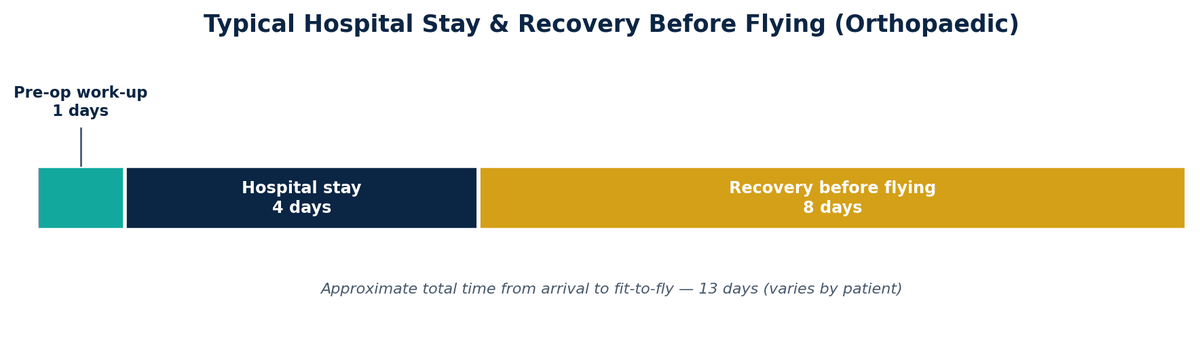
11.Recovery for Rwanda Patients After Orthopaedic Surgery in India
Early Phase
- Pain control
- Wound monitoring
- Early mobilisation as advised
- Prevention of blood clots
- Use of splints, braces or walking aids as needed
Following Weeks
- Progressive weight-bearing or joint use as advised
- Structured physiotherapy
- Wound care
- Gradual increase in range of motion and strength
- Medication reduction where appropriate
- Longer-Term Recovery: Recovery timelines vary enormously by procedure and joint involved: many arthroscopic procedures allow return to normal activity within weeks, while complex reconstruction, trauma surgery, or revision joint replacement may take several months for complete functional recovery.
12.Physiotherapy and Rehabilitation After Orthopaedic Surgery
- Range-of-motion exercises specific to the affected joint
- Progressive strengthening
- Gait or movement pattern retraining as relevant
- Sport-specific or occupation-specific conditioning where relevant
- Balance and proprioception work
- Home exercise programme for continuation in Rwanda
13.When Can Patients Return to Work After Orthopaedic Surgery?
This depends heavily on the joint and procedure involved, and on occupation. A patient with a desk-based job following a relatively small arthroscopic procedure may return within one to two weeks, while someone performing heavy physical work after major reconstruction or joint replacement may need two to three months or longer.
Rwanda Patients — Ready to Take the First Step?
Share your medical reports from Rwanda with our advisory team today and get a MEDICAL CONSULTATION, an indicative cost estimate in US$, and complete support — from your flight out of Kigali to your recovery in India and follow-up back home.
Get Your Medical Consultation14.How Long Should a Rwanda Patient Remain in India After Orthopaedic Surgery?
The appropriate period varies significantly by procedure. The decision should take into account the type of surgery, wound healing, ability to manage independently, pain control, risk of complications, and length of the return journey. A Rwanda patient should not book an inflexible return flight based solely on the expected hospital discharge date.
15.Flying Back to Rwanda After Orthopaedic Surgery in India
- Fit-to-fly timing
- Mobility and independence assessment for the journey
- Hydration
- Blood-clot prevention
- Compression stockings if appropriate
- Medication timing
- Managing luggage and using airport wheelchair assistance if needed
- Suitable seating with room for any splint, brace, or cast
Patients at increased risk of venous thromboembolism, or travelling with a cast or brace, may require individualised preventive measures and specific seating arrangements.
16.What Medical Information Should You Take Back Home?
- Discharge summary
- Operative report
- Final diagnosis
- Relevant X-ray/MRI/CT images
- Postoperative imaging
- Laboratory results
- Implant details (manufacturer and specifications) if applicable
- Medication list
- Physiotherapy instructions
- Wound-care instructions
- Follow-up schedule
- Emergency warning signs
- Treating surgeon’s contact/follow-up pathway
17.Follow-Up After Returning Home
- Wound assessment
- X-rays to check healing, alignment or implant position
- Physiotherapy progression
- Medication review
- Assessment of range of motion and strength
- Return-to-work or return-to-sport planning
18.How Successful Is Orthopaedic Surgery in India?
There is no meaningful single “success rate” for orthopaedic surgery. Outcomes depend on the correct diagnosis, appropriate indication for surgery, severity of disease or injury, age, bone quality, previous surgery, procedure selected and rehabilitation effort. The expected outcome of arthroscopy for a minor tear cannot reasonably be compared with complex trauma reconstruction or revision joint replacement. Patients should be cautious about websites offering one universal success percentage.
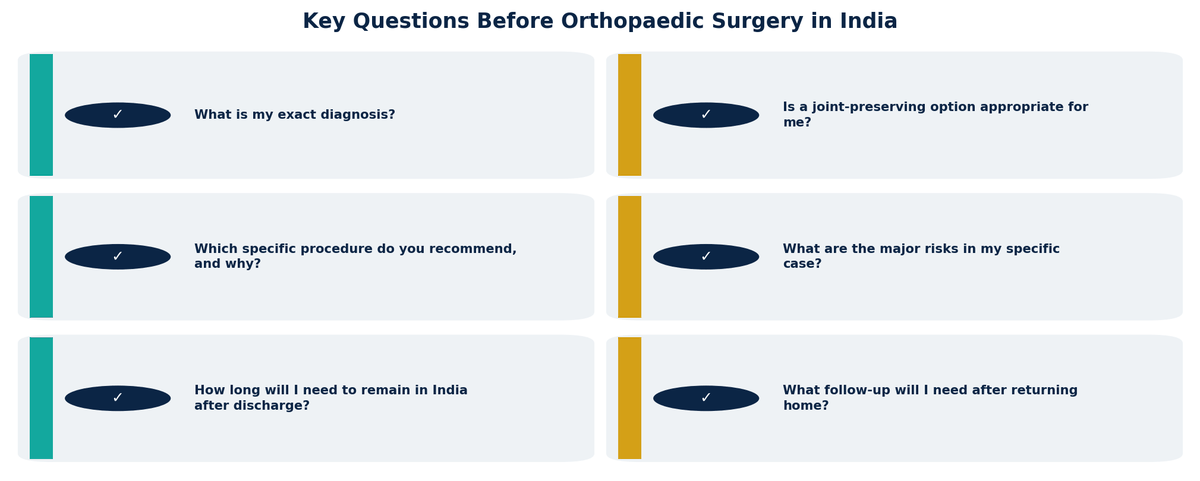
19.Questions Patients Should Ask Before Agreeing to Surgery
- What is my exact diagnosis?
- Which imaging finding explains my symptoms?
- Do I definitely need surgery, or would rehabilitation help first?
- Is a joint-preserving option appropriate for me?
- Which specific procedure do you recommend, and why?
- Will robotic or navigation technology provide a meaningful advantage for me?
- What are the major risks in my specific case?
- How frequently do you perform this exact procedure?
- How long will I be hospitalised, and how long in India afterward?
- When will I be fit to fly back to Rwanda?
- What follow-up will I need after returning home?
Frequently Asked Questions: Rwanda Patients & Orthopaedic Surgery in India
Can my X-ray or MRI be reviewed before I travel from Rwanda?
Often, yes. Digital images, reports and clinical information can be reviewed before travel. A definitive recommendation may still require physical examination and updated investigations.
Does a torn ligament or tendon always require surgery?
No. Many injuries improve with physiotherapy and activity modification. Surgery is usually considered when instability, mechanical symptoms, or functional demands (such as returning to sport) make repair necessary.
Is arthroscopic surgery better than open surgery?
Not universally. It can offer meaningful benefits for appropriately selected procedures, but complex reconstruction or revision surgery may need a traditional open approach.
Is robotic orthopaedic surgery available in India?
Selected centres use robotic and navigation-assisted technology for certain joint replacement and reconstructive procedures.
How soon can I fly back to Rwanda?
There is no universal timeframe. Your surgeon should clear you for long-distance travel based on the procedure, wound healing, mobility and complication risk.
Can I continue physiotherapy in Rwanda?
Usually, yes. The Indian treating team should provide a rehabilitation protocol that can be shared with your physiotherapist in Rwanda.
What if I have already undergone orthopaedic surgery on the same joint?
Revision surgery may still be possible. Send previous operative records, implant information and old and current imaging for assessment.
Should I choose a surgeon based on the technology offered?
No. Technology is one component. Procedure-specific surgeon expertise, correct diagnosis and postoperative care remain fundamental.
Key Takeaway for Rwanda Patients Choosing India
Travelling from Rwanda to India for orthopaedic and joint surgery is a significant decision. The most important step is establishing the correct diagnosis and determining whether surgery is genuinely required, and of what type. When surgery is appropriate, the treatment should be matched to the specific joint and pathology — arthroscopy or repair when the structure can be preserved, reconstruction or replacement when damage is extensive, and advanced technology when it offers a meaningful benefit. For a Rwanda patient, the treatment plan should also extend beyond the operating room to cover recovery in India, fitness for travel, rehabilitation in Rwanda, and a clear pathway for follow-up after returning home.
Citation Block: Rwanda Patients — Orthopaedic Surgery in India
Swipe to see all 10 points
| Field | Details |
|---|---|
| Article / Topic | Orthopaedic Surgery in India for Rwanda Patients |
| Primary Patient Group | Rwanda patients with joint pain, bone deformity, sports injuries or the effects of trauma |
| Procedures Available in India | Shoulder surgery and replacement, sports medicine and arthroscopy, ligament reconstruction, foot and ankle surgery, fracture and trauma reconstruction, limb deformity correction and revision surgery |
| India Cost | Approximately USD 3,500–8,500 (self-pay, package-dependent) |
| Rwanda & Kenya / South Africa Cost | Approximately USD 8,500–16,000 in Rwanda (private); USD 16,000–30,000 in Kenya / South Africa |
| Typical Saving | 45–65% vs. Kenya / South Africa, package-dependent |
| Stay in India | Typically 3–5 days in hospital; approximately 13 days from arrival to fit-to-fly — book a flexible return flight to Rwanda |
| Emergency Conditions | A new fracture, suspected joint dislocation, infection or blood clot need immediate local emergency care in Rwanda |
| Follow-Up in Rwanda | Rehabilitation plan shared with a Rwanda physiotherapist; follow-up X-rays and a pathway back to the Indian surgeon |
| Key Decision Factor | Correct diagnosis and the right procedure for the affected joint or structure, planned through to recovery in Rwanda |