
 +91-9860432255
 MALAWI
 INDIA
In Brief
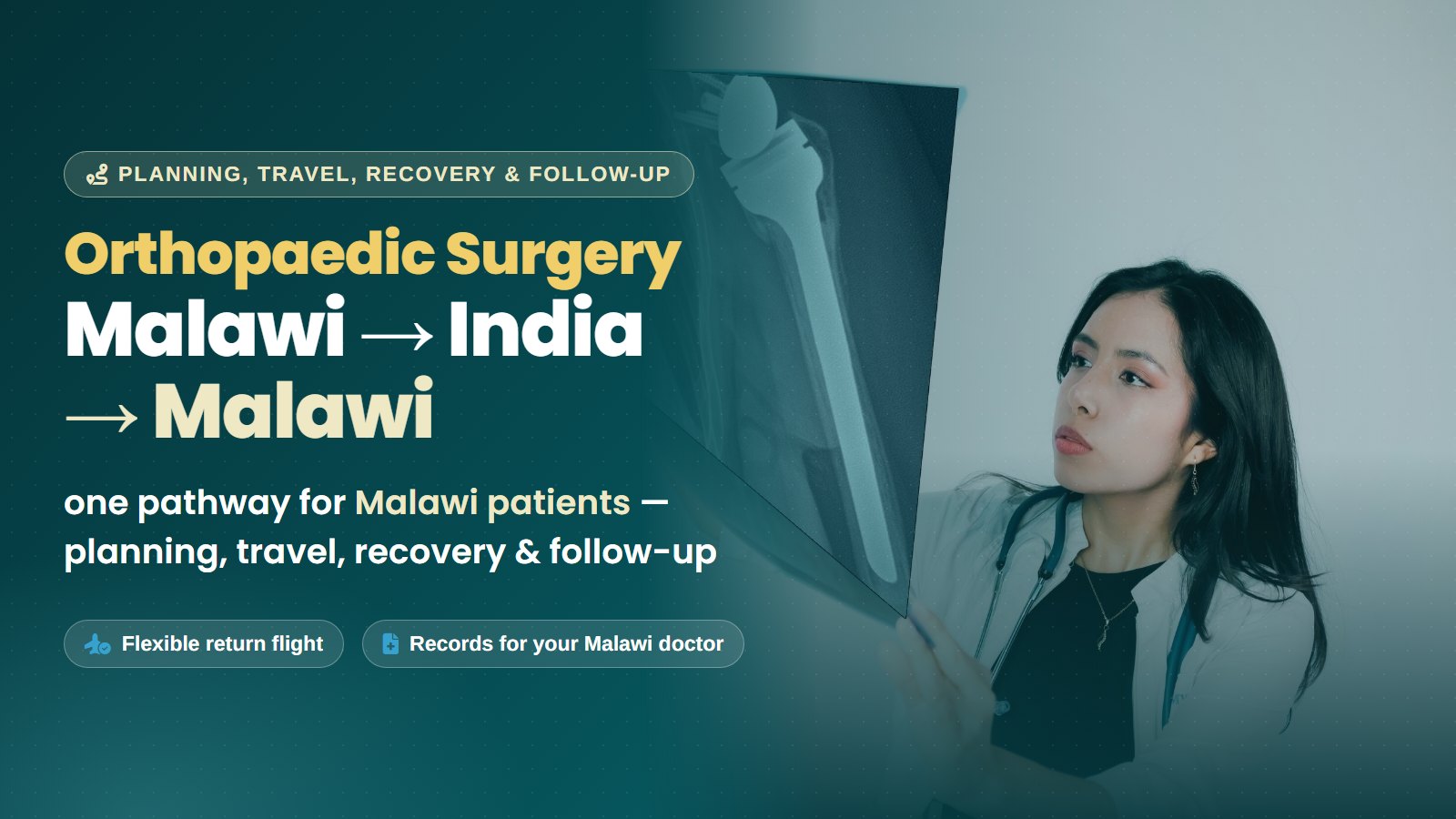
Orthopaedic surgery in India for a Malawi patient should be planned as one continuous journey. Send complete records and images before travel, prepare your home in Malawi, plan an attendant and accessible accommodation, and keep the return flight flexible. Leave India only with fit-to-fly guidance, full medical records and a physiotherapy plan, and agree in advance who to contact in Malawi if something goes wrong.
The existing Malawi orthopaedic and joint surgery series already explains clinical decision-making, costs, surgeon and hospital selection, technology and the most important FAQs. This companion guide focuses on the remaining practical questions: preparing before travel, organising the Malawi-to- India journey, planning an attendant and accommodation, preparing for discharge, flying home safely, physiotherapy in Malawi, warning signs, emergency planning and continuity of care.
- 8 Stepsquick planning framework from records to Malawi follow-up
- 12-Stagefinal Malawi-to-India checklist before and after surgery
Table of Contents(Quick Browse)
- Quick Planning Framework
- Preparation Before Leaving Malawi
- Travel, Documents & Preparation
- Should an Attendant Travel?
- What Happens After Arrival
- Accommodation After Discharge
- Discharge Readiness
- Flying Back to Malawi
- Medical Records to Bring Home
- Recovery in Malawi, Phase by Phase
- If Something Goes Wrong
- Physiotherapy in Malawi
- Work, Driving & Normal Activities
- Cost Contingency & Financial Planning
- Final Malawi-to-India Checklist
1.Quick Planning Framework for Malawi Patients Travelling to India
A successful medical journey should be planned as one continuous pathway rather than as an operation followed by a flight home. The practical sequence is:
- Collect complete medical records and actual X-ray/MRI/CT images.
- Obtain a procedure-specific specialist opinion from India before committing to travel.
- Clarify whether surgery is necessary, what operation is proposed and whether reasonable alternatives exist.
- Shortlist two or three relevant surgeon-hospital combinations rather than collecting many unrelated quotations.
- Obtain a written estimate with implants, technology, hospital stay and exclusions clearly identified.
- Plan travel documents, flights, an attendant where appropriate, accommodation and a contingency reserve.
- Allow time in India for examination, final investigations, surgery, recovery, surgeon review and fit-to-fly clearance.
- Leave India with complete medical records, physiotherapy instructions and a defined Malawi follow-up pathway.
The Key Principle: For Malawi patients, the medical journey does not end at hospital discharge in India. A strong treatment plan includes the return flight and safe continuity of care after the patient reaches Malawi.
2.Pre-Surgery Preparation Before Leaving Malawi for India
Medical Preparation
Before travel, the Indian treating team should receive enough information to understand both the orthopaedic problem and the patient’s general medical condition. The exact preoperative requirements vary by operation and patient.
- Current symptoms, duration and functional limitation.
- X-ray reports and images; MRI/CT where available.
- Previous orthopaedic surgery records and older imaging when relevant.
- Current medicines, allergies and major medical conditions.
- Relevant recent blood tests and other investigations requested by the treating team.
- Weight, mobility aids used and general activity level.
- Medication and Medical-Condition Review: Patients should ask the treating team how medicines such as blood thinners, diabetes medicines and other prescription drugs should be managed around surgery. These decisions must be individualised; medicines should not be stopped solely on the basis of a general travel guide.
Chronic conditions such as diabetes, osteoporosis, hypertension or heart disease can influence anaesthesia, wound healing, infection risk and recovery. Complex patients may need additional medical or anaesthesia review before a final surgical plan is confirmed.
Prepare Your Home Before You Travel
- Arrange help with meals, transport and household tasks for the early recovery period.
- Reduce avoidable stairs or obstacles where practical.
- Plan where the patient will rest comfortably.
- Identify the Malawi doctor or physiotherapist who may assist after return.
- Discuss how postoperative X-rays or wound photographs can be shared with the Indian team.
Can I Send My X-Rays and Reports to India Before I Travel from Malawi?
3.Malawi-to-India Travel, Documents and Practical Preparation
Travel and entry requirements can change. Malawi patients should verify the current Indian visa/entry requirements and airline rules at the time of booking rather than relying on an older guide.
Documents to Keep Together
- Passport and current travel/visa documents as applicable.
- Hospital invitation or appointment documents where provided.
- Medical summary, imaging reports and digital imaging files.
- Medication list and adequate essential medicines for the journey, subject to airline and entry rules.
- Hospital contact details, accommodation details and airport-transfer information.
- Copies of important documents stored securely in digital form as well as the originals where appropriate.
- Flight Planning Before Surgery: Patients with significant pain or reduced mobility should consider airport wheelchair assistance and avoid unnecessarily difficult connections where possible. The hospital should know the planned arrival date so that consultation, evaluation and accommodation can be coordinated.
Do Not Make the Return Flight Too Rigid: Being discharged from hospital and being fit for long-distance air travel are not the same thing. A flexible return itinerary is safer for major orthopaedic surgery because wound healing, mobility and blood-clot risk can vary.
4.Should an Attendant Travel from Malawi to India?
For major orthopaedic surgery, an accompanying family member or attendant is often practical. The attendant can help with admission, communication, belongings, medicines, meals, mobility after discharge, follow-up visits, airport movement and luggage.
Budget for the Attendant
- Malawi-India airfare.
- Accommodation and meals.
- Local transport.
- Possible extended stay if the patient’s recovery takes longer than expected.
- Changes to return flights where necessary.
For a straightforward arthroscopy in an independent patient, the level of assistance required may be lower. For major trauma, joint replacement, deformity correction or revision surgery, support becomes more important.
5.What Happens After Malawi Patients Arrive in India?
A remote opinion is usually preliminary. A typical pathway after arrival is: specialist consultation → physical examination → review of imaging → additional investigations if needed → final diagnosis → final surgical recommendation → anaesthesia/medical clearance → final quotation → admission → surgery.
The final operation or cost can change if examination or new investigations reveal information that was not apparent during remote review. Patients should therefore understand that an initial quotation is not always the final bill.
Before Signing Consent, Clarify
- The exact diagnosis and which finding explains the symptoms.
- Why surgery is recommended and what happens if it is delayed.
- The exact procedure and surgical approach.
- Implants and any navigation or robotic technology proposed.
- Major risks that are particularly relevant to the individual patient.
- Expected hospital stay and estimated total India stay.
- The postoperative plan and anticipated fit-to-fly review.
6.Accommodation After Hospital Discharge in India
Patients do not necessarily need to remain hospitalised for the entire recovery period. When medically appropriate, a nearby hotel or serviced apartment may be suitable.
Features Worth Prioritising
- Elevator access and minimal stairs.
- Accessible bathroom and a suitable bed.
- Easy transport back to the treating hospital.
- Nearby pharmacy and appropriate meals.
- Space for the attendant.
- Reasonable distance from the hospital rather than choosing only by lowest room price.
Medical Value Applies to Accommodation Too: For a recently operated orthopaedic patient, accessible accommodation close to the hospital can be more useful than a cheaper property that creates difficult travel, stairs or long journeys for follow-up.
7.Discharge Readiness: Questions Before Leaving the Hospital
- Is the wound satisfactory and what wound care is required?
- What medicines should be taken, for how long, and which medicines should be avoided?
- How much walking and weight-bearing is appropriate?
- Are there restrictions on bending, driving or specific movements?
- When should sutures or staples be removed if applicable?
- What symptoms require urgent review?
- When is the next surgeon review?
- What imaging will be required before or after returning to Malawi?
- When will the patient be assessed for fitness to fly?
8.Flying Back to Malawi After Orthopaedic Surgery in India
There is no universal fit-to-fly interval after orthopaedic surgery. Timing depends on the procedure, wound healing, mobility and the risk of complications such as venous thromboembolism.
Long-Distance Flight Planning
- Obtain explicit fit-to-fly guidance from the treating surgeon.
- Ask about walking during the journey and how frequently movement is appropriate.
- Maintain hydration as advised.
- Discuss individualised blood-clot prevention and compression stockings where appropriate.
- Plan medication timing across the long journey.
- Arrange wheelchair assistance if walking through large airports will be difficult.
- Discuss suitable seating and luggage restrictions.
- Keep essential medicines and important medical documents accessible during travel.
Important: Hospital discharge should never be treated as automatic clearance for immediate international travel. Malawi patients should allow enough time in India for recovery and medical review before the long journey home.
Malawi Patients — Ready to Take the First Step?
Share your medical reports from Malawi with our advisory team today and get a MEDICAL CONSULTATION, an indicative cost estimate in US$, and complete support — from your flight out of Lilongwe to your recovery in India and follow-up back home.
Get Your Medical Consultation9.The Medical Records Patients Should Bring Home from India
- Final discharge summary.
- Operative report or operative notes.
- Final diagnosis.
- Relevant preoperative and postoperative imaging.
- Laboratory results where applicable.
- Implant details.
- Medication prescription and duration.
- Physiotherapy and activity instructions.
- Wound-care instructions.
- Fit-to-fly advice where required.
- Follow-up schedule and timing of future imaging.
- Emergency warning signs.
- Direct postoperative contact or remote-review pathway with the Indian treating team.
These records allow the Malawi doctor or physiotherapist to understand exactly what was done in India and reduce avoidable gaps in continuity of care.
10.Recovery at Home: A Practical Phase-by-Phase Framework
Recovery varies considerably between arthroscopy, fracture fixation, joint replacement, deformity correction and revision procedures. The following framework is deliberately general and must be replaced by the patient’s own surgeon-specific instructions.
Early Phase After Return
- Follow wound-care and medication instructions exactly.
- Continue the prescribed walking or exercise programme.
- Watch for new swelling, wound changes, fever or other warning signs.
- Arrange the planned local medical or physiotherapy review.
- Avoid assuming that feeling better means all restrictions can immediately be stopped.
Intermediate Recovery
- Progress activity according to the operation and surgeon’s protocol.
- Begin or advance physiotherapy when prescribed.
- Review pain medicines and other postoperative medication.
- Complete scheduled X-rays or other imaging.
- Discuss driving, work and exercise before resuming them.
Longer-Term Recovery
- Joint replacement and revision surgery may require longer-term clinical and imaging follow-up.
- Physiotherapy should be adjusted to the operation and the patient’s functional recovery.
- Return to physically demanding work may take substantially longer than return to desk-based activity.
- Persistent or worsening symptoms should be reassessed rather than simply attributed to ‘normal recovery.’
11.What If Something Goes Wrong After Returning Home?
This question should be answered before surgery. A practical international-patient plan is: Indian surgeon + Malawi doctor/physiotherapist + remote review, with a clear understanding of which problems require local emergency care.
Potential Warning Signs That Require Prompt Medical Assessment
- Increasing pain, swelling or warmth around the surgical site.
- Fever, wound redness, increasing drainage or wound separation.
- Sudden severe pain that is different from the expected recovery pattern.
- Breathing difficulty, chest pain or symptoms that could indicate a blood clot.
- Calf pain or swelling that could indicate a deep vein thrombosis.
- Any sudden deterioration or other symptom the treating team has identified as an emergency.
For urgent symptoms, patients should seek appropriate local emergency care in Malawi rather than waiting for an overseas message response. Remote review can support continuity but cannot replace emergency assessment.
Questions to Settle Before Leaving India
- Who should the patient contact first if a problem develops?
- Can the Indian surgeon review wound photographs, reports and postoperative imaging remotely?
- Can the Malawi doctor communicate directly with the Indian team?
- Which symptoms require immediate emergency assessment in Malawi?
- Under what circumstances might return to India be considered?
12.Physiotherapy and Rehabilitation at Home
Physiotherapy is not identical after every orthopaedic operation. The treating team should provide a written rehabilitation protocol that can be shared with the Malawi physiotherapist.
- Clarify when physiotherapy should start.
- Clarify movements or exercises that should temporarily be avoided.
- Provide the physiotherapist with the operative diagnosis and procedure performed.
- Confirm any weight-bearing restrictions.
- Ask when strengthening, range-of-motion work and more intensive rehabilitation can progress.
- Use remote review if progress is unexpectedly slow or symptoms change.
13.Returning to Work, Driving and Normal Activities
There is no single timeline for return to normal life. A desk-based worker after arthroscopy may progress differently from a patient after joint replacement, deformity correction or revision surgery.
Discuss These Milestones Specifically
- Independent walking and stairs.
- Prolonged sitting.
- Driving.
- Desk work or working from home.
- Manual work and lifting.
- Exercise and gym activity.
- Swimming or other recreation after wound healing.
- Long-distance travel after the initial return to Malawi.
The safest advice is procedure-specific. Patients should obtain written guidance rather than relying on a generic internet recovery timetable.
14.Cost Contingency and Financial Planning
Treatment cost and total medical travel cost are different. The total Malawi-to-India budget can include airfare, accommodation before and after hospitalisation, attendant expenses, meals, local transport, visa-related expenses where applicable, medicines, physiotherapy, flight changes and extended stay.
- Why a Contingency Reserve Matters: Complex orthopaedic surgery may require additional investigations, longer hospitalisation, upgraded implants, treatment of unrelated medical problems or a longer recovery period. A written quotation should therefore identify inclusions and exclusions clearly.
Three-Option Comparison
For major elective surgery, comparing approximately two or three carefully selected treatment options is often more useful than collecting many quotations. Compare:
- Proposed operation and surgical approach.
- Surgeon’s experience with similar cases.
- Hospital capability and relevant technology.
- Implant assumptions.
- Complete treatment estimate and exclusions.
- Expected India stay and Malawi follow-up plan.
15.Final Malawi-to-India Orthopaedic Surgery Checklist
| Stage | Patient Action | Completed |
|---|---|---|
| Before opinion | Collect X-ray/MRI/CT images, reports, history and previous surgery records | ☐ |
| Before booking | Obtain specialist opinion and clarify the proposed procedure | ☐ |
| Comparison | Compare 2–3 relevant surgeon-hospital options | ☐ |
| Cost | Obtain written inclusions, exclusions, implants and contingency assumptions | ☐ |
| Travel | Verify current visa/entry and airline requirements; arrange flights and accommodation | ☐ |
| Attendant | Plan accompanying-person travel and budget if appropriate | ☐ |
| Arrival | Complete examination, investigations and final treatment confirmation in India | ☐ |
| Discharge | Obtain medicines, wound care, activity and rehabilitation instructions | ☐ |
| Fit to fly | Receive individualised guidance for the long flight to Malawi | ☐ |
| Documents | Collect discharge summary, operative notes, imaging, implants and follow-up plan | ☐ |
| Malawi follow-up | Arrange local doctor/physiotherapist and remote Indian surgeon review | ☐ |
| Emergency plan | Know warning signs, who to contact and when to seek urgent Malawi care | ☐ |
Key Takeaway for Malawi Patients Choosing India
Right Diagnosis + Right Procedure + Right Surgeon + Right Hospital + Appropriate Technology + Transparent Cost + Safe Travel + Planned Recovery + Reliable Follow-Up in Malawi. The strongest orthopaedic surgery plan is not simply one that gets the patient through an operation in India. It is one that anticipates the entire journey from Malawi, prepares for recovery, establishes safe fit-to-fly timing, transfers the medical information back home and provides a clear pathway if questions or complications arise after return.
Sources & Further Reading
The following government and medical-authority resources provide independent, publicly available information on this topic:
- Osteoarthritis — National Institute of Arthritis and Musculoskeletal and Skin Diseases (NIH)
- Joint replacement (primary): hip, knee and shoulder — National Institute for Health and Care Excellence (NICE, UK)
- Musculoskeletal health — World Health Organization
- Osteoarthritis — Centers for Disease Control and Prevention (US)
- Broken leg — NHS (UK National Health Service)
Citation Block: Malawi to India Orthopaedic Surgery Planning & Recovery
Swipe to see all 10 points
| Field | Details |
|---|---|
| Article / Topic | Malawi to India Orthopaedic Surgery — Complete Planning, Travel, Recovery & Follow-Up Guide |
| Primary Patient Group | Malawi patients and families planning the full journey for orthopaedic surgery in India |
| Key Principle | Plan one continuous pathway — the journey does not end at hospital discharge in India |
| Before Leaving Malawi | Send records and actual imaging, review medicines with the treating team, prepare the home |
| Travel & Documents | Verify current visa/entry and airline rules; keep medical and travel documents together |
| Attendant | Practical for major orthopaedic surgery; budget airfare, stay, meals and possible extended stay |
| In India | Final plan and cost can change after examination; clarify diagnosis, procedure and risks before consent |
| Flying Home | No universal fit-to-fly interval; obtain explicit surgeon guidance and keep the return flight flexible |
| Back in Malawi | Written physiotherapy protocol, records for the Malawi doctor and a remote-review pathway |
| Emergencies | Increasing pain, swelling, wound problems, infection or blood-clot symptoms need prompt local emergency care in Malawi |